






The research
The research behind every sachet
What is in each supplement, which published studies look at those ingredients, and what they did and did not show. The studies are of individual ingredients, not of Plentum products.


Our method
How we choose ingredients
Four questions we ask about every ingredient before it goes in a sachet and before we mention a study.
-
Start with what's in the sachet
We list each ingredient and its dose per sachet before we look for any evidence.
-
Look for dog studies
We search published research on each ingredient. Dog studies come first, then other species and people.
-
Grade each study
A randomized dog trial counts for more than a review or a study in cats. We label each study so you can see the difference.
-
State what it did not show
Small groups, supplier funding and doses above ours are stated beside the result, not buried.
How we grade studies
- Grade A: Randomized dog trial
- Grade B: Controlled dog study
- Grade C: Other species or human study
- Grade D: Review
Evidence by supplement
Ingredient evidence, supplement by supplement
Each card names one ingredient, what a published study found, who funded it where that matters, and a link to read it. Every one is an ingredient-level study.
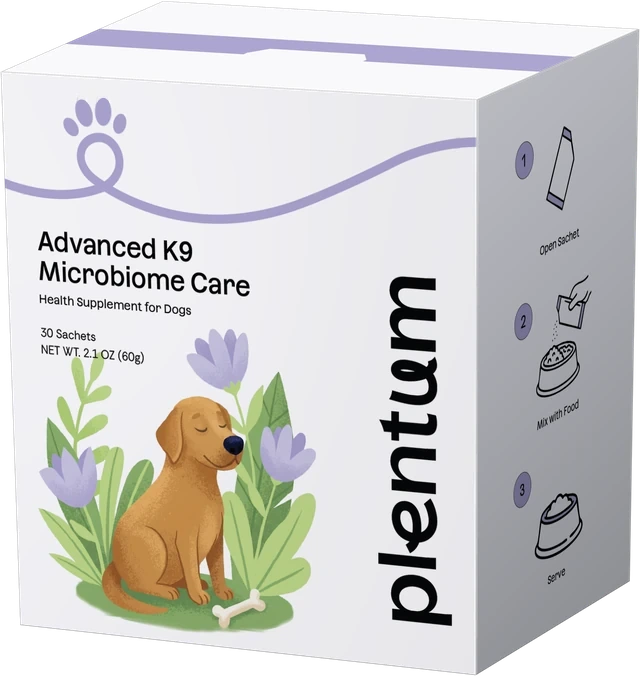
A daily foundation. Its oral-health postbiotic has its own section below; here is the evidence behind the other actives. See Microbiome Care
-

Bovine colostrum
- Grade A: Randomized dog trial
- Same ingredient
In a 40-week randomized study in 24 healthy dogs, a colostrum-supplemented diet was associated with a stronger vaccine antibody response and higher gut IgA than the control diet. The industry ran it, and it tested colostrum, not Plentum.
The dogs were healthy colony dogs. Immune markers are surrogates, not proof of fewer illnesses, and the colostrum source and IgG content may differ from Plentum's.
Read the study Satyaraj E et al., 2013, British Journal of Nutrition -

Fish oil (omega-3)
- Grade A: Randomized dog trial
- Same ingredient
In a 90-day placebo-controlled study in 24 dogs with dull coats, an EPA+DHA supplement was associated with better coat scores from day 60; the effect faded after supplementation stopped. It tested an omega-3 product, not Plentum.
The dogs were selected for dull coats, the benefit faded after stopping, and the EPA+DHA dose was likely higher than Plentum's per sachet.
Read the study Combarros D et al., 2020, Prostaglandins, leukotrienes, and essential fatty acids -

Inulin (prebiotic fiber)
- Grade B: Controlled dog study
- Same ingredient
In a controlled dose-response study in healthy adult dogs, adding inulin to the diet changed fecal fermentation markers (lower phenols, more short-chain fatty acids). Doses tested were higher than in a Plentum sachet; tested inulin, not Plentum.
The study used seven surgically cannulated laboratory dogs, measured markers rather than clinical outcomes, and tested doses well above Plentum's.
Read the study Propst EL et al., 2003, Journal of Animal Science
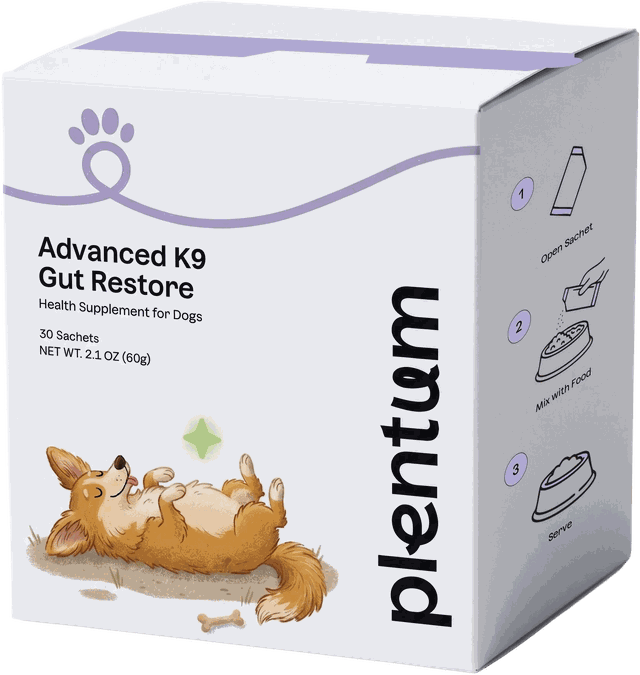
Fiber and gut-focused ingredients. The studies below looked at these ingredients, not at the supplement. See Gut Restore
-
Inulin (prebiotic fiber)
- Grade B: Controlled dog study
- Same ingredient
Even at low inclusion, inulin improved some digestibility measures in a controlled study of five dogs, but it did not change gut-bacteria counts at that level. It tested inulin, not Plentum.
The study used five cannulated laboratory dogs. At these low levels it saw no microbiota change, which argues against microbiome claims for Plentum's even lower inulin dose.
Read the study Barry KA et al., 2009, Journal of Animal Science -

Saccharomyces boulardii
- Grade A: Randomized dog trial
- Same ingredient
In a 35-day randomized study in 25 healthy kennel dogs, S. boulardii did not change stool scores but was associated with lower fecal markers of gut irritation and stress hormones. It tested the yeast alone, not Plentum.
The study used 25 kennel dogs of one breed and measured fecal markers, not clinical outcomes. Plentum's S. boulardii amount is unknown.
Read the study Meineri G et al., 2022, Veterinary Sciences -

Psyllium husk
- Grade A: Randomized dog trial
- Same ingredient
In a randomized crossover study in 17 healthy dogs, psyllium husk caused only minor changes in gut bacteria. It tested psyllium alone, not Plentum.
The dogs were healthy, and the study shows psyllium is gentle on the microbiome rather than a microbiome modifier.
Read the study Salavati Schmitz S et al., 2024, Access microbiology
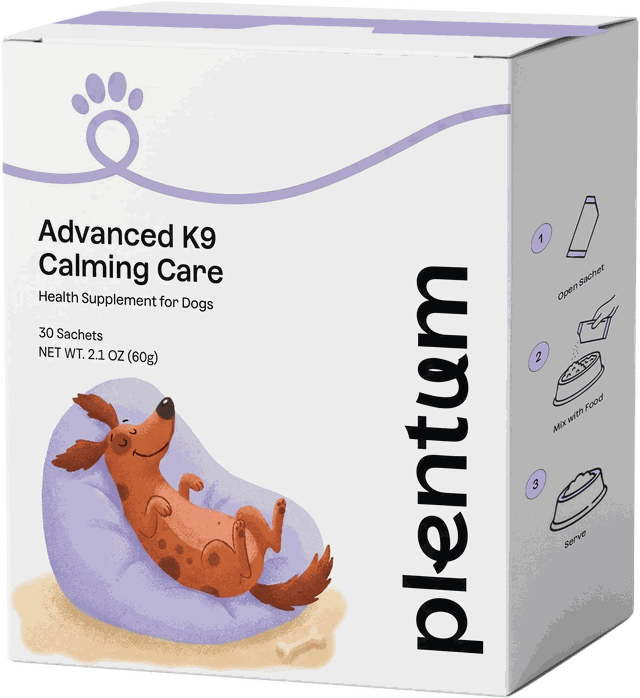
Botanicals and amino acids for everyday calm. Where the only studies are in people, we say so. See Calming Care
-

Tryptophan, valerian and passionflower
- Grade A: Randomized dog trial
- Tested in a blend
In a randomized, placebo-controlled study in 44 dogs, a supplement combining tryptophan, valerian and passionflower was associated with calmer owner-rated behavior and lower cortisol around fireworks. The product's maker funded it; it was a different product at different doses, not Plentum.
The product had three ingredients, so effects cannot be split by ingredient. Owners rated the outcomes, the manufacturer funded the study, and the tryptophan and passionflower doses were higher than Plentum's.
Read the study Ramos D et al., 2024, Animals -

Ashwagandha (KSM-66)
- Grade C: Other species or human study
- Same ingredient
- Humans
In a 60-day placebo-controlled study in 64 stressed adults, KSM-66 ashwagandha (the brand in Calming Care) was associated with lower stress scores and lower cortisol. The brand owner supplied the extract, and it was a human study, not a dog study or a Plentum study.
The adults had chronic stress, and there is no dog data for KSM-66.
Read the study Chandrasekhar K et al., 2012, Indian journal of psychological medicine -

L-theanine
- Grade C: Other species or human study
- Same ingredient
- Humans
In a 4-week placebo-controlled crossover study in 30 healthy adults, 200 mg/day of L-theanine from the Suntheanine maker was associated with better self-rated stress and sleep scores. The supplier funded this human study, and it wasn't a dog study or a Plentum study.
The adults were healthy, outcomes were self-reported, the supplier funded the study, and there is no dog data for Suntheanine specifically.
Read the study Hidese S et al., 2019, Nutrients
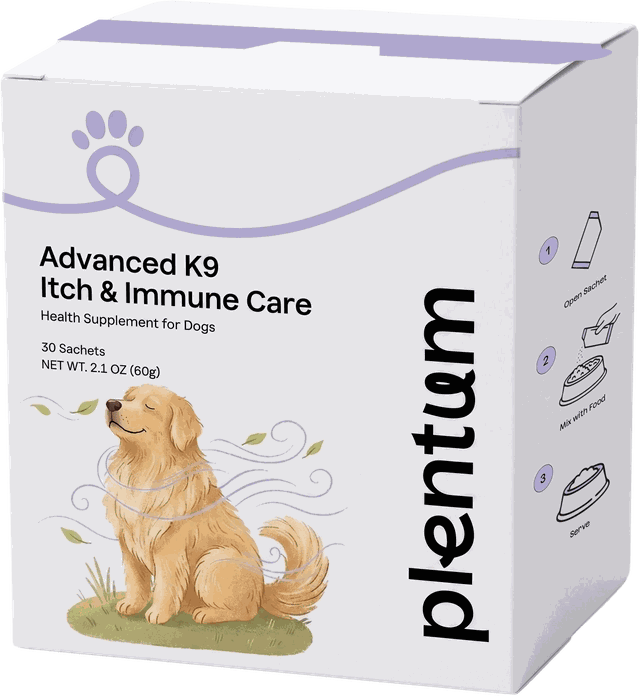
Skin, coat and immune-supporting ingredients. Its immune postbiotic is covered in the postbiotic section below. See Itch & Immune Care
-
Bovine colostrum
- Grade A: Randomized dog trial
- Same ingredient
In a 40-week randomized study in 24 healthy dogs, a colostrum-supplemented diet was associated with a stronger vaccine antibody response and higher gut IgA than the control diet. The industry ran it, and it tested colostrum, not Plentum.
The dogs were healthy colony dogs. Immune markers are surrogates, not proof of fewer illnesses, and the colostrum source and IgG content may differ from Plentum's.
Read the study Satyaraj E et al., 2013, British Journal of Nutrition -

Spirulina
- Grade A: Randomized dog trial
- Same ingredient
In a 42-week randomized study in 30 healthy dogs, a spirulina-supplemented diet was associated with a stronger vaccine antibody response and higher gut IgA than the control diet. The industry funded it, and it tested spirulina in food, not Plentum.
The dogs were healthy colony dogs. Immune markers are surrogates, and the industry funded the study.
Read the study Satyaraj E et al., 2021, Frontiers in Nutrition -

Omega-3 DHA and EPA
- Grade A: Randomized dog trial
- Same ingredient
In a 90-day placebo-controlled study in 24 dogs with dull coats, an EPA+DHA supplement was associated with better coat scores from day 60; the effect faded after supplementation stopped. It tested an omega-3 product, not Plentum.
The dogs were selected for dull coats, the benefit faded after stopping, and the EPA+DHA dose was likely higher than Plentum's per sachet.
Read the study Combarros D et al., 2020, Prostaglandins, leukotrienes, and essential fatty acids
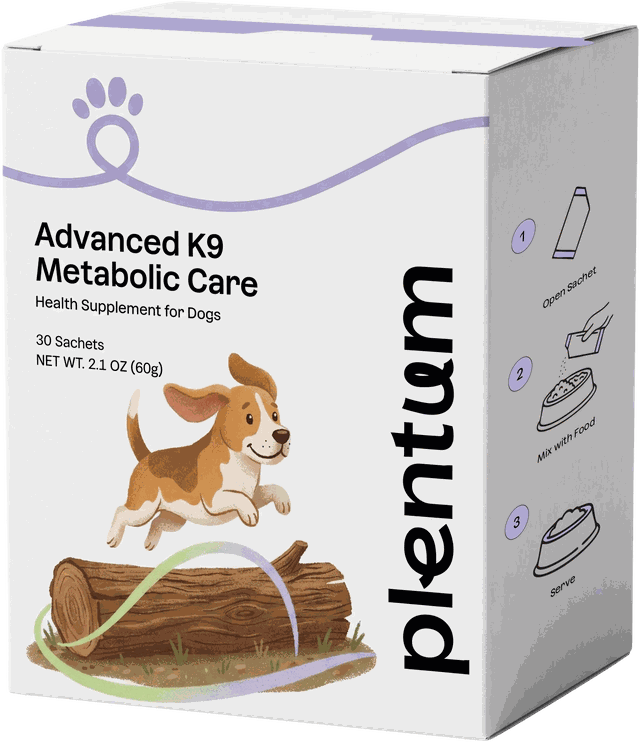
Ingredients for a healthy weight routine. This is the thinnest evidence on the page, and we show it that way. See Metabolic Care
-

L-carnitine
- Grade B: Controlled dog study
- Same ingredient
In exercising Labrador retrievers, 250 mg/day of L-carnitine was associated with better activity and lower muscle-strain markers. It wasn't a weight-loss study, and it didn't test Plentum.
The Labradors were exercising on a low-carnitine diet, and it wasn't a weight-loss study.
Read the study Varney JL et al., 2017, Journal of nutritional science -

Probiotic blend (category evidence)
- Grade A: Randomized dog trial
- Same class, different product
In a 12-week randomized study in 41 overweight dogs, a probiotic blend (different strains from Plentum's) was associated with greater weight and body-condition improvement than control. Shows the category has been studied in dogs; it does not show that Plentum's strains do the same.
The strains differ from Plentum's, the evidence is class-level only, and owners managed the feeding.
Read the study Choi J et al., 2024, Scientific reports -

Acacia fiber
- Grade A: Randomized dog trial
- Tested in a blend
In a 28-day randomized study in 36 healthy dogs, a supplement containing acacia gum with other prebiotics and postbiotics was associated with higher fecal butyrate and lower gut-irritation markers. Effects cannot be credited to acacia alone; not Plentum.
The chew had four ingredients, so effects cannot be credited to acacia alone. It measured biomarkers only.
Read the study Yi C et al., 2026, Veterinary Sciences
Other ingredients vary by supplement; the full list, with doses, is in the ingredient library.
Postbiotic ingredients
Our clinically studied postbiotic ingredients
Two of our ingredients, an oral health postbiotic (COHP) and a canine immune health postbiotic (CIHP), have been studied in dogs in peer-reviewed, placebo-controlled trials. The studies tested the ingredients, not Plentum products.

Used in Microbiome Care
Oral health postbiotic (COHP)
A heat-treated postbiotic made from Pediococcus pentosaceus and Bacillus subtilis fermentation products. In dogs, breath sulfur compounds stayed lower than on placebo over 14 days.
A novel postbiotic reduces canine halitosis
Animals, 2025; 15(11):1596
14 days, 24 dogs, randomized, double-blind, placebo-controlled, 250 mg a day. Breath sulfur compounds were 27% lower than placebo (p = 0.004).
DOI 10.3390/ani15111596Canine halitosis improved with a postbiotic: a validation study
Journal of Veterinary Dentistry, 2026
14 days, 24 dogs, double-blind, placebo-controlled, 150 mg a day. Breath sulfur compounds were 26% lower than placebo on day 14 (p = 0.04).
DOI 10.1177/08987564261437296A postbiotic positively shifts the canine oral microbiome
Journal of Veterinary Dentistry, 2026; 43(6):457-467
7 days, 10 dogs, randomized, double-blind, placebo-controlled. Shifts in oral bacteria were reported. Very small and exploratory.
DOI 10.1177/08987564261439741
Study doses were 150 to 250 mg a day. A Microbiome Care sachet contains 125 mg and your dog's daily amount depends on weight, so we do not claim the same results.

Used in Itch & Immune Care
Canine immune health postbiotic (CIHP)
A heat-treated Pediococcus acidilactici fermentation product. In dogs, itch and coat scores and stool consistency were studied over 28 days.
An indole-rich postbiotic reduces itching in dogs
Animals, 2025; 15(14):2019
28 days, 30 dogs, randomized, double-blind, placebo-controlled, 150 mg a day. Owner-rated itch scores were lower than placebo and coat scores were better.
DOI 10.3390/ani15142019A novel postbiotic improves stool consistency in dogs
Pets, 2026; 3(2):19
28 days, 20 colony-housed dogs, randomized, double-blind, placebo-controlled. Stool consistency improved with the postbiotic and not with placebo.
DOI 10.3390/pets3020019
The itch study used 150 mg a day. We do not claim the same results at the amount on our label.
Supplier disclosure. These studies were run by the ingredient supplier, which also funded and supplied them. The authors are its employees. They are small (10 to 30 dogs), short (7 to 28 days) and have not yet been replicated by an independent group. They studied the ingredients, not Plentum products.
By topic
Research by topic
Five research hubs, one per need: the question, dated sources, what the evidence says at ingredient level and what is still unknown.
- Gut health and digestionProbiotics, S. boulardii, psyllium, inulin, colostrum and postbiotics.
- Skin, coat and itchOmega-3, a postbiotic, colostrum and spirulina.
- Calm and the gut-brain axisTryptophan, valerian, passionflower, L-theanine and ashwagandha.
- Oral health and breathThe oral-health postbiotic studies and what comes first.
- Weight, metabolism and mobilityL-carnitine, probiotics, acacia fiber and omega-3.
Oral health and bad breath
The oral-health postbiotic in Microbiome Care was studied in dogs in published, placebo-controlled trials. Breath sulfur compounds were 27% lower than placebo over 14 days in a 24-dog study funded by the ingredient supplier. The studies tested the ingredient, not Plentum products. Details are in the postbiotic section above.
Joint health
None of our supplements is a joint supplement, and we make no joint-health claims. The ingredient studies on this page cover gut, skin and coat, calm and weight routines.
Gut health and short-chain fatty acids
Short-chain fatty acids (SCFAs) are made when gut bacteria ferment fiber, and the cells lining the gut use them as fuel. In controlled dog studies, adding the prebiotic fiber inulin raised fecal SCFAs. Those studies used higher doses than a Plentum sachet, so we cite them as ingredient evidence only.
Immunity and stool quality
In healthy dogs, diets containing colostrum or spirulina were associated with a stronger vaccine antibody response and higher gut IgA. Both studies were industry-run and tested the ingredients in food. A separate 28-day study of our immune postbiotic ingredient reported better stool consistency than placebo in colony-housed dogs. None of these tested a Plentum product.
Testing & quality
From sourcing to your dog's bowl
This is the testing behind every lot.
-
A certificate for every lot
Every lot of every Plentum supplement is lab-tested and ships with a Certificate of Analysis. Lots of our four newest supplements are tested in their manufacturer's ISO/IEC 17025:2017-accredited laboratory.
-
Our manufacturer's lab, not an outside one
The accredited lab is run by the manufacturer of our four newest supplements. It is accredited to ISO/IEC 17025:2017 by the Standards Council of Canada, and it is not an independent third party.
-
Where it is made
Microbiome Care is made in the USA. Our four newest supplements are made in Canada, following current Good Manufacturing Practices (cGMP).
-
Why we show certificates, not a seal
Plentum doesn't carry the NASC Quality Seal. That seal is a membership program: companies join, pay dues and pass an audit of their processes, and its product testing is random. A certificate of analysis for each lot shows what was tested in the product you buy.
Please read
How to read these studies
Every study linked on this page looked at an ingredient, or at another product containing it, in the amounts and conditions the researchers chose. A result in a study is not a promise of the same result in your dog.
Talk to your veterinarian before adding a supplement, especially if your dog takes medication, is pregnant or nursing, or has a diagnosed condition. Where a page and a printed pack differ, trust the pack and tell us through the contact page.
Not sure which supplement fits your dog?
Answer a few questions about your dog to see which supplement fits, with the evidence behind it.