






What is in each sachet, and why it is there
- 35ingredients explained
- 5supplements
- 56studies linked
Where to start
How it works
It walks you from one sachet to the gut ecosystem, the gut-skin, gut-brain and gut-mouth axes, dosing by weight and a twelve-week routine.
Open the walk-throughThe ingredient library
Every active in all five supplements: what it is, why it is there, how much each supplement uses, and what research exists.
Browse 35 ingredientsCompare the supplements
It lays out five supplements side by side, a quick guide to choosing, and simple rules for using more than one.
Compare the supplementsThe ingredients behind each supplement
Explore what each ingredient is, the role it plays, and the research behind it.
Amounts are per sachet. Each study identifies the population and ingredient form tested.
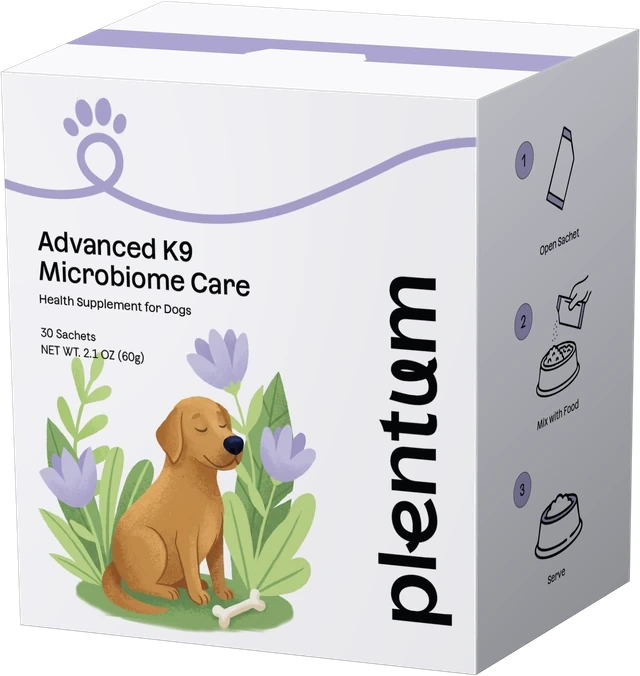
Microbiome Care
It supports daily gut health and fresher breath.
Oral-health postbiotic
125 mgIt contains heat-treated bacterial fermentation products.
It supports a balanced oral microbiome and fresher breath.
See the research
- Sordillo et al., 2025: Dogs · placebo-controlled trial, Oral-health postbioticDogs · placebo-controlled trial
In 24 dogs, an oral-health postbiotic was associated with lower breath sulfur compounds over 14 days.
The ingredient supplier funded the study.
- Sordillo et al., 2026: Dogs · controlled validation study, Oral-health postbioticDogs · controlled validation study
A second 14-day study in 24 dogs found lower breath sulfur compounds than placebo at a 150 mg daily dose.
The perceived-odor score difference did not reach statistical significance.
Inulin
100 mgIt is a plant fiber that gut bacteria ferment.
It supports the beneficial bacteria already living in the gut.
See the research
- Propst et al., 2003: Dogs · feeding study, InulinDogs · feeding study
In seven dogs, inulin changed gut fermentation measures, including short-chain fatty acids.
Responses varied with the amount added to the diet.
Fish oil
150 mgIt supplies the omega-3 fats EPA and DHA.
It supports healthy skin and coat.
See the research
- Combarros et al., 2020: Dogs · placebo-controlled trial, Fish oilDogs · placebo-controlled trial
A 90-day trial in 24 dogs reported better coat scores with EPA and DHA supplementation.
The study used omega-3 oil capsules.
Bovine colostrum
100 mgIt is the first milk from cows and contains immune proteins.
It supports normal immune function and gut health.
See the research
- Satyaraj et al., 2013: Dogs · randomized feeding study, Bovine colostrumDogs · randomized feeding study
In 24 dogs, a colostrum-supplemented diet was associated with higher vaccine antibody responses and gut IgA.
These were immune markers measured over a 40-week feeding period.
L-glutamine
100 mgIt is an amino acid used as fuel by gut-lining cells.
It supports the gut barrier.
See the research
- Humbert et al., 2007: Dogs · controlled feeding experiment, L-glutamineDogs · controlled feeding experiment
In seven dogs after fasting, glutamine changed antioxidant metabolism in the gut lining.
The experiment measured glutathione kinetics, rather than stool quality.
- Pugh et al., 2017: Humans · controlled exercise study, L-glutamineHumans · controlled exercise study
Glutamine supplementation was associated with lower markers of gut permeability during running in the heat.
The population was human runners.
Licorice root
50 mgIt is a botanical made from ground licorice root.
It is included for digestive support.
See the research
- Szweda et al., 2014: Dogs · combination study, Licorice rootDogs · combination study
A licorice and herb blend was associated with lower colon injury scores.
Dogs received the blend alongside anti-inflammatory drugs; the study did not isolate licorice.
- Peterson et al., 2018: Laboratory · human gut microbes, Licorice rootLaboratory · human gut microbes
Licorice and slippery elm changed bacteria and fermentation patterns in human gut microbe cultures.
This was a laboratory experiment.
Zinc methionine
5 mgIt combines the mineral zinc with the amino acid methionine.
It supports healthy skin and normal immune function.
See the research
- Pereira et al., 2021: Dogs · nutrition review, Zinc methionineDogs · nutrition review
The review describes zinc’s roles in enzymes, skin, and immune function.
It reviews nutritional requirements and zinc status, rather than testing a supplement.
Selenomethionine
20 mcgIt is a form of the essential trace mineral selenium.
It supports normal antioxidant defenses.
See the research
- Zentrichová et al., 2021: Dogs · systematic review, SelenomethionineDogs · systematic review
The review summarizes selenium’s roles in normal metabolism and how selenium status is measured in dogs.
It is a review of existing research.
- Todd et al., 2012: Dogs and cats · feeding experiment, SelenomethionineDogs and cats · feeding experiment
Researchers compared how dogs and cats absorbed, stored, and excreted different selenium forms.
The study used high dietary selenium levels to examine metabolism.
Vitamin E
25 IUIt is a fat-soluble antioxidant vitamin.
It supports healthy skin and normal antioxidant defenses.
See the research
- Hall et al., 2003: Dogs · controlled feeding study, Vitamin EDogs · controlled feeding study
In 32 older dogs, vitamin E levels and dietary fatty acid ratios affected some immune-cell measures.
The study varied both nutrients in the diet.
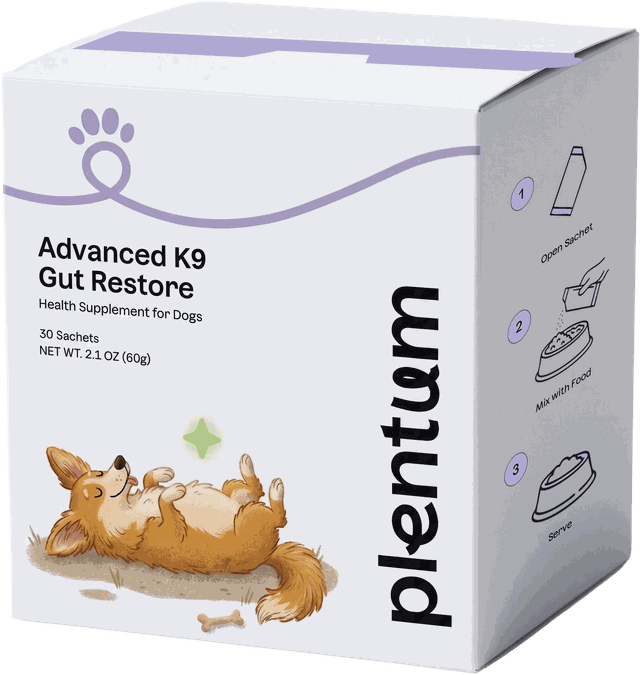
Gut Restore
It supports normal bowel function and healthy stool consistency.
Probiotic blend
300 mg blend · 10 billion CFUIt combines live Lactobacillus cultures and the probiotic yeast S. boulardii.
It supports normal bowel function and healthy stool consistency.
See the research
- Xu et al., 2019: Dogs · controlled feeding study, Probiotic blendDogs · controlled feeding study
In 90 dogs, a three-strain probiotic mixture changed gut bacteria and several immune markers.
The tested strains differ from the strains in this blend.
- Wang et al., 2020: Piglets · feeding study, Probiotic blendPiglets · feeding study
K9-1 and K9-2 cultures changed the abundance of selected intestinal bacteria in weanling piglets.
The study examined selected strains in pigs.
- Meineri et al., 2022: Dogs · randomized feeding study, Probiotic blendDogs · randomized feeding study
In 25 dogs, S. boulardii was associated with changes in fecal calprotectin, IgA, and cortisol.
Stool scores and overall gut microbial composition did not differ significantly.
Yeast cell wall postbiotic
75 mgIt contains non-living yeast cell walls, including mannans and beta-glucans.
It supports gut lining integrity and balanced gut flora.
See the research
- Lin et al., 2020: Dogs · crossover feeding study, Yeast cell wall postbioticDogs · crossover feeding study
In 12 dogs undergoing a diet change, a yeast cell wall fraction showed a tendency toward lower fecal calprotectin.
Most measured stool and gut outcomes did not differ significantly.
- Middelbos et al., 2007: Dogs · dose-response feeding study, Yeast cell wall postbioticDogs · dose-response feeding study
Yeast cell walls changed some digestibility measures and fecal bacterial counts across dietary doses.
The study tested several inclusion levels in food.
Jerusalem artichoke inulin
50 mgIt is a plant fiber that gut bacteria ferment.
It supports the beneficial bacteria already living in the gut.
See the research
- Propst et al., 2003: Dogs · feeding study, Jerusalem artichoke inulinDogs · feeding study
In seven dogs, inulin changed gut fermentation measures, including short-chain fatty acids.
Responses varied with the amount added to the diet.
Psyllium husk
200 mgIt is a soluble plant fiber that forms a gel in water.
It supports normal bowel function and healthy stool consistency.
See the research
- Mackei et al., 2022: Dogs · feeding study, Psyllium huskDogs · feeding study
Psyllium supplementation was associated with higher fecal short-chain fatty acids after 15 days.
The study measured products of gut fermentation.
- Salavati Schmitz et al., 2024: Dogs · randomized crossover trial, Psyllium huskDogs · randomized crossover trial
In 17 healthy dogs, psyllium supplementation produced small changes in selected gut bacteria.
The overall microbial community showed few changes.
Slippery elm bark
150 mgIt is the powdered inner bark of the slippery elm tree.
It is included for gut lining support.
See the research
- Peterson et al., 2018: Laboratory · human gut microbes, Slippery elm barkLaboratory · human gut microbes
Licorice and slippery elm changed bacteria and fermentation patterns in human gut microbe cultures.
This was a laboratory experiment.
- Ried et al., 2020: Humans · combination study, Slippery elm barkHumans · combination study
A blend containing slippery elm was associated with better digestive symptoms and gut barrier measures.
The study had no placebo group and could not isolate slippery elm’s contribution.
Organic pumpkin powder
150 mgIt is dried pumpkin flesh that supplies plant fiber.
It supports healthy stool consistency alongside the other fibers.
See the research
- Nieto et al., 2024: Laboratory · human gut microbes, Organic pumpkin powderLaboratory · human gut microbes
Processed butternut pumpkin fiber changed bacteria and fermentation in a model of the human colon.
The tested preparation differs from whole pumpkin powder.
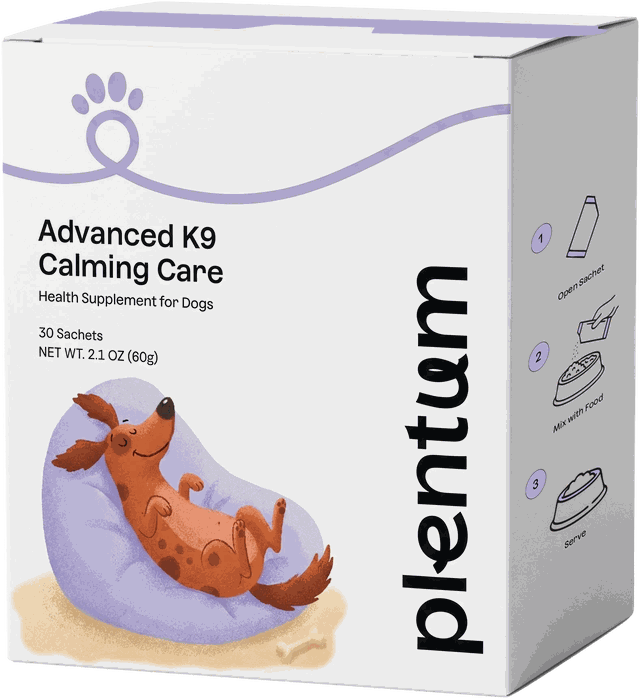
Calming Care
It supports a calm, relaxed demeanor during occasional stress.
Probiotic blend
75 mg blend, 10 billion CFUIt combines live Lactobacillus cultures and the probiotic yeast S. boulardii.
It supports a balanced gut microbiome.
See the research
- Xu et al., 2019: Dogs · controlled feeding study, Probiotic blendDogs · controlled feeding study
In 90 dogs, a three-strain probiotic mixture changed gut bacteria and several immune markers.
The tested strains differ from the strains in this blend.
- Meineri et al., 2022: Dogs · randomized feeding study, Probiotic blendDogs · randomized feeding study
In 25 dogs, S. boulardii was associated with changes in fecal calprotectin, IgA, and cortisol.
Stool scores and overall gut microbial composition did not differ significantly.
Postbiotic
100 mgIt contains non-living microbial material.
It is included alongside the probiotic blend for gut support.
See the research
- Koziol et al., 2023: Dogs · feeding study of another postbiotic, PostbioticDogs · feeding study of another postbiotic
A Lactobacillus fermentation product changed some gut, immune, and antioxidant measures in adult dogs.
The paper provides context for the postbiotic category and tests a different ingredient.
L-theanine
200 mgIt is an amino acid found in tea leaves.
It supports a calm, relaxed demeanor during occasional stress.
See the research
- Pike et al., 2015: Dogs · open-label study, L-theanineDogs · open-label study
Owners of 18 dogs reported lower storm-response scores during L-theanine supplementation.
The study had no placebo group.
- Hidese et al., 2019: Humans · placebo-controlled crossover trial, L-theanineHumans · placebo-controlled crossover trial
In 30 adults, L-theanine was associated with changes in reported stress and sleep measures.
The study used 200 mg daily for four weeks.
GABA
150 mgIt is a messenger involved in normal nervous system signaling.
It is included to support relaxation during occasional stress.
See the research
- Uetake et al., 2012: Dogs · small dose study, GABADogs · small dose study
Four Shih Tzus showed changes in activity and urinary cortisol after oral GABA.
The sample was small and did not include a placebo-controlled group.
- Abdou et al., 2006: Humans · small experimental studies, GABAHumans · small experimental studies
Oral GABA was associated with changes in brain-wave patterns and salivary IgA during stress tasks.
The studies involved small groups of human volunteers.
L-tryptophan
100 mgIt is an essential amino acid used to make serotonin.
It supports normal serotonin metabolism.
See the research
- Ramos et al., 2024: Dogs · placebo-controlled combination trial, L-tryptophanDogs · placebo-controlled combination trial
A three-ingredient blend was associated with lower stress scores during fireworks in 44 dogs.
The blend contained tryptophan, valerian, and passionflower; individual effects cannot be separated.
- Bosch et al., 2009: Dogs · placebo-controlled feeding trial, L-tryptophanDogs · placebo-controlled feeding trial
A higher-tryptophan diet raised blood tryptophan in dogs over eight weeks.
Behavioral scores did not differ from the control diet.
Chamomile
75 mgIt is a botanical made from dried chamomile flowers.
It is included in the blend for relaxation support.
See the research
- Adib-Hajbaghery et al., 2017: Humans · controlled trial, ChamomileHumans · controlled trial
Older adults taking chamomile extract reported better sleep quality than the control group.
The study tested an extract in people, rather than chamomile powder in dogs.
Passionflower
75 mgIt is a botanical made from Passiflora incarnata.
It is included in the blend for relaxation support.
See the research
- Ramos et al., 2024: Dogs · placebo-controlled combination trial, PassionflowerDogs · placebo-controlled combination trial
A three-ingredient blend was associated with lower stress scores during fireworks in 44 dogs.
The blend contained tryptophan, valerian, and passionflower; individual effects cannot be separated.
- Ngan et al., 2011: Humans · placebo-controlled crossover trial, PassionflowerHumans · placebo-controlled crossover trial
In 41 adults, passionflower tea was associated with better self-reported sleep quality.
The study examined tea in people.
Valerian root
50 mgIt is a botanical made from ground Valeriana officinalis root.
It is included in the blend for relaxation support.
See the research
- Ramos et al., 2024: Dogs · placebo-controlled combination trial, Valerian rootDogs · placebo-controlled combination trial
A three-ingredient blend was associated with lower stress scores during fireworks in 44 dogs.
The blend contained tryptophan, valerian, and passionflower; individual effects cannot be separated.
- Cropley et al., 2002: Humans · controlled laboratory study, Valerian rootHumans · controlled laboratory study
Adults taking valerian reported less pressure during a mental stress task and showed changes in heart-rate response.
The study tested valerian in people.
Ashwagandha
50 mgIt is a root extract standardized for its withanolide content.
It supports normal cortisol levels during occasional stress.
See the research
- Bharani et al., 2024: Dogs · placebo-controlled trial, AshwagandhaDogs · placebo-controlled trial
In 20 older dogs, ashwagandha extract was associated with lower cortisol and changes in antioxidant markers.
The study examined a root extract over 60 days.
- Salve et al., 2019: Humans · placebo-controlled trial, AshwagandhaHumans · placebo-controlled trial
Adults taking ashwagandha extract reported lower stress scores and had lower cortisol levels.
The study tested 250 mg or 600 mg daily over eight weeks.
Magnesium
100 mgIt is an essential mineral involved in nerve and muscle function.
It supports normal neurological function.
See the research
- Ando et al., 2017: Dogs · observational pilot study, MagnesiumDogs · observational pilot study
Blood magnesium levels varied with season, training stage, and exercise in dogs.
The study observed magnesium status and did not test supplementation.
- Pouteau et al., 2018: Humans · randomized comparison trial, MagnesiumHumans · randomized comparison trial
Adults with low magnesium reported lower stress scores with magnesium, with or without B6.
Adding B6 showed no overall advantage; a benefit appeared in the subgroup with the highest stress scores.
Vitamin B6
2 mgIt is a vitamin used to make serotonin and other messengers.
It supports normal neurological function.
See the research
- Tran et al., 2007: Dogs · dietary vitamin study, Vitamin B6Dogs · dietary vitamin study
Researchers measured blood vitamin levels after dogs received diets with specified vitamin amounts.
The study examined vitamin status and did not assess calming behavior.
- Pouteau et al., 2018: Humans · randomized comparison trial, Vitamin B6Humans · randomized comparison trial
Adults with low magnesium reported lower stress scores with magnesium, with or without B6.
Adding B6 showed no overall advantage; a benefit appeared in the subgroup with the highest stress scores.
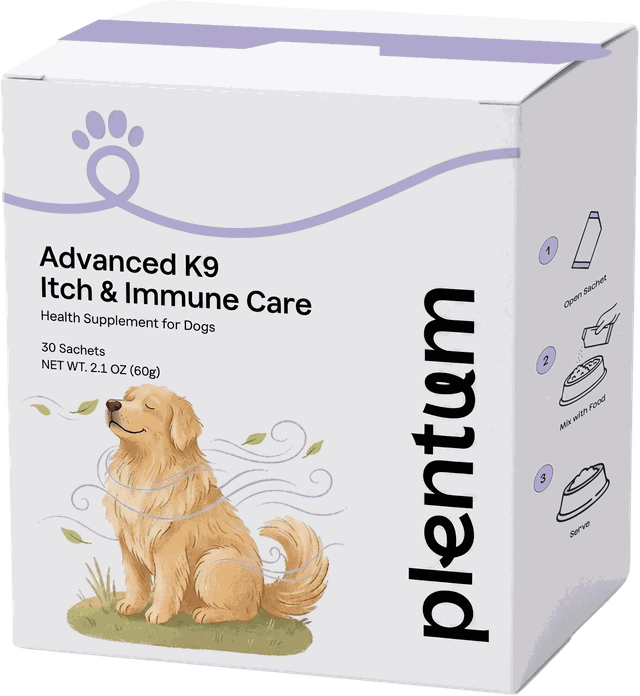
Itch & Immune Care
It supports healthy skin, coat, and a normal immune response.
Probiotic blend
150 mg blend · 2 billion CFUIt combines live Lactobacillus cultures.
It supports a balanced gut microbiome.
See the research
- Xu et al., 2019: Dogs · controlled feeding study, Probiotic blendDogs · controlled feeding study
In 90 dogs, a three-strain probiotic mixture changed gut bacteria and several immune markers.
The tested strains differ from the strains in this blend.
- Mohammadi Dehcheshmeh et al., 2025: Dogs · microbiome study, Probiotic blendDogs · microbiome study
A probiotic and postbiotic combination was associated with changes in bacteria found on skin and in the gut.
The study used a different combination and measured microbiome composition.
Immune-health postbiotic
250 mgIt contains non-living material produced through microbial fermentation.
It supports the gut-skin axis and normal immune function.
See the research
- Sordillo et al., 2025: Dogs · placebo-controlled trial, Immune-health postbioticDogs · placebo-controlled trial
In 30 dogs, an immune-health postbiotic was associated with lower itch scores and better skin and coat scores over 28 days.
The ingredient supplier funded the study.
Algal DHA
250 mgIt supplies the omega-3 fat DHA from microalgae.
It supports healthy skin and coat.
See the research
- Souza et al., 2019: Dogs · feeding study, Algal DHADogs · feeding study
Diets containing DHA-rich microalgae were associated with changes in digestibility and immune-cell measures.
The study tested microalgae in food.
Bovine colostrum
150 mg · 30% IgGIt is the first milk from cows and contains immune proteins.
It supports normal immune function and gut health.
See the research
- Satyaraj et al., 2013: Dogs · randomized feeding study, Bovine colostrumDogs · randomized feeding study
In 24 dogs, a colostrum-supplemented diet was associated with higher vaccine antibody responses and gut IgA.
These were immune markers measured over a 40-week feeding period.
Quercetin
100 mgIt is a plant compound found in apples, capers, and berries.
It supports normal cellular antioxidant activity.
See the research
- Reinboth et al., 2010: Dogs · absorption study, QuercetinDogs · absorption study
Researchers measured how quercetin and its related forms were absorbed and metabolized in nine dogs.
The study measured absorption, rather than skin or immune benefits.
- Móritz et al., 2025: Laboratory · canine immune cells, QuercetinLaboratory · canine immune cells
Quercetin was associated with lower oxidative stress and inflammatory signals in stimulated canine immune cells.
The work was done in cell cultures.
Spirulina
75 mgIt is a blue-green microalga containing protein and natural pigments.
It supports normal immune function and antioxidant activity.
See the research
- Satyaraj et al., 2021: Dogs · randomized feeding study, SpirulinaDogs · randomized feeding study
In 30 dogs, a spirulina-supplemented diet was associated with higher vaccine antibody responses and gut IgA.
The study measured immune markers and gut microbial stability.
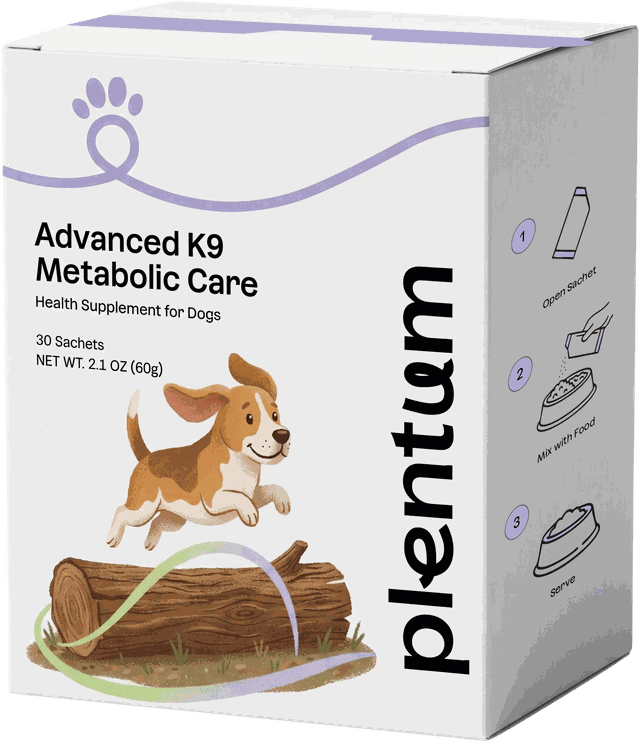
Metabolic Care
It supports healthy weight management alongside measured portions and daily exercise.
Probiotic blend
100 mg blend · 2 billion CFUIt contains live B. animalis subsp. lactis and L. gasseri.
It supports a balanced gut microbiome and normal bowel function.
See the research
- Kayser et al., 2024: Dogs · placebo-controlled trial, Probiotic blendDogs · placebo-controlled trial
A specific B. animalis subsp. lactis strain changed fecal fermentation measures in 36 dogs.
Body weight and blood glucose responses did not differ between groups; live and heat-treated forms were tested.
- Lee et al., 2022: Dogs · pilot combination study, Probiotic blendDogs · pilot combination study
Dogs given a blend containing L. gasseri showed changes in body composition and gut microbes.
The pilot tested a particular strain in a synbiotic combination.
Pediococcus acidilactici postbiotic
200 mgIt contains non-living Pediococcus acidilactici material.
It is included alongside the probiotic blend for gut support.
See the research
- Zhao et al., 2024: Dogs · feeding study of a live culture, Pediococcus acidilactici postbioticDogs · feeding study of a live culture
Live P. acidilactici GLP06 changed gut microbes, fermentation products, and antioxidant markers in 24 beagles.
The study tested a live culture, while Metabolic Care contains a postbiotic.
- Cabello-Olmo et al., 2025: Mice · heat-inactivated culture study, Pediococcus acidilactici postbioticMice · heat-inactivated culture study
Heat-inactivated P. acidilactici affected glucose and body-weight measures in mice on a high-fat diet.
The study tested a specific strain in mice.
Acacia fiber
175 mgIt is a soluble fiber obtained from acacia tree gum.
It supports normal bowel function and balanced gut flora.
See the research
- Yi et al., 2026: Dogs · randomized combination trial, Acacia fiberDogs · randomized combination trial
A blend containing acacia changed gut bacterial composition and fermentation measures in 36 dogs.
Stool scores stayed in the healthy range in both groups; several prebiotics and postbiotics were combined.
- De La Guardia-Hidrogo et al., 2025: Laboratory · canine gut microbes, Acacia fiberLaboratory · canine gut microbes
Acacia fiber fermented in cultures of canine gut microbes, producing short-chain fatty acids and changes in bacteria.
This was a laboratory fermentation model.
Chia seed powder
50 mgIt contains plant fiber and the omega-3 fat ALA.
It supports normal bowel function as part of the fiber blend.
See the research
- Mishima et al., 2022: Rats · feeding study, Chia seed powderRats · feeding study
Chia flour affected stool moisture, fermentation products, and intestinal structure in rats.
The study tested chia as part of controlled diets.
- Ayaz et al., 2017: Humans · randomized crossover trial, Chia seed powderHumans · randomized crossover trial
Adults reported greater fullness and ate less at lunch after yogurt containing chia.
The study used 7 g or 14 g of chia in people.
L-carnitine
75 mgIt carries fatty acids into cells’ energy-producing structures.
It supports normal fat metabolism.
See the research
- Varney et al., 2017: Dogs · controlled exercise studies, L-carnitineDogs · controlled exercise studies
Labradors given L-carnitine during exercise programs showed changes in lean mass and muscle-recovery markers.
The studies tested 250 mg daily with controlled diets and exercise.
- Varney et al., 2020: Dogs · controlled exercise studies, L-carnitineDogs · controlled exercise studies
Labradors given L-carnitine showed changes in muscle protein turnover and energy use during exercise.
The study used 125 mg daily and measured exercise-related metabolism.
White kidney bean extract
50 mgIt is a bean extract containing an alpha-amylase inhibitor.
It is included for carbohydrate metabolism support.
See the research
- Spadafranca et al., 2013: Humans · placebo-controlled meal study, White kidney bean extractHumans · placebo-controlled meal study
In 12 adults, a standardized bean extract was associated with smaller post-meal glucose and insulin rises.
The study tested 100 mg of a specific extract in people.
Chitosan
50 mgIt is a fiber-like compound derived from crustacean shells.
It contributes to the supplement’s fiber blend.
See the research
- Cheng et al., 2023: Dogs · feeding study of a related form, ChitosanDogs · feeding study of a related form
Chitosan oligosaccharides changed immune markers, antioxidant activity, and gut microbes in beagles.
Oligosaccharides are a related form of chitosan.
- Liu et al., 2018: Rats · dietary metabolism study, ChitosanRats · dietary metabolism study
Different molecular-weight forms of chitosan affected blood lipids and fat-metabolism pathways in rats.
The study used high-fat diets in rats.