





Your dog's had soft stools for weeks, or the scratching never quite stops, or the coat looks dull even on good food, and now you're eyeing a gut supplement. Do they work? Some do, for some dogs, and the evidence depends heavily on which ingredient and which claim you're looking at. Every tub on the shelf says it works, so here's how to tell research from good packaging.
- Give a supplement consistently for several weeks.
- Probiotics, prebiotics, postbiotics, and synbiotics are different categories. Check which one a product actually contains.
- The ingredients that matter most are named strains, a labeled prebiotic source and clear manufacturing standards.
What the research says so far
The most interesting recent result is a 2024 randomized controlled trial in Veterinary Sciences (Stübing et al., 2024). It tested a synbiotic in dogs with sudden-onset digestive upset. The researchers reported encouraging results and found that more of the dogs' core gut microbiota stayed intact. It's one trial of one product, so treat it as a promising lead, not a verdict.
Veterinary research keeps circling back to the gut as a player in digestion, immunity, skin and even behavior. A good supplement may support some of that. How strong the evidence is changes a lot from one ingredient, and one promise, to the next.

Signs your dog may need a digestive supplement
The obvious ones live in the yard and the food bowl: loose or chronically soft stool, frequent gas or bloating, vomiting or regurgitation that keeps coming back, and an appetite that's all over the place. A gut microbiome imbalance can play a part in all of them.
Some signs show up far from the belly. A dull, dry or flaky coat, itching with no clear allergen behind it, ear infections that keep recurring and less energy or enthusiasm than usual can all have a gut angle. So can behavior: more stress reactivity, mood changes or a dog who's less social than before.
Every one of these has several possible causes, so run them past your vet before you reach for a supplement. The gut link is real, though. A 2021 review in Frontiers in Veterinary Science noted significantly lower microbiome diversity in dogs with atopic dermatitis than in healthy dogs, and a 2022 study tied gut imbalance to stress markers in dogs (more on that in the gut-brain section below).
Digestive trouble is regularly listed among the top 5 reasons dogs end up at the vet, so if you're dealing with it, you've got plenty of company.

What canine gut health actually is
Gut health is how well your dog's digestive system works, including the trillions of microbes living in it, known together as the gut microbiome. A 2020 paper in PLOS ONE counted over 2.5 million unique microbial genes in there. It's a crowded, complicated ecosystem.
Those microbes do far more than digest dinner. They break food down so the body can absorb nutrients. They help run the immune system, since approximately 70% of a dog's immune cells sit in the gut-associated lymphoid tissue (GALT). A balanced microbiome makes short-chain fatty acids (SCFAs) that support normal inflammatory responses. And the gut makes a large share of the body's serotonin, plus significant amounts of GABA.
When that balance tips into dysbiosis, the effects can reach almost every system. A 2019 study in Veterinary Sciences linked dysbiosis in dogs to GI signs, dermatitis, behavior changes and immune dysfunction. That's a big reason gut supplements went from niche to mainstream.
Probiotics, prebiotics and postbiotics: what's in the scoop
The better supplements don't just toss in a few bacterial strains. They work in layers, and each layer has its own evidence.
Probiotics (live beneficial bacteria)
Probiotics are the live part, and with them the strain is everything. Human probiotics aren't dog probiotics, whatever the pet-store display implies.
The best-studied canine strain is probably Enterococcus faecium SF68. It's been looked at in several clinical trials in dogs with digestive upset. For wider background on canine gut research, Westermarck et al., 2005, in the Journal of Veterinary Internal Medicine, is a common starting point. Bifidobacterium animalis AHC7 was tested in a randomized controlled trial in dogs with digestive upset (Kelley et al., 2009, Veterinary Therapeutics), and Lactobacillus acidophilus DSM13241 is another strain with canine research behind it.
You'll also see Bacillus coagulans, a spore-forming strain that shrugs off heat and stomach acid better than many fragile strains. That toughness is why spore-formers turn up in shelf-stable synbiotic supplements. You'll also hear that multi-strain products beat single-strain ones; a 2020 meta-analysis in PLOS ONE leans that way, but in practice it still comes down to which strains, and how much.
Prebiotics (food for beneficial bacteria)
A prebiotic is a fiber your dog can't digest but the good bacteria can. Inulin from chicory root, for example, feeds Bifidobacterium and Lactobacillus species, which helps probiotic strains settle in instead of passing straight through. Without that fuel, even good strains may not take hold.
On labels you'll usually see fructooligosaccharides (FOS), inulin (a soluble fiber with strong evidence in human and veterinary research) or chicory root extract, a natural inulin source with extra polyphenols. A 2018 study in the Journal of Animal Physiology and Animal Nutrition gave dogs prebiotics alone for 4 weeks and reported fecal Bifidobacterium up by 300%.
Postbiotics (the newer layer)
Postbiotics are the useful compounds bacteria make while they ferment. Short-chain fatty acids like butyrate, acetate and propionate do much of the gut's protective work. They're the main fuel for colonocytes, the cells lining the colon, and they help maintain the intestinal barrier even when live bacteria don't make it through the upper GI tract. They also play a part in normal immune signaling.
Because postbiotics don't depend on anything surviving the trip, a 2021 review in Nutrients suggested they may give more consistent, targeted benefits than probiotics alone.
Synbiotic vs. probiotic vs. prebiotic: how they compare
Most owners have heard of probiotics. Far fewer have heard of synbiotics, which combine probiotics and prebiotics, often with postbiotic components, so each layer backs up the others. The prebiotic feeds both the new strains and the bacteria already there, while the postbiotic layer gets to work as any live strains settle in.
| Feature | Probiotic Only | Prebiotic Only | Synbiotic |
|---|---|---|---|
| Delivers live bacteria | Yes | No | Yes |
| Feeds existing good bacteria | No | Yes | Yes |
| Produces beneficial metabolites (SCFAs) | Partly | Partly | Yes, as a full layer |
| Supports gut barrier integrity | Partly | Partly | Yes |
| Bacteria survive in gut environment | Varies | Not applicable | Often better, since the prebiotic feeds the strains |
| Works on more than one part of gut balance | One layer | One layer | Several layers at once |
| Research backing (canine-specific) | Varies by strain | Varies by ingredient | Varies by product |
Research in Beneficial Microbes indicates synbiotics can support a bigger improvement in fecal microbiome diversity than probiotics alone over several weeks. Note the last row of the table, though: it all comes down to the specific product.
What to look for on the label
Start with the strains. "Lactobacillus acidophilus" is a species. "Lactobacillus acidophilus DSM13241" is a specific strain with a research record, and a maker who prints that level of detail is usually being careful.
Next, find the prebiotic. The label should name it, whether that's FOS, inulin or chicory root.
Check for cGMP (Current Good Manufacturing Practice) certification as a baseline quality sign. Then read the rest of the label for anything your dog is sensitive to, including sweeteners such as xylitol.
How to give it so it has a fair shot
Consistency beats everything else. Give it every day with a meal, since food buffers stomach acid and most probiotic strains survive better that way. Stick to the recommended dose, too. More doesn't speed things up and can cause temporary tummy trouble while the microbiome adjusts.
Then be patient. Most dogs show early changes within 2–3 weeks, so give it 3–6 weeks before you judge it. Deeper microbiome shifts take longer still: a 2019 veterinary review put them at 4–8 weeks of steady use. Plenty of owners quit at week 2, right about when things start to happen, and dogs with more severe imbalance can take longer.
The first 5–7 days sometimes bring a little extra gas or a change in stool while things recalibrate. If it lasts beyond 10 days, have your dog checked.
Storage matters more than people think. Many probiotic strains don't like heat, moisture or light, so follow the directions, and know that individually sealed sachets hold up better than a tub you open every morning. Finally, a gut supplement can't outwork the rest of the bowl. Ultra-processed food, a steady stream of treats and frequent food switches can undercut the microbiome no matter what you add.
The gut-brain connection in dogs
If the dog with the touchy stomach is also the one who trembles through Fourth of July fireworks or the vet's waiting room, there may be a link. The gut-brain axis is the two-way line between the digestive tract and the central nervous system, and it may help explain why dogs with chronic digestive trouble often show behavior changes, and why stressed dogs so often get GI signs.
Here's the surprising part: most of the traffic runs from the gut up to the brain. A very large share of serotonin, the so-called feel-good chemical, is made in the GI tract by enterochromaffin cells, and gut bacteria can influence that output. Dogs with dysbiosis may make less of it, which could add to stress reactivity.
Stress hormones seem to be part of the story too. A 2022 paper in Scientific Reports found that dogs given a multi-strain probiotic for 6 weeks had lower salivary cortisol responses to stressors than controls. It's early, small-scale work, but it fits the broader picture. Research in veterinary models suggests the microbiome helps calibrate the hypothalamic-pituitary-adrenal (HPA) axis, the body's stress-response system, especially early in life.
Fitting a supplement into the bigger picture
A supplement is one piece of a plan that also includes a complete diet, regular vet care and steady habits. It can't stand in for a diagnosis, and if your dog has a health condition or takes medication, check with your vet first.
How Plentum approaches gut health
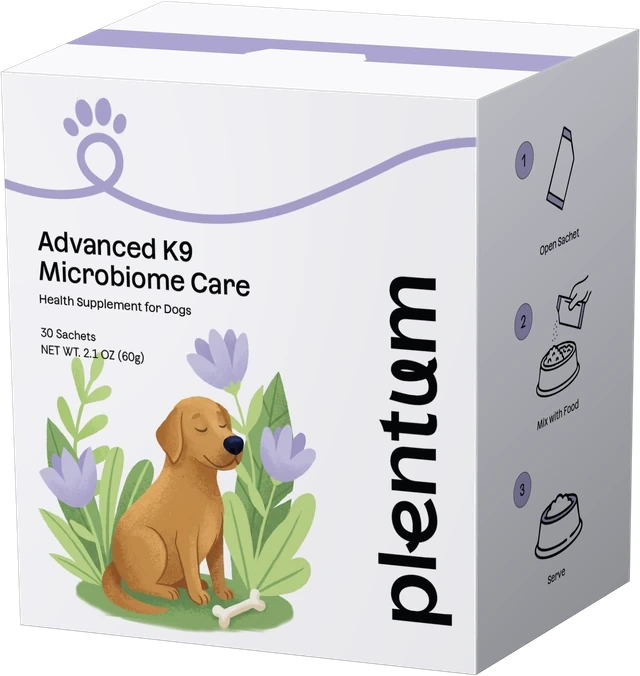
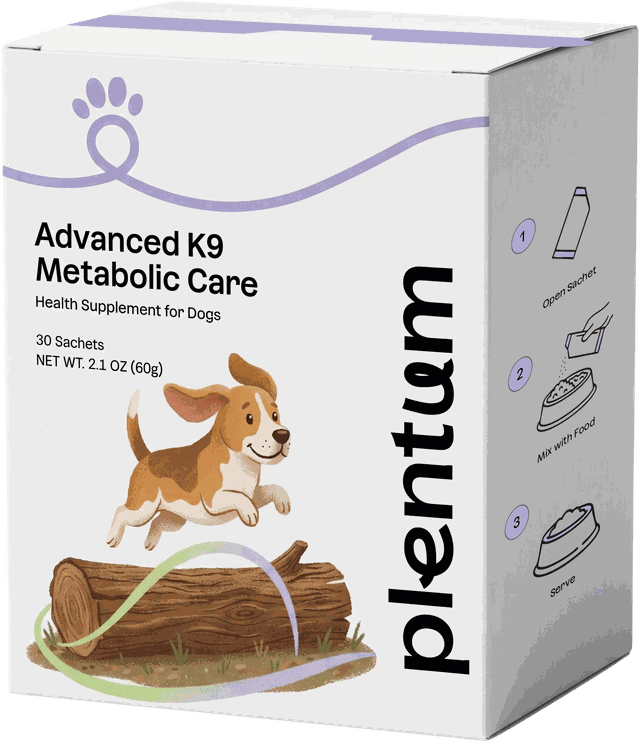
Plentum's Advanced K9 Microbiome Care is a postbiotic and prebiotic powder, so it covers two of the three layers in daily sachets you mix into food once a day, at 1 sachet for dogs under 20 lb, 2 sachets for dogs from 20 to 50 lb, and 3 sachets for dogs above 50 lb. It isn't a probiotic and has no live cultures. Each serving delivers a postbiotic complex plus inulin, a prebiotic fiber, intended to support gut and oral health. With no live bacteria, there's nothing to keep alive in an open tub. You can read the full supplement on Plentum's site.
Frequently asked questions
Do dog gut health supplements work?
It depends on the strain and the situation. SF68, for example, has been studied in several clinical trials in dogs with digestive upset, while plenty of products don't even name their strains.
Can a gut supplement help a dog with atopic dermatitis?
The evidence is early, though a gut-skin link is plausible. Skin disease needs its own treatment plan from your vet, and a supplement would only ever sit alongside it.
Is a gut supplement safe for the long haul?
For healthy dogs, quality probiotic and synbiotic supplements are generally considered fine for daily use. Some studies lasting 12 months or more have reported no adverse effects.
Sources and further reading
These cover general standards and background. They can't replace an exam.