



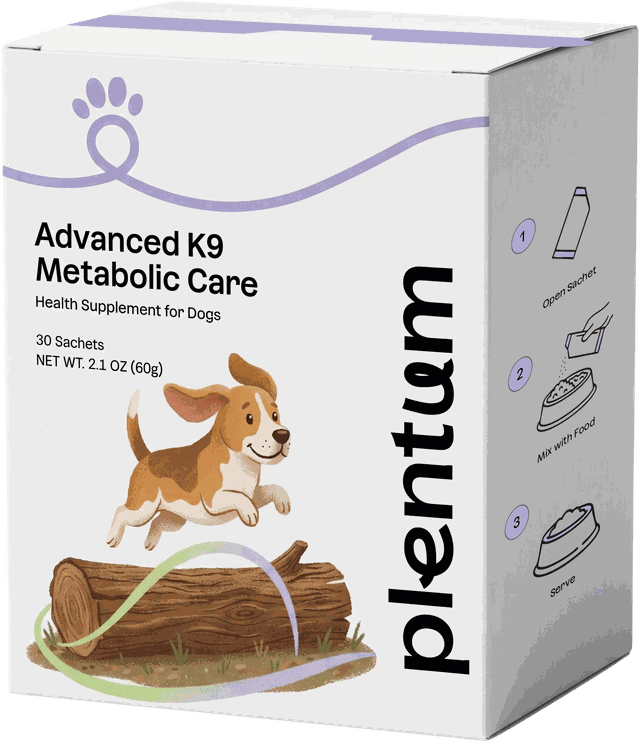


Read a dog probiotic label in this order:
- The serving size
- The daily amount for your dog's weight
- The live cultures and other actives, with amounts
- When the live count applies
- The full ingredient list and any cautions
- The lot number, matched to a test report
It works for any brand, including ours.
What the back of the tub should tell you

A useful label tells you what is inside, how much to give, and how to store it.
Ask the brand for any missing details.
The serving is the unit the label measures. The daily amount is how many servings your dog gets.
The daily amount often depends on weight, so read both before you compare numbers.
| Product | Serving on the label | Daily amount at 50 lb |
|---|---|---|
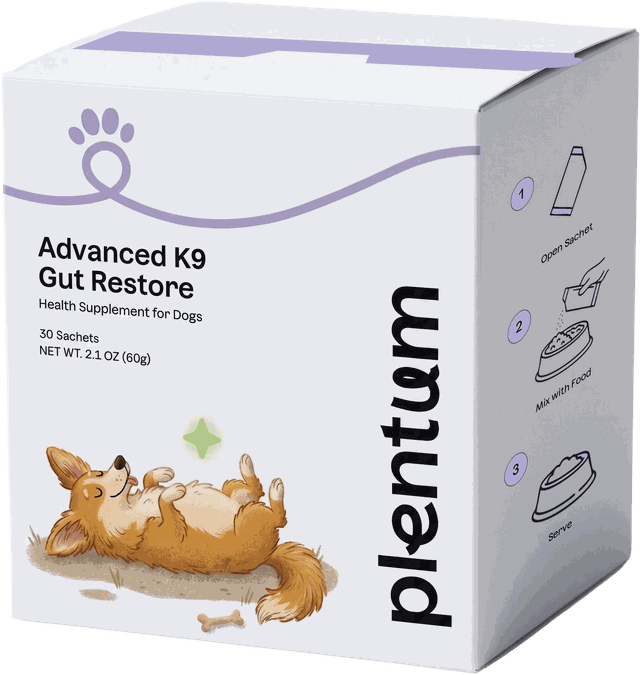
| Plentum Gut Restore | 1 sachet (2 g) | 2 sachets |
| Zesty Paws, pumpkin | 2 chews (7 g) | 2 chews |
| Native Pet | 1 scoop | 1 scoop |
| FortiFlora Original | 1 packet (1 g) | 1 packet |
Labels and directions checked on each brand's US website on October 20, 2026.
Strains, counts, and dates

Check the strains listed.
If a label gives only a blend name, ask the brand which strains are inside.
Next, check the count.
A huge number on the front doesn't make a product useful on its own.
Check whether the label says when that count applies, at manufacture or at expiration, and ask the brand if it doesn't.
Potency can drop over a product's shelf life, so check the expiration or potency date.
If a tub is close to its date, grab a fresher one.
Milligrams (mg) measure weight. CFU, or colony-forming units, counts live cells.
Gut Restore's label lists a 300 mg probiotic blend with 10 billion CFU in total and names five organisms.
A blend total gives the whole amount, not each organism's share.
Ask the brand if you want the split.
| Name on the label | What it tells you |
|---|---|
| Lactobacillus | Genus, the broad family |
| Lactobacillus casei | Species, a type within that family |
| L. casei K9-1 | Strain, one specific line |
Many labels name only the species. You can ask for strain IDs if they matter to you.
Read the words next to the CFU number. Gut Restore's label gives its count “at manufacture.”
Zesty's pumpkin label gives 6 billion CFU per two chews, not per chew.
If a label doesn't say when the count applies, ask the brand what it stands behind at the best-by date.
Probiotic, prebiotic, or postbiotic?
These terms describe different ingredients.

A probiotic contains live microorganisms.
A prebiotic is selectively used by microbes.
A postbiotic contains inactivated microbes or their components.
The ISAPP postbiotic consensus explains that definition.
None of these ingredient categories is automatically better.
Compare evidence for the intended use.
The dog gut health research hub collects the studies on gut ingredients such as probiotics, postbiotics, and fiber.
Storage and format
Follow the storage directions for the product you choose.
If they are unclear, ask the brand rather than assuming a product needs refrigeration or is stable at room temperature.
Then think about your dog.
A chew is easy if your dog takes treats without fuss.
A powder mixes into meals.
The right format is the one your dog will actually take every day.
| Format | Often works well when | Check before you buy |
|---|---|---|
| Chew | Your dog takes treats reliably | Serving size and daily treat allowance |
| Powder | You mix the product into meals | Your dog eats the full serving |
Give it at the same time each day, like breakfast, and jot down the days you miss.
Claims worth a second look
Wording like "supports normal digestion" or "helps maintain regular bowel habits" describes everyday upkeep.
Check the source behind a claim.
A supplement label should not promise that a disease will go away.
A real gut problem needs your vet, not a label.
See our probiotic label comparison for a side-by-side approach.
To review ingredient lists while you compare dog foods online, try the free Plentum Dog Food Checker Chrome extension.
Every ingredient has a job, from carrying the cultures to holding a chew together or keeping a powder dry.
Read the list against what you know about your dog, including any food sensitivities your vet has found.
Cautions belong to a specific product. FortiFlora Plus, for example, contains bovine colostrum.
Follow the directions on the label you have.
Six questions to ask any label
- Does it list the strains or the active ingredients?
- Does it say whether it's a prebiotic, probiotic, postbiotic, or synbiotic?
- Does the format fit how your dog really eats?
- Does it use everyday-support wording instead of medical promises?
- Does it show storage advice and an expiration or potency date?
- Does it provide evidence for its intended use?

Run every brand through these, ours included.
We'd rather you be hard to fool than buy the same tub everyone else does.
The lot number ties a pack to one production run.
Its report should show each test, its limit, and the result.
Here are three lines from Gut Restore lot 260818-02.
| Test | Limit | Result |
|---|---|---|
| Salmonella | Absent in 25 g | Absent |
| Molds | ≤ 100 CFU/g | < 10 CFU/g |
| Water activity (dryness) | < 0.30 aw | < 0.27 aw |
These results show the lot met its safety and dryness limits.
They don't measure every active or what the product does.
The full panel is on our quality testing page.
Our team can send the certificate of analysis for any lot.
Ask any brand for the certificate that matches your lot number.
Where a supplement fits
A supplement can be one part of your dog's day.
It doesn't replace a balanced diet, fresh water, or your vet's advice.
To compare ingredient categories, read Synbiotic vs Probiotic for Dogs, then run both labels through the questions above.
Line up both labels with the five steps above. Then work out each one's cost per day at your dog's weight.
A similar-looking label doesn't make two products interchangeable.
If your vet recommended your current product, or your dog has ongoing stomach trouble, check with your vet first.
For other supplements, see how to read a dog supplement label.
To compare brands, use the dog probiotic comparison chart.
Common questions
What should I look for first on a dog probiotic label?
Check the strains, serving size, storage directions, and potency date.
Check the storage directions too.
What does "probiotic blend" mean?
On its own, the term doesn't say which strains are inside.
Check the strains and the CFU count listed, which let you compare products.
If the label is unclear, ask the brand.
Do I really need to know probiotics from prebiotics and postbiotics?
It helps.
Probiotics contain live microbes.
Prebiotics are selectively used by microbes.
Postbiotics contain inactivated microbes or components, with evidence of benefit.
Knowing which you're buying tells you what to expect.
Is a higher CFU count better?
A higher count isn't better by itself.
Look at the strains, storage advice, and potency date alongside the number.
Sources
What does each label item tell you?
| Label item | What it tells you |
|---|---|
| Named strains | Which organisms the product contains |
| CFU per serving | The live cell count you should expect |
| Serving size | Whether the dose fits your dog's weight |
| Certificate of analysis | Test results for that specific lot |
| Storage directions | How to keep the cells stable |