








Your dog struggles with a predictable trigger.
Begin with routine, a quiet space, suitable activity, and gradual reward-based training.
- Predictable days, a safe space and reward-based training are the foundation for a calmer dog.
- Self-injury, escape attempts, refusal to eat for 24 hours, or sudden personality changes need a vet.
- Supplements such as L-Theanine or valerian root may be one option to discuss with your vet, not a fix for nervousness.

What does stress look like in your dog?
| Compare | What to check |
|---|---|
| Environment | Offer a quiet place and predictable routine |
| Training | Build gradual, reward-based practice around the trigger |
| Calming supplement | Supports relaxed behavior during occasional stress |
| Strong or persistent fear | Needs a veterinary or qualified behavior assessment |
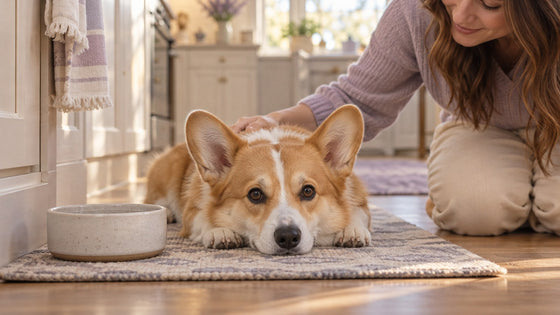
A dog struggling during a thunderstorm may be overwhelmed. Adjust the environment and training to their comfort.

What you'll see on the body
Your dog's body does a lot of the talking. Look for:
- Panting when your dog isn't hot and hasn't been exercising
- Pacing in repetitive patterns, especially along windows or doors
- Drooling more than usual, sometimes enough to soak the bedding
- Trembling that has nothing to do with cold
- Yawning when your dog isn't tired
- Whale eye, where the whites of the eyes show
- A tucked tail or lowered body posture
- Dilated pupils even in normal lighting
What you'll see in what they do
The behavior side tends to be what sends owners searching.
- Destructive behavior, such as chewing furniture, digging at doors or shredding bedding
- Indoor accidents in a house-trained dog while you're away
- Excessive barking, whining or howling, especially when alone
- Hiding under furniture, in closets or behind you
- Compulsive behaviors, such as tail chasing, flank sucking or fixating on light and shadow
- Appetite changes, either refusing food or eating to cope with stress
- Hypervigilance, with your dog constantly scanning the room
Situational or chronic
The plan depends on whether your dog's anxiety is situational or chronic.
Situational anxiety happens around specific triggers such as thunderstorms, fireworks, vet visits, car rides or unfamiliar dogs.
The episodes are intense but pass. Chronic anxiety is a steady state of worry.
It can look like separation anxiety, generalized anxiety or a noise phobia that reaches beyond single events.
Mild anxiety around a predictable event, such as the garbage truck, can often be managed at home.
Which triggers can you plan for?
Anxious dogs may react to predictable triggers. Naming them helps you choose a first step small enough to succeed.
Each trigger below has a simple starting point.
| Trigger | First step |
|---|---|
| Being left alone | Practice short absences during the day |
| Thunder or fireworks | Close blinds and play steady background sound |
| Car rides | Start with short, calm trips |
| Visitors at the door | Keep a quiet room with a bed |
For being left alone, our guide on separation anxiety in dogs walks through the same steps in more detail.
For noise, see how to help a dog that is afraid of thunderstorms and fireworks.
Does training work better than calming support?
Guidance commonly recommends gradual, reward-based practice around triggers.
Keep exposure within your dog’s comfort. AKC on dog anxiety. Merck Veterinary Manual.
The calm dog guide, training first, lays out how to sequence the steps.
What to try first at home
Before you reach for a supplement, start with behavior and the environment.
Predictability, distance from triggers, safe spaces and reward-based training are the foundation for helping a dog feel safer.
A steady routine
- Daily pattern
- Keep meals, walks, and rest predictable.
- Quiet place
- Give your dog access to a calm, familiar space.
- Training
- Use gradual, reward-based practice.
A safe space
A safe space taps into your dog's denning instinct.
It can be a crate with the door open, a gated room or a quiet corner.
Fill it with familiar bedding, toys that smell like you and soft background sound to mask noise from outside.
Keep it open all the time.
A dog who only ever meets the crate right before the thunderstorm will reasonably decide the crate means thunder.
Exercise before a known trigger
A decompression walk, some sniffing or gentle play can help some dogs settle before a trigger you can see coming.
Match the activity to your dog's age, joints, the weather and fitness.
You're after a relaxed dog, and a wiped-out one can still be a worried one.
Calming music and white noise
- Sound
- Background sound may help soften outside noise.
- Choice
- Let your dog use the quiet area they prefer.
- Observation
- Watch whether the setup helps them settle.
Pressure wraps
Pressure wraps help some dogs during predictable triggers, though not every dog enjoys being hugged by a vest.
Introduce the wrap during calm moments and keep sessions short.
Take it off if your dog freezes, pants harder, hides or tries to escape.
Pheromone diffusers
Dog-appeasing pheromone (DAP) diffusers are designed to mimic the pheromones mother dogs produce while nursing.
They may help a room feel safe and familiar.
Follow the diffuser’s directions when preparing for a known stressor.

What the vet sources say
Anxiety-like behavior has no single cause.
The safest plan starts by finding the trigger, ruling out pain or medical contributors and moving at your dog's pace.
Here is what the main veterinary sources say.
- Cornell lists destructive behavior, drooling, barking, lip licking, panting, shaking, whining and showing the whites of the eyes, and notes that anxious behavior often has another driver behind it (Cornell Riney Canine Health Center: anxious behavior).
- The Merck Veterinary Manual says to consider medical contributors, including pain, when assessing behavior problems in dogs (Merck Veterinary Manual: Behavior Problems of Dogs).
- Merck's owner guidance describes behavior modification and counterconditioning as teaching a dog other responses, with progress set by the dog's behavior (Merck Veterinary Manual: Behavior Modification in Dogs).
- AAHA names veterinarians as the primary resource for current behavior information and stresses reducing fear, anxiety and stress (AAHA canine life stage behavior guidance).
- The ASPCA describes counterconditioning and gradual alone-time practice for mild separation anxiety, and says severe cases need structured professional support (ASPCA: Separation Anxiety).
Natural supplements people ask about
- Ingredient
- Effects differ by ingredient and preparation.
- Situation
- Consider the trigger and severity of distress.
- Broader plan
- Keep routine, training, and environmental support in place.
L-Theanine
L-Theanine is an amino acid found in green tea.
It is thought to support GABA activity, part of the brain's calming signaling.
Unlike sedatives, it isn't usually linked to drowsiness, and many owners describe a more alert calm.
Ashwagandha
Ashwagandha is an adaptogenic herb with a long history in Ayurvedic medicine.
People explore it for its role in the body's stress response, including cortisol, the stress hormone that can run high in chronic stress.
The idea is to even out the stress response, and nobody is trying to muffle the dog.
Some early work suggests it may be especially supportive for dogs prone to chronic stress or noise sensitivity.
Valerian root
Valerian root contains compounds that interact with GABA receptors.
Effects depend on the ingredient, dose, and situation.
Discuss the intended use rather than assuming a natural product suits every dog.
Some early evidence suggests it may reduce startle responses and help a dog return to baseline sooner after a stressful event.
Chamomile
Chamomile is often chosen for dogs whose stress shows up as digestive upset or excessive licking.
It has a traditional use for calm and a gentle effect on the gut, which stress can disturb.
Treat it like any new ingredient and introduce it slowly.
Probiotics and the gut-brain connection
Probiotics may seem unrelated, but the gut-brain axis is an active area of research.
Researchers are exploring some Bifidobacterium and Lactobacillus strains in relation to gut-brain signaling.
The evidence in dogs is still early, so treat any probiotic as one layer of a wider plan.
Choose a clear label and keep training, a predictable routine, and trigger management in place.
When to call the vet
Self-harm and injury
Self-injury needs veterinary assessment. Head pressing against walls can signal a medical problem requiring urgent care.
Injured teeth or nails during escape attempts need veterinary attention and a safer behavior plan.
No improvement after 4 to 6 weeks
If the plan is not helping, seek reassessment. Do not wait through severe or worsening distress.
Record when episodes happen, how long they last, their intensity, and possible triggers.
Share it with your vet, because patterns are easy to miss day to day.
If calming chews, a lick mat and a pressure wrap haven't helped, change the plan instead of adding a fourth product.
Most of those tools add comfort in the moment and do little about the trigger itself.
Go back to your episode journal, work on gradual exposure to the trigger with a trainer.
Ask about a veterinary behaviorist too, and give any new routine 4 to 6 weeks while you change one thing at a time.
Many owners also ask about calming chews that didn't work for your dog, and the answer starts with dose and timing.
Sudden onset
Sudden anxiety in a dog who was calm before needs prompt veterinary attention.
It may be behavioral, such as a frightening event you didn't see, but it can also point to a medical cause.
Your vet may investigate pain, hormonal problems, neurological disease, or age-related cognitive changes.
Your vet might recommend:
- Bloodwork to check thyroid, organ function and hormone levels
- A pain assessment, especially for senior dogs or breeds prone to joint problems
- A referral to a veterinary behaviorist, a vet with additional training in behavioral medicine
- A short prescription course to break a severe anxiety cycle while behavior work continues
Asking a vet about anxiety doesn't mean giving up on natural approaches.
Your natural strategies work alongside professional insight into your dog's needs.
When to see your vet
- Refusal to eat for 24 hours or more.
- Anxiety that interferes with sleep, or with normal urination or defecation.
- Any of the self-harm, injury or sudden-onset signs described above.
Where a calming product fits
Try a new product on an ordinary day. Follow its directions and watch your dog’s response.
Check with your vet first if your dog takes an MAOI, SSRI, trazodone or other medication.
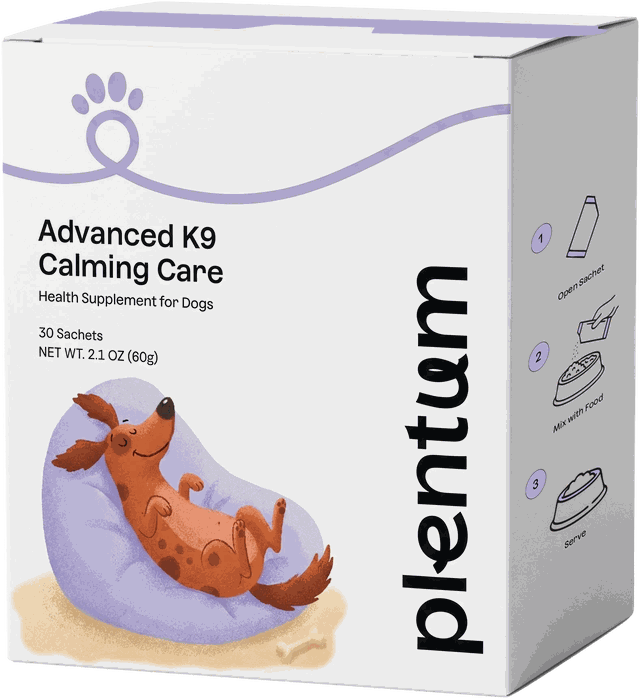
Advanced K9 Calming Care is our melatonin-free calming powder with L-theanine, GABA and three botanicals.
See calming supplements compared by dose and onset.
Frequently asked questions
How can owners calm an anxious dog naturally?
Start with a quiet resting spot and one predictable trigger. A short walk and background sound may help.
What are the first signs that a dog is anxious?
Panting, pacing, drooling, or hiding can signal stress. Look for a pattern linked to a trigger.
Are calming supplements safe for every dog?
Calming supplements are not safe for every dog. Ask your vet about age, illness, and drug interactions.
How long should a natural calming plan take to show results?
Give a consistent plan 4 to 6 weeks before you judge it.
Sources
- Cornell Riney Canine Health Center: anxious behavior
- Merck Veterinary Manual: Behavior Problems of Dogs
- Merck Veterinary Manual: Behavior Modification in Dogs
- AAHA canine life stage behavior guidance
- ASPCA: Separation Anxiety
Use these resources for general standards and background.
Diagnosis and treatment decisions require a vet who has examined your dog.