







Guide
Dog calming and gut-brain research hub
Which calming ingredients have been studied, in dogs or only in people, and what does the gut-brain research really show? This hub keeps the evidence at ingredient level and labels human-only studies clearly.
The question
Owners want to know whether a daily supplement can support a calm, relaxed dog during situational stress such as fireworks, storms or travel. A supplement can be one part of a routine. Sudden behavior changes, aggression, self-injury or distress when left alone need a veterinarian or a veterinary behavior professional, who may recommend training, environment changes or medication.
What the evidence says, ingredient by ingredient
| Ingredient | What was studied | Worth knowing | Study |
|---|---|---|---|
| Tryptophan, valerian and passionflower | In a randomized, placebo-controlled study in 44 dogs, a supplement combining the three was associated with calmer owner-rated behavior and lower cortisol around fireworks. | A three-ingredient product, so effects cannot be split by ingredient. Owner-rated outcomes; manufacturer-funded; doses differ from Plentum's. | Animals, 2024 |
| L-theanine | In a 4-week placebo-controlled crossover study in 30 healthy adults, 200 mg a day was associated with better self-rated stress and sleep scores. | Human study, supplier-funded, self-reported outcomes. No equivalent dog data cited here. | Nutrients, 2019 |
| Ashwagandha root extract | In a 60-day placebo-controlled study in 64 stressed adults, ashwagandha was associated with lower stress scores and lower cortisol. | Human study; the extract was supplied by its maker. No dog data. | Indian Journal of Psychological Medicine, 2012 |
| Probiotics and the gut-brain axis | A 2024 review of canine probiotic research describes how gut microbes interact with the host, including signalling along the gut-brain axis. | Mechanism and review evidence, not a calming outcome in dogs. | Microorganisms 12(6):1248, 2024 |
What is still unknown
- Dog studies of L-theanine, ashwagandha, GABA, magnesium and chamomile for calm behavior are few or missing.
- Whether a postbiotic or probiotic supports calm behavior in dogs has not been shown in a controlled dog study.
- How a supplement compares with behavior training and environment changes, which veterinary sources put first.
- No study has tested a Plentum formula.
How to read the label
- Check the ingredient class: a live probiotic (counted in CFU), a postbiotic (inactivated, so no CFU) or a prebiotic fiber.
- Check the amount of each active per serving and the serving by body weight.
- Look for structure and function wording ("supports", "helps maintain"), not disease promises.
- Look for a lot number and best-by date, and ask the brand for the certificate of analysis.
Where Plentum fits
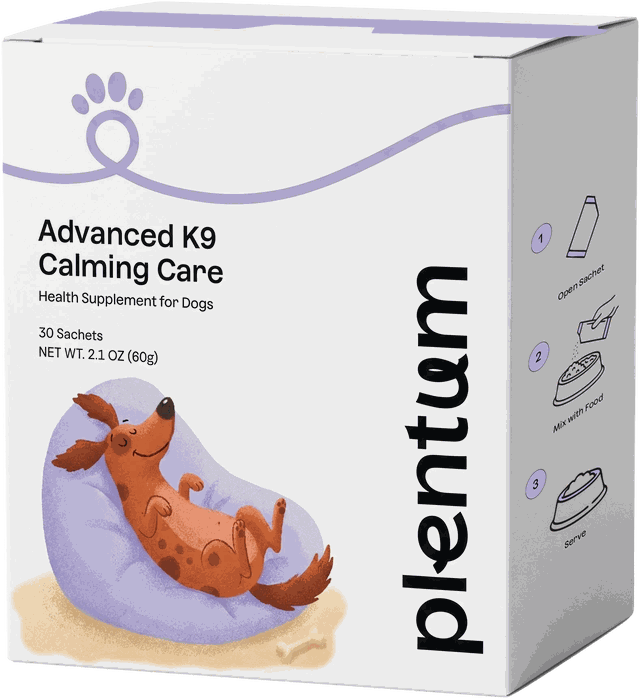
- Advanced K9 Calming Care: L-theanine, GABA, magnesium, L-tryptophan, a postbiotic, a proprietary probiotic blend yielding 10 billion CFU, chamomile, passionflower, valerian root, ashwagandha root extract and vitamin B6. Supports a calm and relaxed demeanor during situational stress.
- Compare options in calm and stress supplements.
Sources
Studies
- Tryptophan, valerian and passionflower supplement around fireworks (randomized, placebo-controlled, 44 dogs). Animals, 2024.
- L-theanine, stress and sleep in healthy adults (placebo-controlled crossover; human study). Nutrients, 2019.
- Ashwagandha root extract and stress in adults (placebo-controlled; human study). Indian Journal of Psychological Medicine, 2012.
- The function of probiotics and prebiotics on canine intestinal health and their evaluation criteria (review). Microorganisms 12(6):1248, 2024.
Veterinary and nutrition references
- Behavior problems of dogs. Merck Veterinary Manual; checked 10 Oct 2026.
- Treatment of behavior problems in animals. Merck Veterinary Manual; checked 10 Oct 2026.
- Behavior modification in dogs. Merck Veterinary Manual; checked 10 Oct 2026.
- WSAVA Global Nutrition Guidelines. WSAVA; checked 10 Oct 2026.
Studies listed here tested ingredients, not Plentum products. Where a study was funded or run by an ingredient supplier, we say so. This page is educational and does not diagnose, treat, cure or prevent any disease. Talk to your veterinarian before adding a supplement, especially if your dog takes medication, is pregnant or nursing, or has a diagnosed condition.
Last reviewed 10 October 2026. This hub brings together 2 of our earlier 2026 topic reports into one page with a single, checked source list. See all topics in the Plentum research library.
For general education only, not veterinary advice. Talk to your veterinarian if your dog has a health condition or takes medication, or if signs persist or get worse. These statements have not been evaluated by the Food and Drug Administration. Plentum products are not intended to diagnose, treat, cure, or prevent any disease.