




Can Dogs Eat Broccoli?

|March 03, 2026
Yes, dogs can eat broccoli in small amounts — nutritious but contains compounds that irritate GI in large quantities. Learn safe portions, raw vs cooked differences, and gut health benefits.
Bernese Mountain Dog looking curiously at broccoli florets on a kitchen counter


Quick Answer: Yes, dogs can eat broccoli in small amounts — raw or cooked. It is nutritious and low in calories, but it contains isothiocyanates that can cause GI irritation in large quantities. Keep portions small (under 10% of daily food intake) and introduce gradually.
Bernese Mountain Dog looking curiously at broccoli florets on a kitchen counter

Is Broccoli Safe for Dogs?

Broccoli is safe for dogs in appropriate amounts — recognized as a safe food by veterinary nutritionists and appearing in some commercial dog food formulations.

The qualification is quantity.

Broccoli contains isothiocyanates — naturally occurring chemicals that give broccoli its slightly bitter, sulfurous flavor. In small amounts, isothiocyanates have documented antioxidant and anti-cancer properties.

In larger amounts, they cause GI irritation: nausea, vomiting, gas, and diarrhea. This is why broccoli is an "in moderation" food rather than an unlimited treat.

Nutritional Benefits

Supporting visual for Can Dogs Eat Broccoli?

Vitamin C — broccoli is an exceptionally rich source, providing antioxidant protection and immune support.

Vitamin K — essential for blood clotting and bone health.

One of the best plant-based sources.

Folate (B9) — supports cell division and DNA synthesis.

Potassium — supports heart function and fluid balance.

Sulforaphane — a bioactive compound with significant antioxidant and anti-inflammatory properties.

Research suggests sulforaphane may support cellular health and detoxification pathways.

Low calorie — about 31 calories per cup of raw broccoli, excellent for weight-conscious dogs.

How to Prepare Broccoli for Dogs

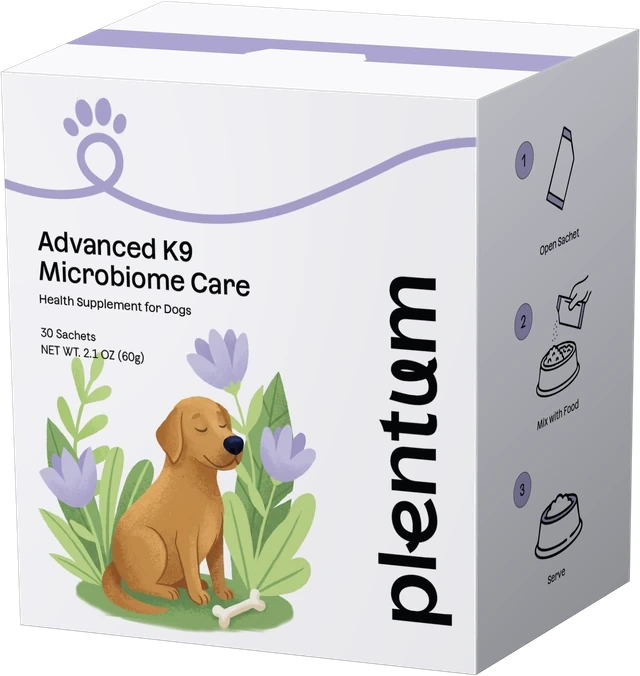
Supporting your dog's firm, healthy stools? Plentum Advanced K9 Microbiome Care is a veterinarian-formulated daily postbiotic + prebiotic sachet — combines oral-health postbiotic complex, prebiotic inulin, colostrum, and omega-3. Simply add one sachet to your dog's food.

Raw: Wash thoroughly, cut florets into small bite-sized pieces. Best for medium and large dogs without digestive sensitivity.

Lightly steamed: Optimal for most dogs. Steam 3-4 minutes until just tender.

No butter, salt, or seasoning.

Roasted plain: Develops natural sweetness without oil or seasoning. Makes broccoli more palatable for picky dogs.

Always avoid: broccoli prepared with butter, cheese sauce, garlic, salt, or any seasoning.

How Much Can Dogs Eat?

Supporting visual for Can Dogs Eat Broccoli?

No more than 10% of daily food intake.

Practical portions: small dogs — 1-2 small florets; medium dogs — 2-4 florets or about 1/4 cup chopped; large dogs — up to 1/2 cup. Start with smaller amounts and increase gradually.

If your dog develops gas or soft stools, reduce the amount.

Broccoli and the Gut Microbiome

Broccoli's fiber and polyphenolic compounds have documented effects on gut microbiome composition.

The fiber feeds beneficial bacteria; the sulforaphane and other bioactive compounds influence the gut environment in ways that promote beneficial microbial populations.

The gas-producing effect of broccoli is a sign that gut bacteria are actively fermenting the fiber — producing short-chain fatty acids that feed intestinal cells.

For ongoing gut microbiome support that helps your dog process vegetables like broccoli with fewer digestive side effects, a daily postbiotic + prebiotic sachet like Plentum's Advanced K9 Microbiome Care provides a postbiotic complex, prebiotic inulin fiber, and colostrum for daily gut and oral health support — without live probiotic cultures. Loved by 5,185+ dog parents. Read our dog gut health guide.

Frequently Asked Questions

How much broccoli can I give my dog?

Broccoli should make up no more than 10% of your dog's daily food intake. Small dogs (under 25 lbs): 1-2 small florets. Medium dogs (25-50 lbs): 2-4 florets. Large dogs (50+ lbs): up to half a cup chopped.

Start even smaller when first introducing broccoli.

Can dogs eat broccoli stems?

Yes, but stems are tougher and harder to digest than florets, and a potential choking hazard if given as large pieces.

If sharing stems, cook them until soft and cut into small pieces. Raw stems are best avoided for smaller dogs.

Is raw or cooked broccoli better for dogs?

Both are safe in appropriate amounts. Raw retains more vitamin C but is harder to digest. Lightly steamed broccoli is easier on the digestive system and nutrients remain largely intact.

Avoid extended boiling, which significantly reduces water-soluble vitamins.

Why does my dog get gassy after eating broccoli?

Broccoli contains sulfur compounds and fiber that some dogs' gut bacteria ferment into gas.

This is more pronounced in dogs with less microbial diversity. Start with very small amounts and increase gradually to allow the microbiome to adapt.

Can puppies eat broccoli?

Yes, in very small amounts of lightly steamed broccoli. Start with one small floret and monitor for digestive reaction.

Puppies' digestive systems are more sensitive, and the gas-producing compounds in broccoli may cause more discomfort in younger dogs.

This article is for educational purposes only.

Consult your veterinarian if your dog has specific dietary needs or health conditions.

Support your dog's health with Advanced K9 Microbiome Care — the postbiotic supplement trusted by 5,185+ dog parents. One sachet a day.

Ready to support your dog's firm, healthy stools?

Plentum Advanced K9 Microbiome Care is a veterinarian-formulated daily postbiotic + prebiotic sachet — combines oral-health postbiotic complex, prebiotic inulin, colostrum, and omega-3. Simply add one sachet to your dog's food.

Try Plentum Advanced K9 Microbiome Care →

What's one thing you noticed about your dog this week? Drop it in the comments.

For the broader digestive-support overview, compare this with the best probiotic for dogs guide.

For food and routine context, see gut-healthy foods for dogs.

These statements have not been evaluated by the Food and Drug Administration. This product is not intended to diagnose, treat, cure, or prevent any disease.

Regulatory Notice These statements have not been evaluated by the Food and Drug Administration. This product is not intended to diagnose, treat, cure, or prevent any disease.

Leave a comment

Please note, comments need to be approved before they are published.

Read Plentum in Google more often

If Plentum is one of the dog wellness sources you trust, you can add us as a Google Preferred Source. Google may then highlight Plentum in your own Search, AI Overviews, and AI Mode results when our content is relevant.

Add Plentum as a preferred source

More on Guidance

Plentum dog wellness image Plentum dog wellness image

One Sachet,

Endless Health Benefits

shop now