









Free tool · Healthy weight
Dog calorie calculator and body condition chart
Work out a starting daily calorie range for your dog, then check their shape against the 9-point body condition scale.
Your result appears here. Enter today's weight and pick a life stage and activity level.
Daily calorie range
0 to 0 kcal a day
- Resting energy (RER)
- 0 kcal
- Life-stage factor
- 1.6
- Weight used
- 0
Weight-management starting range: 0 to 0 kcal a day. This is the resting energy at the ideal weight, up to 10% more. Move toward it in steps, weigh every two weeks and let your vet set the pace.
Your ideal weight is above today's weight. The range above is built on the ideal weight. Ask your vet first, since a lean dog may have a reason.
Puppies grow fast, so we use today's weight and recheck it every two weeks. Follow your vet's growth plan.
A starting estimate. Confirm with your vet. Every dog is different, and illness, medicines and breed change what a dog needs.
Body condition
The 9-point body condition chart
Vets score dogs from 1 to 9. A score of 4 or 5 is the goal. Find the card that sounds most like your dog, from above and from the side.
-
Score 1: Very thin
Ribs, spine and hip bones are easy to see from a distance. Little or no fat. Ask your vet soon.
-
Score 2: Very thin
Ribs and spine are easy to see. Almost no fat you can feel. Muscle loss may show.
-
Score 3: Thin
Ribs are easy to feel and may show. A clear waist and a deep belly tuck.
-
Score 4: Lean
Ribs are easy to feel with a thin cover. The waist is clear from above and the belly tucks up.
-
Score 5: Ideal
Ribs feel like the back of your hand, with a thin cover. A waist behind the ribs and a gentle tuck.
-
Score 6: A little above ideal
Ribs can be felt with a light press. The waist is there but soft. The tuck is fading.
-
Score 7: Above ideal
Ribs are hard to feel under fat. The waist is barely there and the tuck is almost gone.
-
Score 8: Well above ideal
Ribs can't be felt under thick fat. No waist. The belly hangs or rounds out.
-
Score 9: Far above ideal
Heavy fat over the ribs, back and tail base. No waist or tuck. Time for a vet plan.
-
Ribs
Run your hands along the sides. You should feel them without pressing.
-
Waist
From above, your dog should narrow behind the ribs.
-
Tummy tuck
From the side, the belly line should rise toward the back legs.
What to do with the number
Turn the range into a daily portion
-
Weigh the food
Check the kcal on the food label and weigh each meal on a kitchen scale. Cups vary a lot.
-
Keep treats to 10% or less
Treats and chews count. Take them out of the daily total.
-
Recheck every 2 weeks
Weigh your dog, feel the ribs and adjust by about 10% at a time.
Beside portion control
Metabolic Care supports a healthy weight
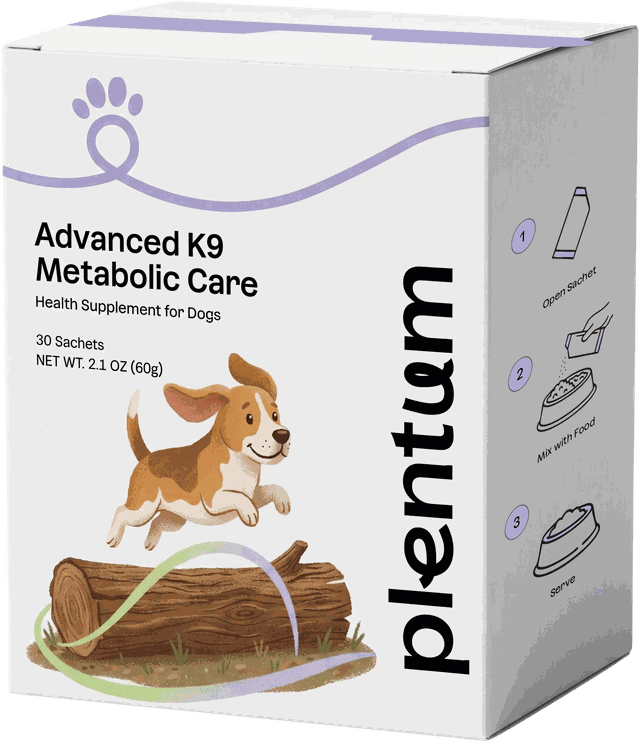
A daily powder that sits alongside portion control and exercise. It has acacia and chia fiber, a probiotic and postbiotic, and L-carnitine with white kidney bean extract to support healthy weight management.
Contains chitosan (shellfish). Skip it for shellfish-sensitive dogs.
How the calculator works
Resting energy, RER = 70 × (weight in kg)0.75, is the energy a resting dog needs. We multiply it by a life-stage factor and an activity band.
| Life stage | Factor × RER |
|---|---|
| Puppy, under 4 months | 3.0 |
| Puppy, 4 to 12 months | 2.0 |
| Adult, neutered | 1.6 |
| Adult, intact | 1.8 |
| Senior | 1.4 |
| Weight management (at ideal weight) | 1.0 to 1.1 |
Activity bands: low × 0.85 to 1.0, moderate × 0.95 to 1.1, high × 1.1 to 1.3. Results are rounded to the nearest 5 kcal.
Sources: WSAVA Global Nutrition Guidelines · AAHA Nutrition and Weight Management Guidelines.
Common questions
How many calories does my dog need a day?
It depends on weight, life stage and activity. Most adult neutered dogs land near 1.6 times their resting energy. This calculator gives a starting range, so confirm it with your vet.
What is RER?
RER is resting energy requirement, the energy a resting dog needs. It is 70 times body weight in kg to the power of 0.75.
What body condition score should my dog have?
A score of 4 or 5 out of 9 is the goal for most dogs. You should feel the ribs easily, see a waist from above and a belly tuck from the side.
Can a supplement make my dog lose weight?
No. Healthy weight comes from portion control, exercise and your vet's plan. Metabolic Care is a supplement that supports a healthy weight alongside that routine.
How often should I check my dog's weight?
Every two weeks while you change portions, then monthly. Feel the ribs each time, since the scale doesn't show shape.