






Maybe your vet said "a little round" at the last checkup, or you ran your hands down your dog's sides and couldn't find the ribs. Either way, the plan has three parts: a calorie target based on what your dog actually needs, daily movement that suits their breed and age, and a gut that digests food the same way from day to day. Cutting portions is the obvious part, but the calorie density of the food and how well your dog absorbs it matter too.
Why weight matters more than it looks
Extra weight is one of the most common health problems vets see in dogs. See where it hits hardest.
- Joints: Every extra pound adds load. Dogs with hip or elbow dysplasia or early arthritis do noticeably worse when overweight.
- Metabolism: Body fat is active tissue. It sends out inflammatory signals and can change how the body handles insulin.
- Lifespan: In a lifelong study of Labrador Retrievers, dogs fed to stay lean lived longer than matched dogs that were fed more (Kealy et al., 2002).
- Breathing and heat: Flat-faced dogs (bulldogs, pugs, French bulldogs) feel it most, because extra weight adds to airways that are already narrow.

Step 1: Check your dog's body condition
A number on the scale doesn't say whether your dog is carrying fat or muscle. Vets use the Body Condition Score (BCS), a 9-point scale based on how much fat you can see and feel at a few spots. You can try it at home with our body condition score guide.
Start with the ribs. With light pressure you should feel each one under a thin layer of fat; if you have to press hard, your dog is likely overweight, and if you can see them from across the room, your dog is underweight. Then look from above for a waist behind the rib cage. Finally, check from the side: the belly should tuck up toward the back legs, and a flat or hanging belly points to extra weight.
A BCS of 4–5 out of 9 is ideal, 6–7 is overweight, and 8–9 is well overweight.

Step 2: Get the calories right
The feeding guide on the bag is written for an average adult dog with average activity. It doesn't account for your dog's metabolism, age, breed, or spay/neuter status (which typically lowers calorie needs by 20–25%). For a dog on a weight plan, those differences add up.
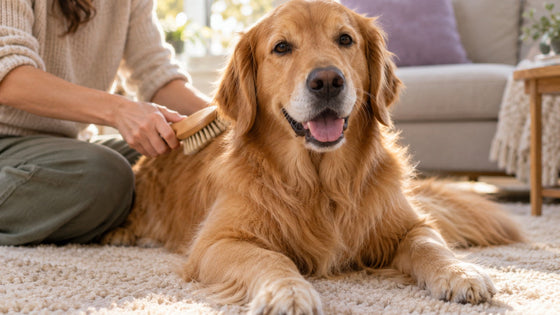
If your Golden got overweight after being neutered, you're seeing a common pattern. After spay or neuter, hormones shift, calorie needs drop by roughly 20 to 25%, and many dogs ask for more food at the same time. The same bowl that kept her lean now supplies a surplus, and Goldens are famously food motivated.
So recalculate the target with your vet, weigh every meal, count treats inside the daily total, and keep activity steady. Then check body condition every few weeks, because the target changes as the weight comes off.

Working out a target
Veterinary nutrition starts from the Resting Energy Requirement (RER):
- RER = 70 × (body weight in kg)^0.75
- For a weight plan, your vet sets the daily calories, starting from your dog's RER
- Set the pace with your vet; if the weight trend changes or stops, review portions and activity together before adjusting the daily calorie allowance
Your vet or a veterinary nutritionist can work this out exactly. For a home estimate, try an online calculator such as the one from the Ohio State University Veterinary Medical Center.
Weigh the food
That scoop you fill every morning is a rough guess, and cups vary a lot from scoop to scoop. Put the bowl on a kitchen scale and use the grams-per-day amount for your target weight. If you only change one thing, make it this.
Count treats and extras
Training rewards and a spoonful of wet food on top add up faster than you'd expect. Keep treats to no more than 10% of daily calories and take them out of the daily food amount. Small pieces of plain cooked chicken, carrot sticks or blueberries are low-calorie options most dogs tolerate well.
Step 3: Add regular movement
A longer walk won't cancel out an extra scoop of kibble. In dogs, the change in food does most of the work; exercise backs it up and adds metabolic and behavioral benefits food changes can't.
What exercise works?
Steady, moderate activity does more for fat metabolism than short, intense bursts. For most breeds, a leash walk of 30–45 minutes at a pace that keeps your dog moving is a good place to start, which means fewer stops to sniff every 10 steps. Swimming is a good option for dogs with joint problems.
Breed and physical limits
A dog carrying a lot of extra weight on sore joints shouldn't start with an hour of running. Start with comfortable daily walks and add a few minutes every week or two as the weight comes off. Flat-faced dogs do better with shorter sessions in cool weather because of their breathing.
Step 4: Gut health and weight
The link between the gut microbiome and body weight is an active research area in human and veterinary medicine. For dogs, here is what the evidence supports so far.
Lean and heavier dogs have been found to carry different gut bacteria, though which causes which is still debated. The bacteria also make short-chain fatty acids (SCFAs) that influence appetite signals, fat storage and inflammation, so a balanced microbiome may support better metabolic outcomes. And a dog with gut dysbiosis or ongoing inflammation may absorb food less predictably, which makes calorie planning harder.
For dogs on fewer calories, gut support through a prebiotic-enriched food, a probiotic supplement or both (a synbiotic) is increasingly discussed. The evidence is growing but not yet definitive.
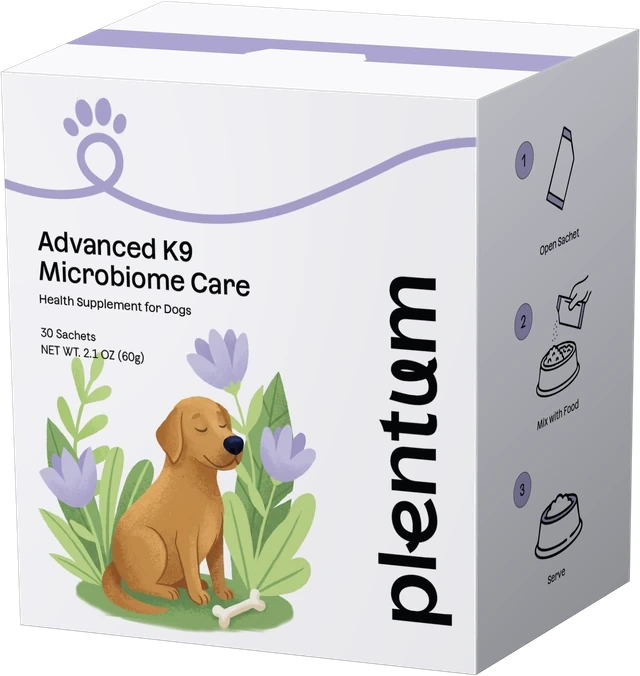
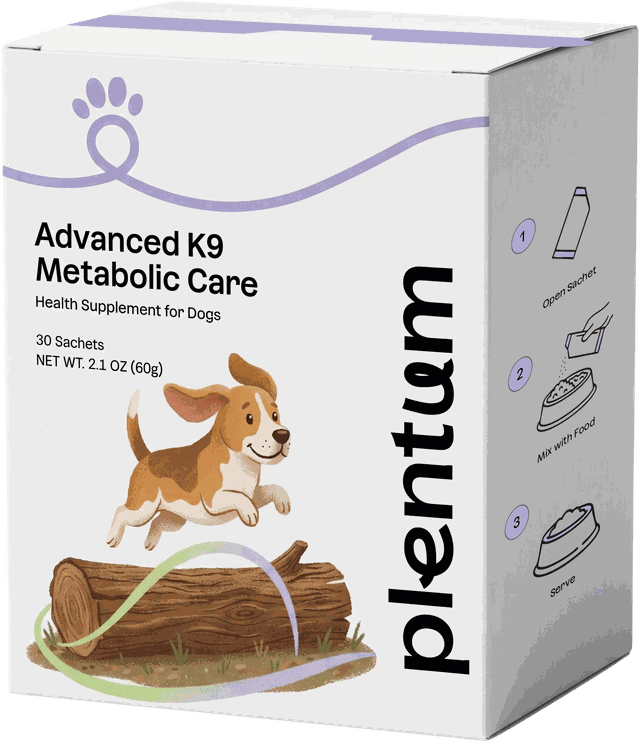
Advanced K9 Metabolic Care adds L-carnitine, acacia and chia fiber, white kidney bean extract and a probiotic blend to support healthy weight alongside portion control; it contains chitosan from shellfish.
Sizes and prices are in the healthy weight collection.
Step 5: Track and adjust
Around week 4 or 5 the scale often stalls, because a dog's metabolism slows on fewer calories. That's when the target gets adjusted.
If you weigh out every meal and your Lab still isn't losing, look for the calories you're not counting. Treats, dental chews, a lick of the plate and food from other family members can add more than you'd expect. Check the scale, and recalculate the target at your dog's current weight. Labs have a reputation for a strong food drive, and research has linked a gene variant in many of them to stronger food motivation, so a little extra effort pays off.
Weigh monthly at minimum, on the same scale at the same time of day. For a small dog, weigh yourself holding the dog, then alone, and subtract. Let your vet set the pace and the calorie target.
A fast drop on the scale can mean your dog is losing muscle too, so check in with your vet. As your dog gets lighter, ask your vet to recheck the numbers, since a lighter dog has a lower RER.
What is different for beagles?
Breed raises the risk, so the plan should start early.
The table lists the breed facts that change what you do.
| Fact | How it changes what you do | Source |
|---|---|---|
| Beagle overweight odds: 2.67 times those of crossbreds | Agree on regular weigh-ins with your vet | Pegram 2021 |
| Beagles are named as a priority breed for overweight prevention | Set portions early, before extra weight appears | Pegram 2021 |
| Neutering was linked to higher odds of overweight status | Recheck portions after neutering | Pegram 2021 |
Sources:
What is different for golden retrievers?
Breed and thyroid health both shape the plan.
The table lists the facts that change what you do.
| Fact | How it changes what you do | Source |
|---|---|---|
| Golden Retriever overweight odds: 2.58 times those of crossbreds | Agree on regular weight checks with your vet | Pegram 2021 |
| Golden Retrievers are named among the high-risk breeds for hypothyroidism | Check the thyroid if weight rises on an unchanged diet | AKC hypothyroidism |
| Weight gain without appetite change is a common hypothyroid sign | Log food and weight together to spot the pattern | AKC hypothyroidism |
Sources:
What is different for pugs?
Breed and face shape both change the plan.
The table lists the facts that change what you do each week.
| Fact | How it changes what you do | Source |
|---|---|---|
| Pug overweight odds: 3.12 times those of crossbreds | Agree on regular weight checks with your vet | Pegram 2021 |
| Pugs are named as a priority breed for overweight prevention | Set portions early, before extra weight appears | Pegram 2021 |
| Excess weight adds stress to the breathing of flat-faced dogs | Keep your pug lean, and check its weight at every visit | VCA airway |
| Flat-faced breathing is often worse in hot or humid weather | Plan walks for cool hours and avoid heat | VCA airway |
Sources:
Why does weight matter more for large-breed puppies and adults?
Large and giant breeds need fewer calories per pound than smaller dogs.
Merck: osteochondrosis is a developmental disorder of fast-growing medium and large dogs.
Excessive nutrition and rapid growth are suspected contributing factors.
The exact cause is unknown.
VCA warns that overfeeding can cause orthopedic problems even on an appropriate diet.
A puppy kept lean grows at a steadier rate.
The AKC lists large and giant breeds among the dogs at higher risk for osteoarthritis.
Examples are German Shepherd Dogs, Labrador Retrievers, and Golden Retrievers.
Obesity, age, repetitive stress from sports, and injuries add to that risk.
See your vet for limping in a growing puppy, joint swelling, or muscle loss in the legs.
Sources: Merck Veterinary Manual, VCA, and AKC.
Can extra weight affect a small dog's heart?
A study looked at healthy small-breed dogs under 25 pounds.
Obese dogs had changes in heart structure and function versus ideal-weight dogs.
It was observational, so it shows an association, not that obesity caused the changes.
Its authors said extra weight may add to heart disease in dogs with valve disease.
Small breeds have a high prevalence of degenerative valve disease.
Report coughing, fainting, or less stamina on walks when you discuss weight with your vet.
Symptoms and exam findings guide any further heart tests.
Source: Cardiac and metabolic variables in obese dogs, J Vet Intern Med, 2017.
The 12-week plan
| Weeks | What to do | Check |
|---|---|---|
| Week 0 | Vet visit: weight, body condition score, target weight, and daily calories. Rule out medical causes. | Starting weight and score |
| Weeks 1–4 | Weigh every meal on a kitchen scale. Count treats inside the daily total. Add one extra short walk or play session. | Weigh in every 2 weeks |
| Weeks 5–8 | Add puzzle feeders for slower meals. | Weigh in every 2 weeks |
| Weeks 9–12 | Recheck body condition with your vet. Set the next target or move to a maintenance amount. | Score and waist check |
Body condition score chart
| Score (1–9) | What you see and feel |
|---|---|
| 1–3 Too thin | Ribs, spine and hip bones easy to see |
| 4–5 Ideal | Ribs easy to feel, waist visible from above, tummy tuck |
| 6–7 Overweight | Ribs hard to feel, waist barely visible |
| 8–9 Well overweight | Ribs can't be felt under fat, no waist, sagging belly |
Step-by-step photos are in our body condition score guide. For why fiber helps dogs feel full, see fiber and satiety in dogs; for older dogs, the senior weight guide.
Where Advanced K9 Metabolic Care fits
Food and movement do the heavy lifting, so a supplement comes last, once the plan is running. Metabolic Care pairs acacia and chia fiber with L-carnitine, white kidney bean extract, and probiotics. It supports healthy body condition alongside a vet-guided feeding plan.
Compare options in healthy weight.
Our weight, metabolic and mobility research hub sums up what published studies say about weight, metabolic and mobility ingredients.
Use the dog calorie calculator to get a starting daily calorie range, then check your dog's shape on the 9-point body condition chart.
Sources and further reading
- FDA: Animal Food Labeling and Pet Food Claims
- AAHA Canine Life Stage Guidelines
- WSAVA Body Condition Score chart (dogs and cats), hosted by Ohio State Veterinary Medical Center
- Body Condition Scores - VCA Animal Hospitals
- Obesity in Dogs - VCA Animal Hospitals
- Body Condition Scoring for Pets - Association for Pet Obesity Prevention
- Nutritional Requirements of Small Animals - Merck Veterinary Manual
Use these resources for general standards and background. Individual symptoms, diagnoses, medications, and treatment decisions require a veterinarian who has examined your dog.
Related reading
Our portion control guide explains how much food a dog actually needs each day.
Frequently asked questions
When should I see my vet about an overweight dog with stiff joints?
If your dog is stiff after rest, slow on stairs or reluctant to walk, see your vet before starting a weight plan. Extra weight and joint discomfort often go together, and your vet can set a safe exercise level.
Do treats count in a weight plan?
Yes, count them toward the daily calories, use small pieces, and swap some for praise or play.
How quickly should a healthy-weight plan move?
Your vet sets the pace for your dog.
Can I just walk my dog more instead of cutting food?
Walks help, but they can't cancel out extra calories. The change in food does most of the work.
What else can I do to support him besides feeding less?
Food comes first, but several habits back it up. Add steady daily walks or swimming, use a puzzle feeder to slow meals, swap some treats for part of the daily kibble or a few low-calorie vegetables, and weigh in on the same scale each month.
What should I ask my vet about tracking progress on a weight plan?
Ask for a target weight and body condition score, how often to weigh in, how fast is safe for your dog, and what to change if progress stalls.
How do I find my dog's healthy target weight?
Your vet team finds your dog's target weight by combining body condition score with current weight.
Breed weight ranges don't account for your individual dog, so body condition score and your vet's judgment come first.
Have both measurements recorded together, so the target reflects your dog as an individual.
When considering supplements as a small part of your dog's plan, review what the evidence says about weight supplements.
How many calories does my dog need each day?
For a healthy dog at maintenance, the estimate combines resting energy needs with a factor for age and neuter status.
For a dog on a weight plan, your vet sets the daily target.
It isn't a fixed allowance: your dog's weight and body condition show whether it needs adjusting. Ask your vet for the final daily calorie number.
Does spaying or neutering change a dog's weight and calorie needs?
Yes, and a large study found a higher risk of becoming overweight during the first two years after surgery.
The age at surgery didn't change that risk. Use post-surgery checkups to review portions with your vet, since calorie needs are often lower.
How can a dog lose weight without losing muscle?
A veterinary weight plan with enough protein supports your dog's muscle while calories are reduced.
Losing weight too quickly can mean losing muscle, so your vet sets the pace and decides when exercise can increase.
If you're considering a supplement, check what is in a weight-support supplement.
Which weight question should you start with?
Two questions come up most. Pick the guide that matches yours, then return here for the daily routine.
| If you are asking | Read this guide |
|---|---|
| Is my dog carrying extra weight? | Is my dog overweight? Body condition score |
| How much food should I measure? | How much should I feed my dog |
Build a simple weekly check-in
A short weekly check keeps changes visible without daily worry. Use the same spot, the same scale, and the same time of day, so your readings stay comparable.
- Feel the ribs and note any change
- Check the waist from above
- Review portions and total daily chews
- Log minutes of walking or play