






Predictable meals, walks, and rest can help your dog settle.
Start with the parts of the day that trigger pacing.
Knowing when meals, walks, and naps happen gives your dog less to monitor.
Here's a daily structure that helps, and where gut support fits.
Three points on routines for a calm dog:
- A calm dog routine is built from predictable meals, walks, rest, enrichment and sleep.
- Feed at the same times, and avoid free-feeding so that meals anchor the day.
- Two structured walks a day, with time to sniff, give most dogs a clear rhythm.
Why do predictable routines help dogs settle?
Dogs get tense about the unknown. When's dinner? When's the person leaving? When's the walk?
Each open question adds a little tension, and over days and weeks it builds.
A consistent schedule answers those questions.
Your dog can relax between events instead of staying on alert.
Many trainers and behavior pros count it among the simplest tools for a calmer dog.
Day to day, knowing the walk comes after breakfast gives your dog something to count on.
Over months, a steady schedule often makes a dog easier to settle and less jumpy about everyday surprises.

How can meal times anchor your dog’s routine?
Meals are the easiest part of the day to pin down.
The gut and brain talk to each other constantly, a link often called the gut-brain axis.
Regular meals may help that back-and-forth stay steady.
When meal times jump around, digestion does too, and that can show up in behavior.
Most adult dogs do well on two meals a day at fixed times.
Puppies and senior dogs may do better with three smaller meals.
Aim for the same 30-minute window each day.
Feeding tips
- Feed at the same clock times every day, weekends included.
- Skip free-feeding.A bowl that's always full means there's no mealtime to count on.
- Plan 20-40 minutes of quiet time after a meal before any vigorous activity.That matters most for large, deep-chested dogs.
- If you change your dog's food, switch gradually over 7-10 days.An upset stomach can become a stressor of its own.How to Switch Dog Food Without Diarrhea: 10-Day Transition Guide.
- If your vet has recommended a gut-support supplement, give it with the same meal each day, without skipping or doubling up.
Two walks a day, with time to sniff
Walks give your dog smells, sights and a bit of social time on top of burning energy.
Keep walks at roughly the same time each day.
A predictable routine can help your dog relax while waiting.
Aim for at least two a day.
- The morning walk works off overnight energy.A dog who gets a proper one is often easier to settle during the day.
- The evening walk lets your dog take in the day's smells and starts the wind-down toward bed.
Let your dog set the pace and follow their nose on a 20-minute walk.
This can be more settling than 45 brisk minutes at your pace.
Give your dog time to sniff on every walk.
Many dogs slow down when they can explore scents.
Don't shortchange sleep
Adult dogs sleep 12-14 hours a day. Senior dogs may need 16-18.
That surprises a lot of owners, but a dog who's always short on rest can be quick to react.
Quality and timing count as much as total hours.
Dogs do better on a regular sleep-wake schedule.
Late-night activity, irregular wake-ups, and random noise can disrupt sleep.
Set up a good rest spot
- Pick a rest space your dog can always get to, such as a crate, an orthopedic bed or a quiet corner, in a low-traffic part of the house.
- Use a consistent "settle" cue for rest, and practice it daily.
- Turn down screens, loud music and doorbells in the hour before bedtime.
- Keep the room at a moderate temperature.A dog who's too warm, especially a thick-coated breed, may sleep in fits and starts.
- Keep it dark or dim.Blackout curtains help if the room gets irregular light.
- Sudden noises disrupt sleep more than steady background sound, so a fan or white noise machine can help, especially in a city.
- A familiar-smelling blanket or a shirt you've worn can be settling, especially for dogs who sleep apart from their people.
- Many dogs sleep most soundly in an enclosed space, such as a covered crate or a corner bed with raised sides.
Plenty of owners focus on exercise and enrichment and skimp on rest.
If your dog seems wound up despite good exercise, look at sleep first.
Enrichment that settles
Mental work and physical exercise aren't the same thing, and your dog needs both.
You're after the kind of brain work that leaves your dog pleasantly tired, not revved up.
- Sniff work, like nose games and scatter feeding, is often calming.It's best in the morning or before rest.
- Food puzzles and slow feeders turn mealtime into mental work.They help dogs who eat too fast or need extra settling after meals.
- Chewing is a natural outlet.A long-lasting chew at a consistent time, often mid-afternoon, can lead into a rest period.
- Short 5-10 minute training sessions with rewards keep the brain busy without getting your dog too excited.Keep them away from meal times.
- Calm, predictable time with familiar dogs or people gives your dog company without surprises.
Avoid high-energy play right before meals or bedtime.
Schedule enrichment for mid-morning and mid-afternoon, with rest and meals on either side.
Teaching your dog to wind down
Some dogs need practice moving from activity to rest. Give them regular opportunities to settle.
You can teach it.
A settle mat by the door gives your dog a familiar place to pause.
Practice the same settling routine there.
- After a vigorous walk, give your dog 5-10 minutes of sniffing in a quiet spot before heading inside.
- Sit quietly with your dog, with no commands and no play, and let them settle on their own.Reward calm lying down with quiet praise or a slow, gentle stroke.
- Teach a solid "go to your mat" cue.It gives your dog a place to settle anywhere, and you can build up the time on the mat day by day.
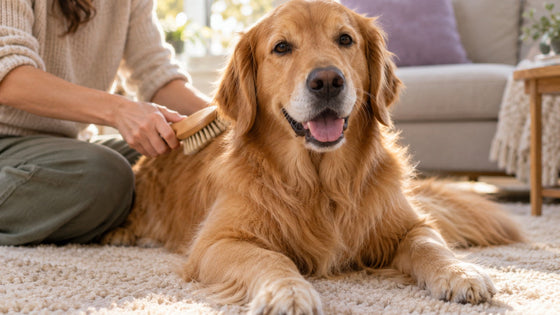
- Light, slow stroking along the spine, especially in the evening, settles many dogs.Stop if your dog seems uncomfortable.
- Build a predictable 30-minute bedtime routine: last walk, a little sniff time, last meal or dental chew, then quiet.Dogs learn the order quickly and start to unwind as soon as it begins.
A sample day
Use this as a starting point and shift the times to fit your household.
Sticking to the same order every day matters far more than the exact hours.
| Time | Activity | Why it helps |
|---|---|---|
| 7:00 AM | Sniff walk, 20–30 min | Energy, then rest |
| 7:30 AM | Meal; supplement if advised | Keep a daily time |
| 8:00 AM | Quiet rest, 20–30 min | Feed, then rest |
| 10:00 AM | Sniff game/puzzle, 10–15 min | Calm brain work |
| 12:00 PM | Nap in usual spot | Daily sleep |
| 3:00 PM | Chew/training, 10 min | Brain work |
| 5:30 PM | Walk, 20–30 min | Evening wind-down |
| 6:00 PM | Evening meal | Regular digestion |
| 7:00 PM | Quiet family time | Calm company |
| 9:00 PM | Potty break | Fewer wake-ups |
| 9:30 PM | Usual bedtime and rest spot | Dark, quiet room |
Where supplements fit
The gut-brain axis is a two-way pathway between digestion and the brain.
It involves the vagus nerve, immune signals, and compounds made by gut bacteria.
Researchers are still working out how much gut health shapes behavior in dogs.
It's one factor among many. A supplement can be one addition to a calm routine.
Meals, walks, enrichment and sleep do the heavy lifting, and no supplement makes up for a chaotic schedule.
If your vet suggests a supplement, give it at the same meal daily.
Record changes so you can assess it.
If you are comparing daily support options, see our guide to the best calming supplement for dogs.
Ask your vet if your dog has a health condition or takes medication.
Frequently asked questions
How many meals a day is best for a calm dog?
Two meals at fixed times works well for most adult dogs, and puppies and seniors may do better with three smaller ones.
Aim for the same 30-minute window each day and skip free-feeding.
Do I have to keep the same schedule on weekends?
For meals, yes: feed at the same clock times every day.
The rest can flex a little, since keeping the same order matters more than hitting exact hours.
Is it normal for my dog to sleep most of the day?
Yes.
Adult dogs commonly sleep 12-14 hours a day, and seniors may need 16-18 hours, so a lot of napping is normal.
A sudden change in how much your dog sleeps is worth mentioning to your vet.
What should I track while I change my dog's routine?
Track the one change you made, plus appetite, stool, sleep, energy and any restlessness.
A dated record helps you and your vet see trends instead of reacting to single days.
Change one thing at a time so you can tell what made the difference.