







Science / How it works
How it works
One sachet. A whole gut ecosystem.
Follow a 2 g sachet from the bowl to the gut, and see how gut, skin, brain and mouth are linked. Then dosing by weight, and twelve weeks of notes.
- 2 gone sachet
- 1-4sachets a day, by weight
- 12weeks to track
One sachet
From the bowl to the gut ecosystem.
A walk through what happens, in plain language. Tap a step, or let it play.
- Tear one sachet.
Each 2 g sachet is pre-measured. No scoop, no guessing. Dogs take 1 to 4 a day, by weight.
- Pour it over food.
Sprinkle it on your dog's usual meal. Stir in a splash of warm water or wet food if you like.
- It meets the gut ecosystem.
Prebiotic fibres feed the bacteria already there. Probiotic strains, in the four targeted formulas, add live microbes. Postbiotics are non-living microbial material that researchers study for how it interacts with the gut lining and immune cells.
- Gut, skin, brain and mouth are linked.
The gut is in constant conversation with the immune system, the nerves and the rest of the body. Each formula is built to support one area of wellbeing.
Three kinds of support
Feed. Add. Signal.
Pre-, pro- and postbiotics do different jobs. Here is what each one is, in plain words, and where it appears in our range.
Prebiotics feed what is already there.
They are not alive. Prebiotics are fibres that beneficial gut bacteria use as food. Dogs do not digest them well themselves, so they reach the large intestine, where resident bacteria ferment them.
A substrate that gut microbes use selectively, giving the host a health benefit.Definition from the ISAPP consensus statement, 2017 · PubMed
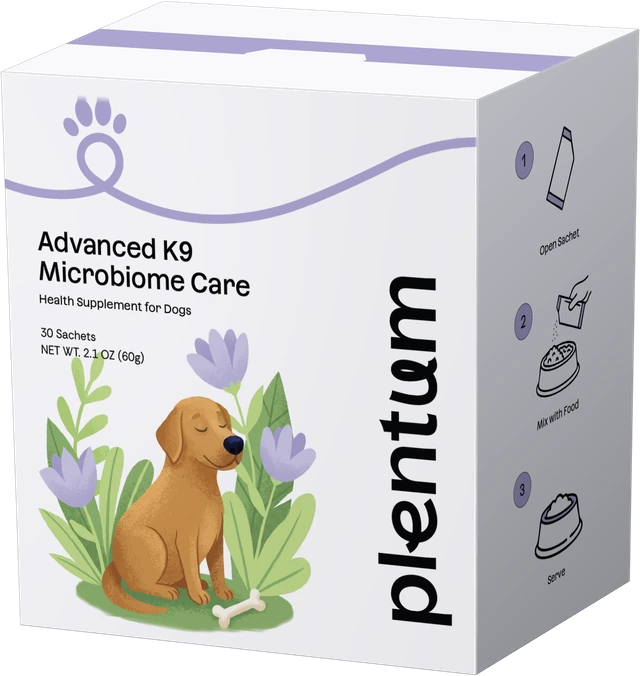
In Plentum: inulin in Microbiome Care and Gut Restore, plus fibres such as psyllium, acacia and chia that add bulk and support normal stools.
What we saySupports the beneficial bacteria already in the gut, and normal bowel function.
What we do not sayThat a prebiotic adds new microbes. It does not. That is what a probiotic does.
Probiotics add live microbes.
They are living microorganisms. What they do depends on the strain and the amount, so a general "probiotic" label tells you little. Look for named strains and a CFU count on the label.
Live microorganisms that, given in adequate amounts, give the host a health benefit.Definition from the ISAPP consensus statement, 2014 · PubMed
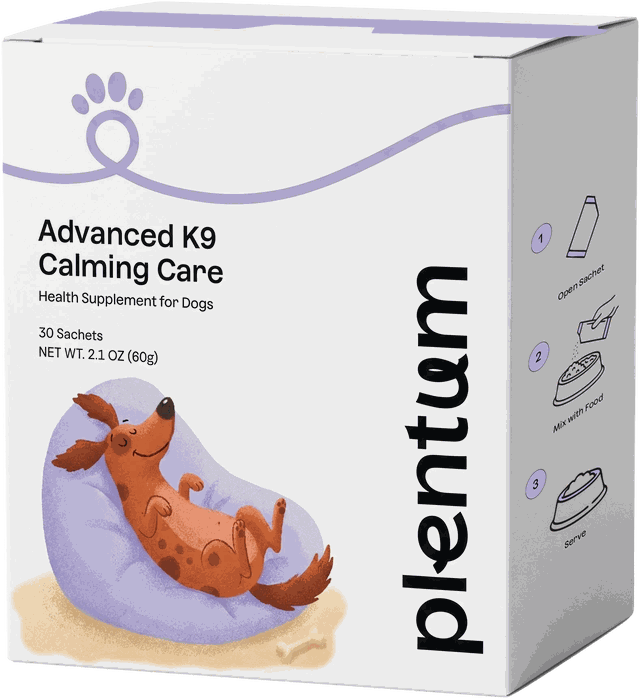
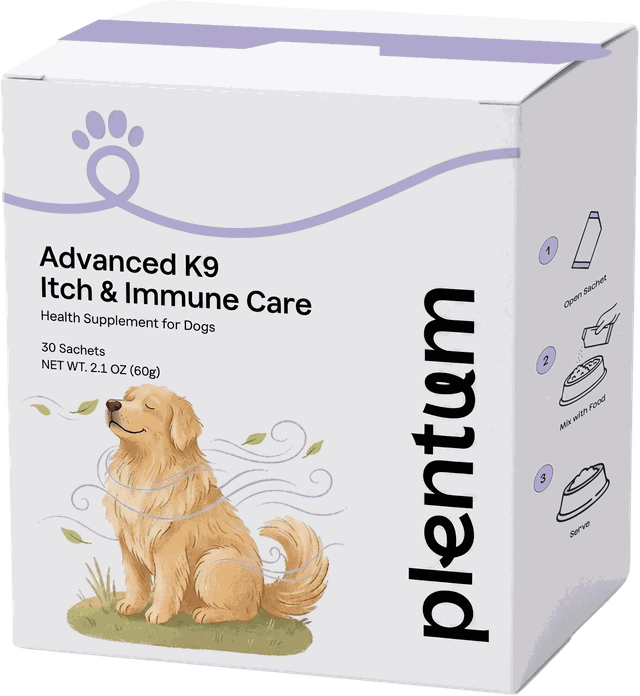
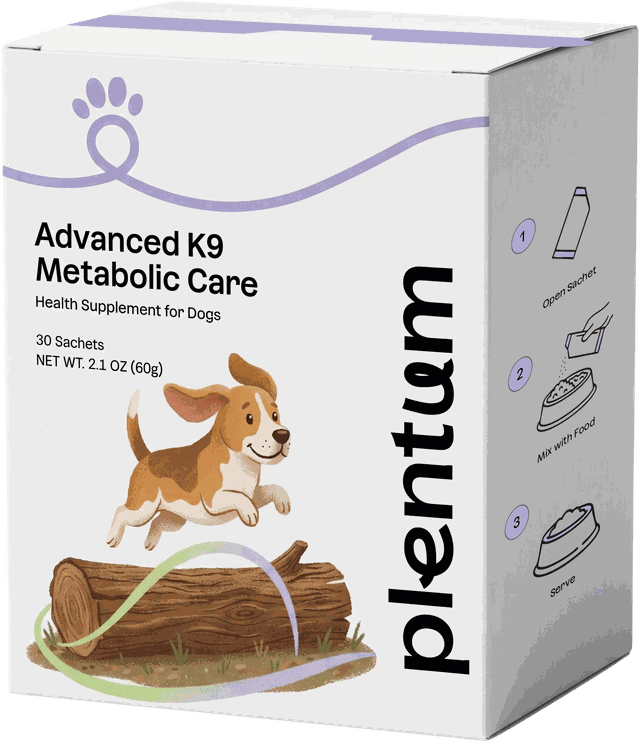
In Plentum: Plentum's proprietary Heritage Probiotic Blend of named canine strains in Gut Restore (plus S. boulardii) and Itch & Immune Care, a three-strain blend (L. reuteri, L. helveticus, B. longum) in Calming Care, and a Bifidobacterium and Lactobacillus blend in Metabolic Care. Microbiome Care contains no live cultures.
What we sayHelps maintain a balanced gut flora. Named strains and CFU are printed on the label of each formula that has them.
What we do not sayThat probiotics are a remedy for digestive upset, or that any one strain works for every dog. Effects are strain-specific.
Postbiotics are non-living microbial material.
A postbiotic is made from microbes that have been inactivated, with or without their by-products, such as fermentation products or cell-wall fragments. Because they are not alive, they do not need to survive the gut or storage. Researchers study how they interact with the gut lining and immune cells.
A preparation of inanimate microorganisms and/or their components that gives the host a health benefit.Definition from the ISAPP consensus statement, 2021 · PubMed
In Plentum: the oral-health postbiotic (Microbiome Care), yeast cell wall (Gut Restore), the canine immune-health postbiotic (Calming Care, Itch & Immune Care) and a Pediococcus acidilactici postbiotic (Metabolic Care).
What we saySupports a balanced microbiome and the gut barrier, in the way each label describes.
What we do not sayThat postbiotics are proven for any condition. Dog research on postbiotics is young and specific to each ingredient.
Which formula has which
- PrebioticProbioticPostbiotic
- Microbiome Care InulinNone (no live cultures) Oral
- Gut Restore Inulin 10B CFU Yeast wall
- Calming CareNot listed 2B CFU Immune
- Itch & ImmuneNot listed 2B CFU Immune
- Metabolic CareFibre blend 2B CFU P. acidilactici
From the printed labels. "Fibre blend" means acacia fibre and chia seed, which support normal stools but are not labelled as prebiotics.
The axes
The gut talks to the whole dog.
Three links researchers study: gut and skin, gut and brain, gut and mouth. What the idea is, what is known, and where we stop.
Two barriers, one immune system.
Skin and gut are both barriers between your dog and the outside world, and the immune system watches both. Scientists study whether the balance of gut bacteria, and the compounds they make, relates to how skin and coat look and feel.
What research shows so far. In dogs this is an active area of research. Studies have linked differences in gut bacteria with differences in skin, and a small number of trials have tested probiotics, postbiotics and omega-3s. Results vary by ingredient, dose and dog.
What the label saysItch & Immune Care supports a normal immune system response to environmental and seasonal triggers, a healthy, vibrant coat, and the gut-skin axis. Microbiome Care adds fish oil, zinc and vitamin E for normal skin and coat health.
What we do not sayThat any formula is a medical answer to skin problems. Constant scratching, red or broken skin and hot spots need a vet.
A two-way line between gut and brain.
The gut and brain exchange signals all day through nerves, immune messengers and chemicals that gut bacteria make. In mammals, a large share of the body's serotonin is made in the gut.
What research shows so far. Research in dogs is ongoing. It is one reason we pair calming nutrients with gut support.
What the label saysCalming Care supports a calm and relaxed demeanor during situational stress, such as thunderstorms and travel, and promotes a healthy gut-brain axis. Calm, not sedated.
What we do not sayThat it addresses behaviour or emotional health problems, or replaces training, behaviour support or your vet's plan. Talk to your vet if your dog takes medication.
One shared microbial neighbourhood.
Dogs swallow oral bacteria all day, so the mouth and the gut share part of their microbial world. Dental care comes first: brushing, dental chews and vet cleanings. Researchers also ask whether supporting the oral microbiome from the inside helps with breath.
What research shows so far. A 2025 placebo-controlled study looked at a postbiotic and breath odour compounds in dogs. It tested one specific ingredient, and the ingredient developer funded it.
What the label saysMicrobiome Care's oral-health postbiotic is formulated to support a balanced oral microbiome and fresher breath, as part of a complete dental-care routine.
What we do not sayThat it replaces brushing or professional dental care, or that it takes the place of your vet's dental care. Persistent bad breath, drooling or a sore mouth need a vet.
Why a powder sachet
Pour. Nothing extra.
A powder sachet has no binders and no fillers, no artificial flavours or colours, and just a trace of what keeps the powder free-flowing. More of every gram is active, every dose is on the label, and it mixes into any food.
- 1Tear
- 2Pour
- 3Stir
A notch, a snap.
- 2 gone pre-measured sachet
- 1 to 4sachets a day, by weight
- 30sealed doses in a box
- 977 mgof actives in one 2 g sachet (Calming Care)
No bindersNo fillersNo artificial flavours or coloursEvery dose on the labelOne pre-measured 2 g sachetMix into any food
| Plentum powder sachet | A typical chew | |
|---|---|---|
| Binders and fillers | None. A powder does not need them to hold a shape. | Usually needed to hold the shape and bulk of the chew. |
| Flavours, colours, flow | No artificial flavours or colours. Just a trace of what keeps the powder free-flowing, named on the label. | Varies by brand. Check the other-ingredients list. |
| Actives per serving | More of each gram is active: up to 977 mg of actives in one 2 g sachet. | Actives share the serving with the chew matrix and flavour base. |
| Doses | Every dose in mg on the label, ingredient by ingredient. | Some labels list a blend total only. |
| Dosing by weight | One pre-measured 2 g sachet, 1 to 4 a day by weight. | Fixed piece sizes and counts. |
| How it is given | Mix into any food: dry, wet or a warm-water gravy. | Offered as a treat, or hidden in food. |
A fair comparison with typical chews in general, not with any brand. A chew can be a good choice. Compare the label.
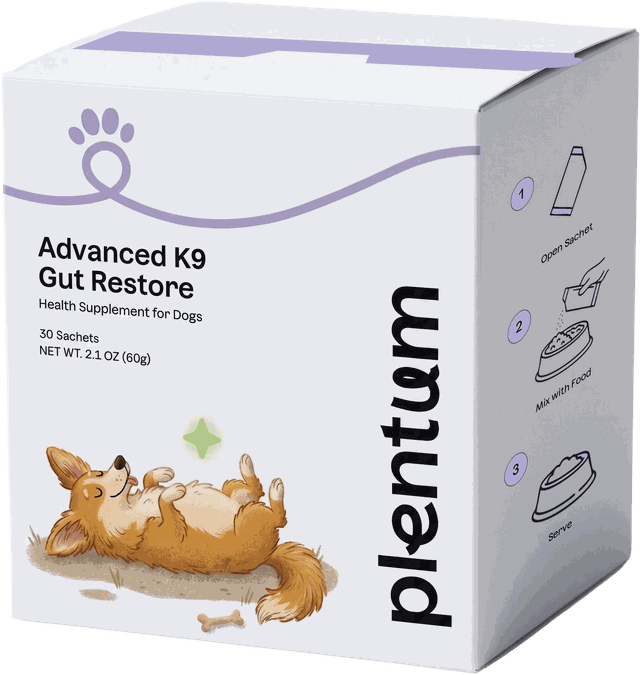
One box, 30 sealed doses Why it matters
Each sachet is opened fresh, on its day. The rest stay sealed until you need them, which protects the live cultures in the four targeted formulas.
-
Dose follows size 1 to 4 sachets a day by weight, so a small dog and a large dog each get a dose scaled to them. A chew comes in one fixed piece.
-
Mixes into any food Sprinkle on dry food, stir into wet food, or mix with warm water into a gravy. No chewing, no treat habit.
-
Every dose in the open Each active is listed with its mg on the label, rather than hidden inside a blend total.
Dosing
One to four sachets, by weight.
Slide to your dog's weight to see the daily amount and what it costs a day.
lb
SmallMediumLargeGiant
Weight tiers come from the printed labels. Puppies, senior dogs, and dogs with health needs: ask your vet about the right amount.
2
Microbiome Care4 g a day ·
2
Gut Restore, Calming Care, Itch & Immune Care, Metabolic Care4 g a day ·
Sachets a day, one 2 g sachet each. Price a day is the one-time box price divided by 30 days at that size. Subscription pricing is lower. See each product page.
Twelve weeks
A routine you can track.
Drag the slider through twelve weeks. This is how we suggest you keep notes, not a forecast of what will happen.
Week 1 · Start
Settle in
Choose one daily meal and give the sachet with it. Write a short baseline: stools, coat, breath, energy, or whatever your formula is for.
StoolsCoatEnergyAppetite
Week 2 · Start
Pick the moment
Same meal, same time, if you can. If your dog is picky, stir the powder into a spoonful of wet food first.
StoolsCoatEnergyAppetite
Week 3 · Start
Check in
Look at your notes. Small, honest notes are more useful than a memory of how things felt.
StoolsCoatEnergyAppetite
Week 4 · Month one
One month
A natural point to compare with week one. Reorder before the box runs out so there is no gap in the routine.
StoolsCoatEnergyAppetite
Week 5 · Build
Keep going
A daily supplement is a daily habit. The job now is consistency, not checking for changes every morning.
StoolsCoatEnergyAppetite
Week 6 · Build
Keep going
Take one photo this month in the same light, from the same angle, so you can compare later.
StoolsCoatEnergyAppetite
Week 7 · Build
Keep going
Keep the notes short. If something worries you, call your vet instead of waiting for the next check-in.
StoolsCoatEnergyAppetite
Week 8 · Build
Halfway
Half way. Read your notes back from week one.
StoolsCoatEnergyAppetite
Week 9 · Review
Look back
Compare the last few weeks with your baseline. Look at the pattern, not one day.
StoolsCoatEnergyAppetite
Week 10 · Review
Look back
If your dog changed food, season or routine, write that down too. It affects what you see.
StoolsCoatEnergyAppetite
Week 11 · Review
Look back
Gather your notes and photos. You will want them for your vet and for your own decision.
StoolsCoatEnergyAppetite
Week 12 · Review
Review
Compare with week one. Share your notes with your vet at the next visit, whether you saw a difference or not.
StoolsCoatEnergyAppetite
A guide to keeping notes, not a promise of results. Every dog is different, and timing varies by formula, dog and diet.
Good to know.
Ask your vet first
Talk to your veterinarian before adding a supplement, especially if your dog takes medication, is pregnant or nursing, has a diagnosed condition, or has reacted to new foods. A supplement does not replace veterinary care.
The label is the source of truth
Doses on these pages are copied from the printed label for each formula. If a page and a pack ever differ, trust the pack and tell us through the contact page.