







Guide
Dog gut health research hub
Which digestive-support ingredients have been studied in dogs, what did those studies find, and how far can you trust them? This hub answers that at ingredient level, with dated sources, and is clear about where the evidence runs out.
The question
Most dog owners ask some version of "will this help my dog's stools stay normal or settle a sensitive stomach?" The honest answer depends on the ingredient, the dose and the strain, and on whether the dog needs a veterinarian first. Repeated diarrhea or vomiting, blood in the stool, weight loss, low energy or pain are reasons to call your vet, not to try a supplement.
What the evidence says, ingredient by ingredient
| Ingredient | What was studied | Worth knowing | Study |
|---|---|---|---|
| Probiotics (as a class) | A 2024 review of canine studies found probiotic effects on gut health are strain-specific and depend on dose and study design. | Results for one strain do not transfer to another. Many studies are small. | Microorganisms 12(6):1248, 2024 |
| Probiotic + prebiotic supplement | In a randomized, double-blind study in a dog shelter, fewer dogs given the supplement had loose stools lasting two days or more than dogs on placebo. | Shelter dogs, a different product and different strains from Plentum's. | Journal of Veterinary Internal Medicine, 2017 |
| Saccharomyces boulardii | In a 35-day randomized study in 25 healthy kennel dogs, S. boulardii did not change stool scores but was associated with lower fecal markers of gut irritation and stress hormones. | One breed, fecal markers rather than clinical outcomes. Tested the yeast alone. | Veterinary Sciences, 2022 |
| Psyllium husk | In a randomized crossover study in 17 healthy dogs, psyllium caused only minor changes in gut bacteria. | Shows psyllium is gentle on the microbiome; it is a bulking fiber, not a microbiome modifier. | Access Microbiology, 2024 |
| Inulin (prebiotic fiber) | In controlled studies, adding inulin changed fecal fermentation markers (more short-chain fatty acids, fewer phenols). At low inclusion it improved some digestibility measures without changing bacterial counts. | Small groups of laboratory dogs; doses higher than a supplement serving. |
Journal of Animal Science, 2003 Journal of Animal Science, 2009 |
| Bovine colostrum | In weaned puppies, colostrum was associated with better fecal quality. In a 40-week study in 24 healthy dogs, a colostrum diet was associated with higher gut IgA. | Industry-run studies; immune markers are surrogates. Colostrum source and IgG content vary. |
Journal of Nutrition, 2004 British Journal of Nutrition, 2013 |
| Postbiotics | An international consensus defines a postbiotic as inactivated microorganisms or their components that confer a health benefit, which makes them different from live probiotics. In a 28-day randomized, placebo-controlled study in 20 colony-housed dogs, a Pediococcus acidilactici postbiotic (CIHP) improved stool consistency compared with placebo. | The stool study was run and funded by the ingredient supplier and has not been independently replicated. |
Nature Reviews Gastroenterology & Hepatology, 2021 Pets 3(2):19, 2026 |
What is still unknown
- Whether a given strain combination works the same way in a pet dog at home as in a shelter, kennel or laboratory dog.
- The best dose for most ingredients: many studies used larger amounts than one supplement serving provides.
- How long any change lasts after a dog stops a supplement.
- Independent replication of the postbiotic studies, which so far come from the ingredient supplier.
- No study has tested a Plentum formula. Everything above is ingredient-level evidence.
How to read the label
- Check the ingredient class: a live probiotic (counted in CFU), a postbiotic (inactivated, so no CFU) or a prebiotic fiber.
- Check the amount of each active per serving and the serving by body weight.
- Look for structure and function wording ("supports", "helps maintain"), not disease promises.
- Look for a lot number and best-by date, and ask the brand for the certificate of analysis.
Where Plentum fits
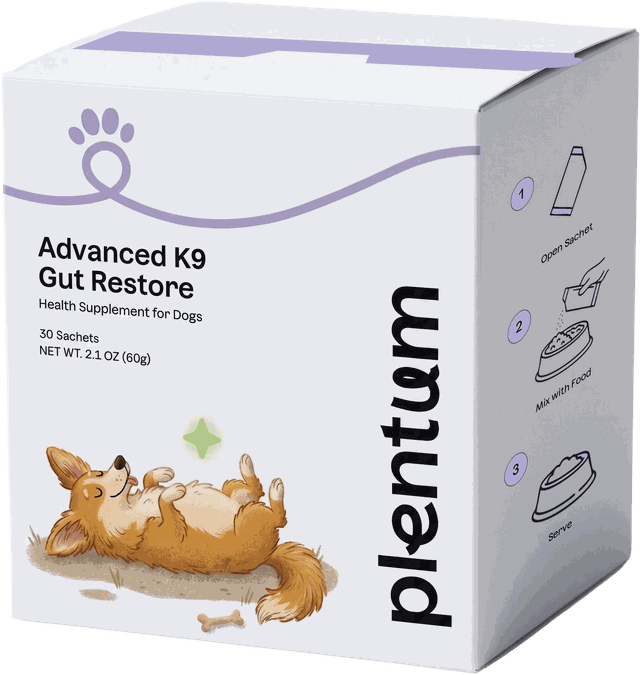
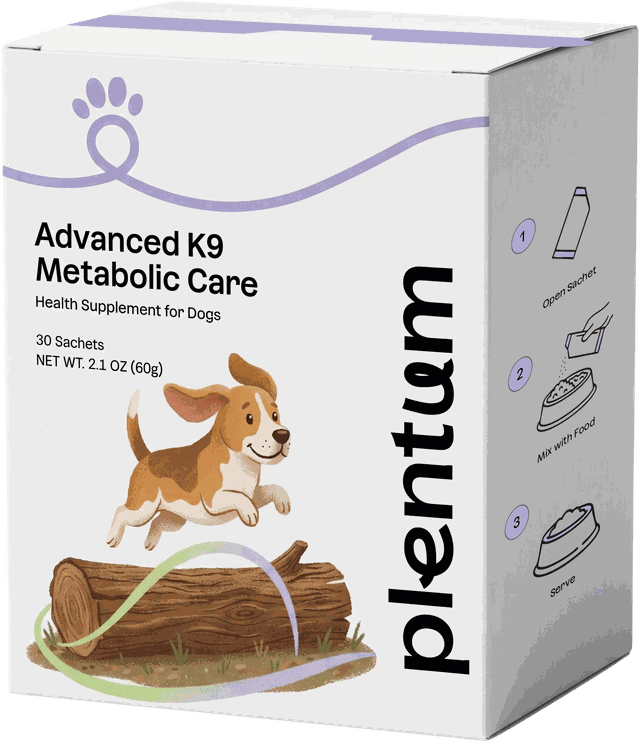
- Advanced K9 Gut Restore: a proprietary probiotic blend (L. casei K9-1, L. fermentum K9-2, L. brevis WF-1B, L. reuteri WF-1 and Saccharomyces boulardii) yielding 10 billion CFU per sachet, with psyllium husk, slippery elm, pumpkin, a yeast cell wall postbiotic and inulin. Supports normal bowel function and healthy stool consistency.
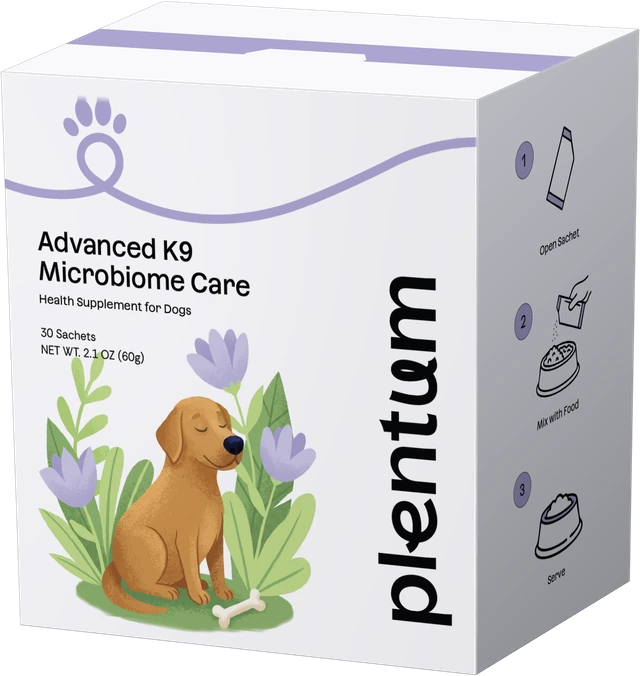
- Advanced K9 Microbiome Care: a daily foundation with a postbiotic, inulin, colostrum and fish oil.
- Compare both, and the bundles, in gut and digestion supplements. For everyday tips, read the dog gut health guide.
Sources
Studies
- ISAPP consensus statement on the definition and scope of postbiotics. Nature Reviews Gastroenterology & Hepatology, 2021.
- The function of probiotics and prebiotics on canine intestinal health and their evaluation criteria (review). Microorganisms 12(6):1248, 2024.
- Efficacy of a probiotic-prebiotic supplement on incidence of diarrhea in a dog shelter (randomized, double-blind). Journal of Veterinary Internal Medicine, 2017.
- A randomized, double-blinded, placebo-controlled trial of a probiotic or metronidazole for acute canine diarrhea. Frontiers in Veterinary Science, 2019.
- Saccharomyces boulardii in healthy kennel dogs (randomized, 35 days). Veterinary Sciences, 2022.
- Psyllium husk and the fecal microbiome of healthy dogs (randomized crossover). Access Microbiology, 2024.
- Inulin dose-response and fecal fermentation markers in dogs (controlled study). Journal of Animal Science, 2003.
- Low-level inulin and digestibility in dogs (controlled study). Journal of Animal Science, 2009.
- Benefits of bovine colostrum on fecal quality in recently weaned puppies. Journal of Nutrition, 2004.
- Supplementation of diets with bovine colostrum influences immune function in dogs. British Journal of Nutrition, 2013.
- A novel postbiotic improves stool consistency in dogs (randomized, double-blind, placebo-controlled). Pets 3(2):19, 2026.
Veterinary and nutrition references
- WSAVA Global Nutrition Guidelines. WSAVA; checked 10 Oct 2026.
- Selecting a pet food for your pet (Global Nutrition Toolkit). WSAVA, updated 2021; checked 10 Oct 2026.
- Prebiotics for dogs: what are they and how can they help your pet?. Ontario Veterinary College Pet Nutrition, 30 Jul 2025; checked 10 Oct 2026.
- Introduction to digestive disorders of dogs. Merck Veterinary Manual; checked 10 Oct 2026.
- Disorders of the stomach and intestines in dogs. Merck Veterinary Manual; checked 10 Oct 2026.
- Constipation, obstipation and megacolon in small animals. Merck Veterinary Manual; checked 10 Oct 2026.
- Diarrhea in dogs. VCA Animal Hospitals; checked 10 Oct 2026.
- Dog and cat foods. Merck Veterinary Manual; checked 10 Oct 2026.
- Complete and balanced pet food. U.S. FDA; checked 10 Oct 2026.
- Animal food labeling and pet food claims. U.S. FDA; checked 10 Oct 2026.
Studies listed here tested ingredients, not Plentum products. Where a study was funded or run by an ingredient supplier, we say so. This page is educational and does not diagnose, treat, cure or prevent any disease. Talk to your veterinarian before adding a supplement, especially if your dog takes medication, is pregnant or nursing, or has a diagnosed condition.
Last reviewed 10 October 2026. This hub brings together 19 of our earlier 2026 topic reports into one page with a single, checked source list. See all topics in the Plentum research library.
For general education only, not veterinary advice. Talk to your veterinarian if your dog has a health condition or takes medication, or if signs persist or get worse. These statements have not been evaluated by the Food and Drug Administration. Plentum products are not intended to diagnose, treat, cure, or prevent any disease.