







Guide
Dog weight, metabolic and mobility research hub
Which ingredients have been studied in dogs for weight, metabolism and mobility, and how strong is that evidence? Short answer: thinner than for gut health, and we show it that way.
The question
Owners of dogs carrying extra weight want to know whether a supplement can help. Portion control, treat limits and activity do most of the work; extra weight also loads the joints. A sudden weight change, increased thirst, lethargy or stiffness needs a veterinarian, and any weight-loss plan is best agreed with your vet. Start with our dog calorie calculator for a daily calorie estimate.
What the evidence says, ingredient by ingredient
| Ingredient | What was studied | Worth knowing | Study |
|---|---|---|---|
| L-carnitine | In exercising Labrador retrievers, 250 mg a day was associated with better activity and lower muscle-strain markers. | Not a weight-loss study; dogs were on a low-carnitine diet. | Journal of Nutritional Science, 2017 |
| Probiotic blend (class evidence) | In a 12-week randomized study in 41 overweight dogs, a probiotic blend was associated with greater weight and body-condition improvement than control. | Different strains from Plentum's; it shows the category has been studied, not that Plentum's strains do the same. | Scientific Reports, 2024 |
| Acacia fiber | In a 28-day randomized study in 36 healthy dogs, a chew containing acacia gum with other prebiotics and postbiotics was associated with higher fecal butyrate and lower gut-irritation markers. | Effects cannot be credited to acacia alone; biomarkers only. | Veterinary Sciences, 2026 |
| Omega-3 and mobility | A 2022 meta-analysis of diets and nutraceuticals in dogs and cats with joint disease found the most consistent support for omega-3-enriched diets. A 2024 dog study linked supplementation to a higher omega-3 index. | Therapeutic diets under veterinary care, not weight-loss supplements. Plentum makes no joint-health claims. |
International Journal of Molecular Sciences, 2022 Animals 14(21):3108, 2024 |
What is still unknown
- Dog studies of white kidney bean extract, chitosan, chia seed and Pediococcus acidilactici postbiotics for weight are limited.
- Whether a supplement adds anything once calories and activity are managed.
- Joint supplements: veterinary sources describe mixed evidence for most of them; omega-3 has the most support.
- No study has tested a Plentum formula.
How to read the label
- Check the ingredient class: a live probiotic (counted in CFU), a postbiotic (inactivated, so no CFU) or a prebiotic fiber.
- Check the amount of each active per serving and the serving by body weight.
- Look for structure and function wording ("supports", "helps maintain"), not disease promises.
- Look for a lot number and best-by date, and ask the brand for the certificate of analysis.
Where Plentum fits
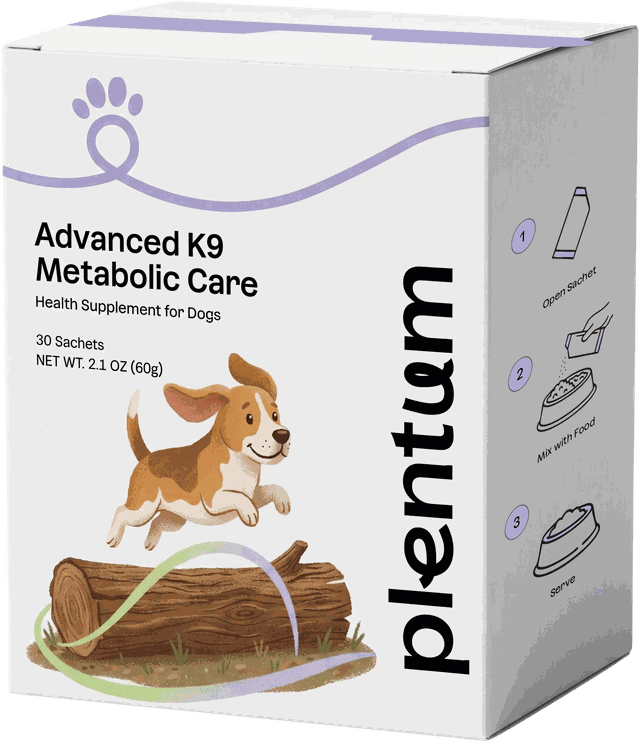
- Advanced K9 Metabolic Care: a proprietary postbiotic (Pediococcus acidilactici), acacia fiber, a proprietary probiotic blend (B. animalis lactis, L. gasseri) yielding 2 billion CFU, L-carnitine, white kidney bean extract, chia seed and chitosan. Supports proper weight management alongside a vet-agreed feeding plan. Contains chitosan (a shellfish derivative).
- Compare options in healthy weight supplements.
Sources
Studies
- L-carnitine in exercising Labrador retrievers. Journal of Nutritional Science, 2017.
- A probiotic blend in overweight dogs (randomized, 12 weeks, 41 dogs). Scientific Reports, 2024.
- A prebiotic and postbiotic chew containing acacia gum in healthy dogs (randomized, 28 days). Veterinary Sciences, 2026.
- Systematic review and meta-analysis of enriched therapeutic diets and nutraceuticals in canine and feline osteoarthritis. International Journal of Molecular Sciences, 2022.
- Omega-3 supplementation, the omega-3 index, quality of life and pain scores in dogs. Animals 14(21):3108, 2024.
Veterinary and nutrition references
- WSAVA Global Nutrition Guidelines. WSAVA; checked 10 Oct 2026.
- Selecting a pet food for your pet (Global Nutrition Toolkit). WSAVA, updated 2021; checked 10 Oct 2026.
- Prebiotics for dogs: what are they and how can they help your pet?. Ontario Veterinary College Pet Nutrition, 30 Jul 2025; checked 10 Oct 2026.
- Osteoarthritis in dogs and cats. Merck Veterinary Manual; checked 10 Oct 2026.
- Nondrug therapies used to relieve pain in animals. Merck Veterinary Manual; checked 10 Oct 2026.
- Chronic pain in animals. Merck Veterinary Manual; checked 10 Oct 2026.
- How joint supplements can help orthopedic conditions. Cornell Riney Canine Health Center; checked 10 Oct 2026.
Studies listed here tested ingredients, not Plentum products. Where a study was funded or run by an ingredient supplier, we say so. This page is educational and does not diagnose, treat, cure or prevent any disease. Talk to your veterinarian before adding a supplement, especially if your dog takes medication, is pregnant or nursing, or has a diagnosed condition.
Last reviewed 10 October 2026. This hub brings together 3 of our earlier 2026 topic reports into one page with a single, checked source list. See all topics in the Plentum research library.
For general education only, not veterinary advice. Talk to your veterinarian if your dog has a health condition or takes medication, or if signs persist or get worse. These statements have not been evaluated by the Food and Drug Administration. Plentum products are not intended to diagnose, treat, cure, or prevent any disease.