
Quick answer: Probiotics for dachshunds can help support a steadier gut, but they work best as part of a plan. A dachshund's gut and spine are linked through pain, stress and weight, so managing weight, meals and back health matters as much as any probiotic. Choose a product dosed for small dogs, give it 2-4 weeks for stool changes, and check with your vet first.
Key takeaways
- A dachshund's gut and spine are locked in a feedback loop, so it helps to manage both together.
- Soft stools, food sensitivities and weight gain are common gut challenges in the breed.
- A synbiotic approach (probiotics, prebiotics and postbiotics) covers more ground than a probiotic alone.
- Dose for small dogs: dachshunds run roughly 8-32 lbs, and large-breed formulas are often wrong for them.
- Expect stool changes in 2-4 weeks and assess wider benefits at 8-12 weeks.
Why Dachshund Gut Health Isn't Optional

Dachshunds get most of their health attention for their backs — IVDD affects up to a quarter of the breed. But what's missed is this: their gut and spine are locked together in a feedback loop, and managing both produces meaningfully better outcomes than treating them separately.
Dogs in chronic pain have elevated cortisol. Elevated cortisol directly disrupts gut flora. Disrupted gut flora increases systemic inflammation. Systemic inflammation worsens spinal outcomes.
Round and round it goes.
A 2023 review in Animals (MDPI), compiling veterinary gastroenterology data, confirmed that chronic pain states measurably alter the canine gut microbiome within weeks.

Dachshund-Specific Gut Issues
Beyond the IVDD connection, Dachshunds share common gut challenges with many small breeds:
- Obesity risk — Dachshunds gain weight easily, and extra pounds independently disrupt gut flora
- Food sensitivities — more common in small breeds generally
- Soft stools — frequent in the breed, often tied to stress, diet, or microbiome imbalance
Dachshund supplements for digestion, including a probiotic, are one tool for these problems. They sit alongside weight control, a suitable diet and your vet's advice.
The Dachshund Body Shape Changes Everything
The same elongated spine that makes Dachshunds susceptible to IVDD also shapes their entire abdominal cavity.
Their intestines run through a longer, lower body than most breeds. Peristalsis — the wave-like muscle contractions that move food through the gut — has more length to cover.
When a Dachshund has spinal disc pain, even subclinical compression, the muscles along the lower back tense up. That tension pulls on the mesentery — the tissue holding the intestines in place. Blood flow gets restricted. Transit slows.
The local bacterial environment shifts. Firm one day, loose the next. No dietary explanation.
In a dachshund with extra weight and a low-slung belly, the added load can increase intra-abdominal pressure, slow gastric emptying, and trigger reflux-like symptoms after meals. Ask your vet whether two smaller meals a day would suit your dog, alongside any microbiome work.
7 Signs Your Dachshund's Gut Needs Support

- Inconsistent stool texture — firm Monday, soup Wednesday. Classic Dachshund. This reflects microbiome instability, not necessarily a food issue.
- Urgency or accidents indoors — gut motility problems mean less warning time; often mistaken for a training issue in younger dogs
- Visible straining — can indicate constipation from dehydration, motility changes, or reluctance to squat fully due to back pain
- Excessive grass eating — they seek out roughage instinctively when their gut's off
- Weight gain without dietary change — dysbiosis alters how efficiently calories get extracted; some bacterial profiles are linked to greater extraction
- Recurring anal gland impaction — common in Dachshunds and often downstream of soft stools, which are themselves a sign of gut imbalance
- Post-IVDD gut disruption — after any spinal episode involving rest or meds (especially NSAIDs and antibiotics), gut flora is significantly disrupted. This window matters most.
How Synbiotics Help Dachshunds
A synbiotic combines three things: probiotics (beneficial live bacteria), prebiotics (the fibre that feeds them), and postbiotics (the functional compounds those bacteria produce).
For Dachshunds, where gut intersects with spinal health, weight, and food sensitivity — all at once — this three-part approach covers more ground than a probiotic alone.
Probiotics: Look for strains with evidence in small-breed dogs.
Bifidobacterium animalis and Lactobacillus acidophilus have the strongest published data for producing firmer, more consistent stools in dogs under 30 lbs.
Prebiotics — specifically inulin-type fructooligosaccharides from chicory root — do double duty in Dachshunds. They feed beneficial bacteria.
They also produce short-chain fatty acids that support satiety signalling. That matters in a breed where every extra pound compresses spinal discs more with every step.
A Dachshund carrying just 10% extra body weight is placing meaningfully more load on those discs daily.
Postbiotics — particularly butyrate — directly support the gut epithelial lining. A stronger gut lining means less translocation of inflammatory molecules into the bloodstream.
Less systemic inflammation matters for a breed already dealing with spinal inflammation. Learn more about how the gut microbiome influences whole-body inflammation at Plentum's science hub.
What Actually Works
Small-breed dosing: Dachshunds run 8–32 lbs depending on mini or standard. Make sure any probiotic is dosed for their size — many large-breed formulas significantly over-dose small dogs, or under-dose them if you just halve the portion.
Prebiotic support: For Dachshunds carrying extra weight, prebiotic fibre (especially inulin) helps with satiety signalling — which helps with the weight management that protects the spine.
Easy administration: Dachshunds can be stubborn about pills and pill pockets. Powders mixed directly into wet food are often the easiest option in this breed.
Where supplements fit
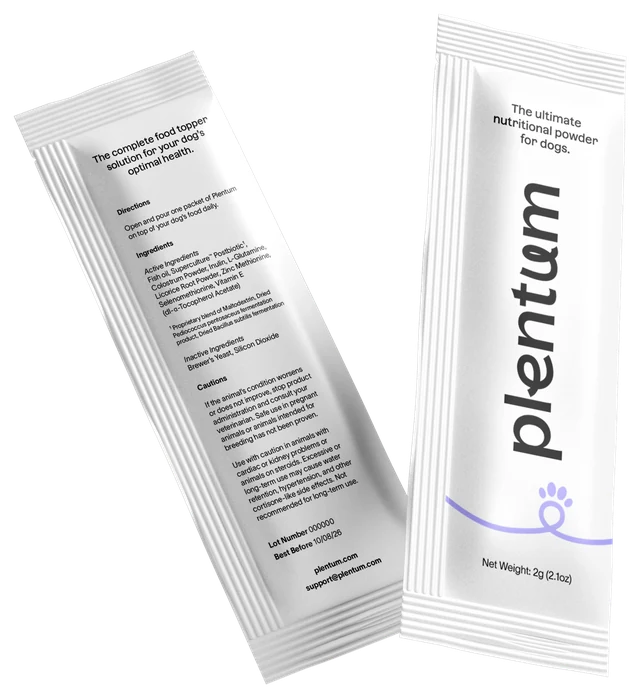
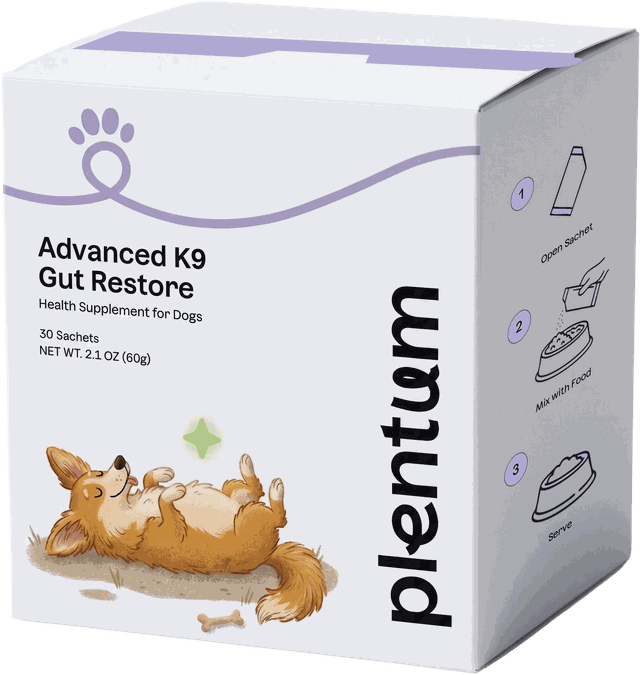
A supplement never replaces weight control, a suitable diet or your vet's care for your dachshund's back. For a daily foundation, some owners use Plentum Advanced K9 Microbiome Care, a sealed daily sachet with a postbiotic + prebiotic dose: an oral-health postbiotic complex, prebiotic inulin, colostrum and omega-3, sprinkled on food. It is a postbiotic and prebiotic product, not a probiotic.
Supplement, not a medicine. Ask your vet if your dog has a health condition or takes medication. Contains bovine colostrum.
What to Expect (And When)
- Stool consistency: 2–4 weeks.
- Inflammatory load reduction (relevant to spinal health): assess at 8–12 weeks.
- Weight management support: ongoing.
If stools stay loose or you see no change at all, speak to your vet rather than adding more products.
Primary veterinary reference
Use this owner guide alongside the WSAVA Global Nutrition Guidelines and the advice of the veterinarian managing the individual animal.
Frequently asked questions
Do dachshunds have stomach problems?
Many dachshunds share common small-breed gut challenges: soft stools, food sensitivities and a tendency to gain weight. Spinal pain can also affect gut motility and the gut microbiome. Persistent or severe signs need a vet visit.
Do dachshunds have sensitive stomachs?
Food sensitivities are more common in small breeds generally, and soft stools are frequent in dachshunds, often tied to stress, diet or microbiome imbalance. Change foods slowly and track what your dog eats alongside stool quality.
How to prevent IVDD in dachshunds?
This guide is about gut health, so ask your vet for a full IVDD plan. Keeping your dachshund at a healthy weight helps, because every extra pound adds load to the spinal discs.
What should I look for in a probiotic for a dachshund?
Choose a product dosed for small dogs, with named strains such as Bifidobacterium animalis or Lactobacillus acidophilus. Powders mixed into wet food are often easy to give. Check with your vet first, especially after a spinal episode or medication.
Sources
Supplement, not a medicine. Ask your vet if your dog has a health condition or takes medication. These statements have not been evaluated by the Food and Drug Administration. This product is not intended to diagnose, treat, cure, or prevent any disease.