





Your German Shepherd has loose stools again, perhaps gas, or a coat that never shines despite what you feed.
If that sounds familiar, you're in good company.
Gut problems are a common reason German Shepherd owners visit the vet.
German Shepherds have above-average risks of EPI, IBD, and food sensitivities.
A new bag of kibble won't resolve every cause.
A steady diet, smaller meals and an early.
For the bigger picture on the breed, read Why German Shepherds Are Prone to Gut Problems.
What to remember about German Shepherd gut health
- Diet stability, smaller meals and steady stress management form the daily framework for most GSD owners.
- EPI is diagnosed with a blood test and managed with pancreatic enzyme replacement, not with diet changes alone.
- This guide helps you understand German Shepherd gut health. It can't diagnose or treat your dog.
Why do German Shepherds have digestive trouble?
German Shepherds are among America's most popular dogs.
They also rank highly for breed-specific gastrointestinal, or GI, problems.
Vets see certain immune-related and structural gut issues more often in GSDs than in mixed breeds or many other purebreds.
Genetics are part of it.
The gut-wall immune system can overreact.
This can make the lining more sensitive to food proteins and environmental exposures.
Some researchers think the breed may begin with fewer beneficial Lactobacillus and Bifidobacterium bacteria.
That may leave less protection when something goes wrong.
Then there's the pancreas.
German Shepherds are among the breeds most often diagnosed with EPI.
With EPI, the pancreas produces too few digestive enzymes.
Some German Shepherds move food through faster than normal, leaving less time for absorption.
Stool can stay loose even on a good diet.
All of this changes your game plan. Swapping foods and hoping won't get you far.
Change one thing at a time so you can actually tell what helped.
What is EPI in German Shepherds?
Exocrine pancreatic insufficiency is serious, but it's manageable once it's diagnosed.
The pancreas makes lipase, protease, and amylase.
These enzymes break down fat, protein, and carbohydrates in the small intestine.
In EPI, the cells that make those enzymes are slowly destroyed, a process called pancreatic acinar atrophy (PAA).
As it progresses, food passes through mostly undigested and gut bacteria ferment whatever isn't absorbed.
That's how a dog can lose weight while eating normally, or even wolfing down every meal.
What EPI tends to look like
- Big, pale, greasy or especially foul-smelling stools
- Dramatic weight loss even though your dog's appetite is good or bigger than usual
- Eating poop (coprophagia), a common EPI sign that often gets written off as a bad habit
- A rumbling belly and a lot of gas
- A dull, dry coat
Your vet can check for EPI with a simple blood test called serum trypsin-like immunoreactivity (TLI).
It's usually managed with lifelong pancreatic enzyme supplements, and diet changes alone won't fix it.

Food sensitivities and IBD look a lot alike
Food sensitivities and inflammatory bowel disease, or IBD, follow EPI in frequency.
These are the most common gut diagnoses in adult German Shepherds.
The symptoms overlap, so a proper workup from your vet is the only real way to tell them apart.
A food sensitivity is a reaction to an ingredient that doesn't involve the immune system the way a true allergy does.
Chicken, beef, and dairy are common suspects.
A German Shepherd may react to a protein they've eaten happily for years.
Watch for on-and-off loose stools, mucus in the stool, itching and ear infections that keep coming back.
Diagnosis usually involves a hydrolyzed or novel-protein elimination diet for at least eight to twelve weeks.
Your vet guides the trial.
A few days on a different food won't tell you anything.
IBD describes chronic, immune-driven inflammation in the GI tract.
German Shepherds are overrepresented in IBD diagnoses.
It can affect the stomach, small intestine, or large intestine.
Signs include ongoing vomiting, diarrhea, weight loss, or a thin appearance.
Diagnosis usually takes a biopsy, so it's something to have checked instead of guessed at.
What's going on with the GSD microbiome
Your dog's gut is home to a whole community of bacteria, fungi and other microbes.
Vets call this disrupted balance dysbiosis.
It's linked to digestive trouble, immune function, skin, and even behavior.
German Shepherds may tip into dysbiosis more easily than many breeds.
That reactive gut wall can make it a less welcoming place for good bacteria.
Repeated antibiotic courses for GI infections can thin out the normal population.
And these are high-drive working dogs, so long stretches of stress can show up in the gut too.
Supporting the microbiome comes down to steady habits over months.
Probiotics, prebiotics, and postbiotics for a GSD
These three words show up on a lot of labels, and they mean different things.
See how they compare.
| Supplement type | What it is | Main role in GSD gut support |
|---|---|---|
| Prebiotic | Fiber your dog can't digest that feeds beneficial bacteria | Fuels microbial growth and supports regularity and stool quality |
| Probiotic | Live beneficial bacteria | Adds to microbial populations and may crowd out harmful bacteria |
| Postbiotic | Bioactive compounds bacteria make when they ferment fiber | Supports the gut lining and immune signaling, and it's shelf-stable |
Some owners go with a supplement that pairs prebiotics and live probiotics.
Others go with one built around postbiotics.
Either can make sense, depending on your dog, your vet's advice and what's actually on the label.
Postbiotics are what bacteria produce: short-chain fatty acids, peptides and other compounds that nourish the gut lining.
Since nothing in them is alive, they don't depend on bacteria surviving stomach acid.
Dog research on postbiotics is still growing.
Most direct clinical evidence concerns mouth and breath outcomes; evidence on gut markers is still catching up.
Read postbiotic claims with the same healthy skepticism you'd bring to any supplement.
A daily routine for your German Shepherd's gut
No single product fixes this breed's stomach. Boring, steady habits do.
Here's a routine many owners find easy to keep.
1. Keep the food steady
Feed a complete, balanced diet.
If your dog has a history of tummy trouble, your vet may suggest a single, novel or hydrolyzed protein.
Skip the frequent food rotations, because this breed's gut does better with sameness than variety.
When you do switch, stretch it over at least ten to fourteen days.
2. Split meals up
German Shepherds can have faster gut transit.
They're also prone to bloat, or gastric dilatation-volvulus (GDV).
Dividing the day's food into two meals means less volume hits the gut at once, which supports more complete digestion.
3. Add a daily gut supplement if your vet agrees
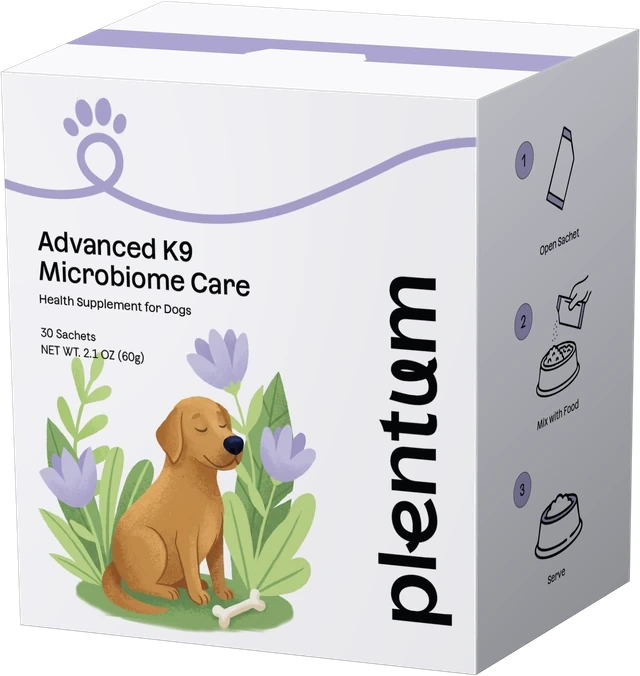
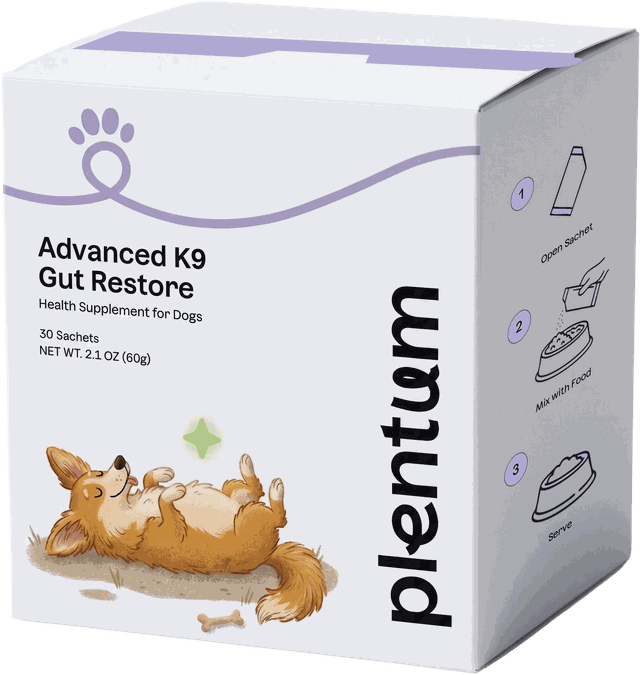
A powdered gut supplement for German Shepherds that mixes into food is one option to discuss with your vet.
It's a postbiotic and prebiotic blend without live cultures. Mixing it into breakfast can make the routine easy to maintain.
4. Have a plan for antibiotics
Given how often GSDs pick up GI infections, antibiotics come up a lot.
They can wipe out beneficial bacteria along with the bad, and the effect may be more noticeable in this breed.
5. Cut the stress you can
These are sensitive, high-drive dogs.
Chronic stress is thought to raise cortisol, which may affect gut permeability and microbiome balance.
Daily exercise, a job to do with their brain and a predictable routine help the gut as much as the dog.
6. Look at the poop
Stool is the easiest window into gut health.
You're aiming for well-formed stools that score 3 to 4 on the WSAVA fecal scoring chart.
Pale, fatty or high-volume stools that stick around mean a vet visit now.
A quick log on your phone gives your vet the pattern.
How to compare gut supplements
Strain choice and product design matter. Use this list when you're standing in the aisle or scrolling online.
- Look for exact species and strain names, such as Lactobacillus or Bifidobacterium, instead of a vague "probiotic blend."
- Check that the CFU count is stated for the end of shelf life. Encapsulated or heat-treated supplements can be more reliable than loose powders with unprotected cultures.
- See whether there's postbiotic content. A product that pairs live cultures with postbiotic compounds covers both topping up bacteria and supporting the gut lining.
- Make sure strain names, CFU counts, ingredient sources and the maker's contact details are all on the label.
A supplement is one layer of support for a German Shepherd.
It doesn't replace diagnosis, diet management, or veterinary care.
Check in first if your dog has a health condition or takes medication.
For nutrition basics, the WSAVA Global Nutrition Guidelines are a good companion to your vet's advice.
Why does German Shepherd history matter?
Merck says EPI occurs in many breeds but is especially seen in German Shepherds and Rough Collies.
In young adult German Shepherds, the most frequent cause is pancreatic acinar atrophy.
This is a wasting of the tissue that makes the enzymes.
Give your vet the breed and the age at the first visit, since both shape the test a vet orders.
How does a vet manage EPI?
Merck reports that most dogs with EPI can be managed successfully with pancreatic enzyme replacement therapy (PERT).
Merck also says cobalamin should be supplemented.
The dose and the plan belong to your vet, and they follow the test results.
Sources:
Frequently asked questions
Why are German Shepherds more prone to gut problems?
The breed carries a higher-than-average risk of EPI, IBD and food sensitivities.
Genetics may contribute to digestive problems.
An overreactive gut-wall immune response or pancreatic insufficiency can be involved.
Knowing that helps you catch early signs.
What are the early signs of EPI in a German Shepherd?
Classic signs include big, pale, or greasy stools and weight loss despite a good appetite.
Eating poop, excess gas, and a dull coat are other signs.
A blood test confirms it, so if you're seeing several together, call your vet before you try a new food.
Can diet alone fix a German Shepherd's gut problems?
Diet matters a lot, but it can't fix everything.
EPI needs pancreatic enzyme replacement, and IBD usually needs a vet's diagnosis and care.
A steady, high-quality diet is the foundation that the rest of the plan sits on.
Should I give my German Shepherd a probiotic?
Some dogs do well on one, especially during or after antibiotics, but it isn't right for every dog.
Look for named strains and CFU counts on the label.
Sources
These resources provide general background.
A vet who has examined your dog should guide diagnosis, medication, and treatment.