





If you've been stirring a probiotic into your dog's dinner and figuring that covers gut health, there's a piece you might be missing.
Because they're not alive, they don't need to survive stomach acid. Early research suggests they may support gut barrier integrity, normal immune function, and oral microbiome balance in dogs.
Prebiotics are fiber that feeds gut bacteria, probiotics are the live bacteria themselves, and postbiotics come from those bacteria. Because postbiotics are heat-stable, stomach acid and shelf time aren't a problem.
Give any new supplement at least a month, and don't let one stand in for a vet visit if the stomach trouble keeps going.

What exactly are postbiotics
Think of your dog's gut as a tiny brewery.
- Prebiotic fiber is the grain.
- Probiotic bacteria are the brewers.
- Postbiotics are what comes out of the tank: the compounds that actually do something.
That output covers a lot of ground. There are:
- Short-chain fatty acids (butyrate, acetate, and propionate)
- Bacteriocins
- Enzymes
- Fragments of bacterial cell walls
- Peptide metabolites
The International Scientific Association for Probiotics and Prebiotics (ISAPP) agreed on a formal definition in 2021: "a preparation of inanimate microorganisms and/or their components that confers a health benefit on the host."
Definitions vary, though: ISAPP's centers on inactivated microbes and their components, while many brands use "postbiotic" for fermentation by-products like short-chain fatty acids too.
Postbiotics skip all of it. They're already active, they don't need the fridge, and they hold up in conditions that would wipe out most probiotic cultures. That toughness is a big reason canine nutrition researchers have started paying attention.
You may also see it written as post biotics for dogs, and it means the same thing.

Why your dog's gut is worth the attention
Whatever the exact count in your dog, that crowd does a lot more than digest dinner. Cornell College of Veterinary Medicine and other groups are studying how the canine gut microbiome ties into skin and coat, immune signaling, and the gut-brain axis.
When things are in balance, you tend to see:
- Regular, comfortable stools
- A shinier coat
- Steadier energy
When a course of antibiotics, a food switch, a stressful week, or a stay at the boarding kennel throws it off, you usually notice fast, often in the backyard first.
What postbiotics actually do for a dog's gut
Researchers are looking at three main areas:
- The first is the gut lining. Butyrate, one of those short-chain fatty acids, is the main fuel for colonocytes, the cells that line the large intestine. Reviews as recent as 2022 point to butyrate's role in supporting the tight junctions that hold those cells together.
- The second is immune signaling. Bits of bacterial cell wall interact with receptors in gut-associated lymphoid tissue, where a large share of the body's immune-active cells live.
- The third is the mouth. Postbiotics may also support microbial balance there, which is why gut health and doggy breath so often come up together. Our guide to the best supplement for dog bad breath covers that side.
- Prebiotics are the raw ingredients.
- Probiotics are the workers.
- Postbiotics are the finished product.

Prebiotics vs. probiotics vs. postbiotics: the full picture
The three words are easy to mix up, so here they are side by side.
| Component | What it is | The catch | What it brings |
|---|---|---|---|
| Prebiotic | Fiber your dog can't digest, which feeds gut bacteria | Has to reach the colon intact | Fuels bacterial growth and short-chain fatty acid production |
| Probiotic | Live beneficial bacteria | Has to survive heat, acid, and storage | Adds to the bacteria already living there |
| Postbiotic | Active compounds made by fermentation | None to speak of, since it's already active | Stable; signals directly to immune cells and the gut lining |
That's why they work well together. Postbiotics hand over the compounds directly, probiotics bring the bacteria that keep making them, and prebiotics give those bacteria something to eat.
Comparing postbiotic brands, including Fera and AnimalBiome
More brands sell a postbiotic for dogs every year, and most of them were built from an ingredient list, not a canine trial.
Two you'll likely come across do different jobs:
- Fera Probiotic is a multi-strain probiotic plus prebiotic, so it's worth asking whether a published canine postbiotic trial sits behind it.
- AnimalBiome Gut Restore Plus is a set of oral capsules based on fecal microbiota transplant (FMT). It's a different kind of product from a daily postbiotic, and controlled canine data on the postbiotic side are limited.
How to pick (and use) the best postbiotic for your dog
Ask for the trial, not the testimonial. If a brand can't name a published study in dogs, its claims are probably borrowed from human data.
Then think about how your dog will actually take it. Heat-stabilized powders stirred into food tend to go down better than capsules.
Be patient. Give a new supplement at least a month, and 28 to 56 days is a fairer window before you decide.
Change one thing at a time and keep a dated note of stool, appetite, and energy, so you and your vet can tell whether it's helping.
Are postbiotics safe for dogs?
Three points on postbiotic safety
- Postbiotics appear well tolerated in healthy adult dogs in the studies available so far.
- Well tolerated is not the same as guaranteed safe for every dog.
- Postbiotics contain no live bacteria.
Why "no live bacteria" matters
The defining feature of a postbiotic is that the microbes in it have been inactivated. The International Scientific Association for Probiotics and Prebiotics (ISAPP) describes a postbiotic as a preparation of inanimate microbes and/or their components that gives a health benefit to the host. The word inanimate has practical safety implications. For the basic difference between these categories, see Probiotics, Prebiotics, and Postbiotics for Dogs: What Is the Difference?
No live bacteria to overgrow
Live probiotics are designed to colonize the gut. In healthy dogs, that's generally benign. In immunocompromised dogs, even beneficial bacteria can theoretically cause concern, which is why that group gets its own section below.
How storage and handling compare
Postbiotics don't depend on living cells for their effect. For a live probiotic or a postbiotic, follow the storage directions on the label.
They work without living cells
Live probiotics deliver living microbes to the gut. Postbiotic components, including cell wall fragments, short-chain fatty acids and bioactive peptides, can act without a live cell to deliver them.
| Property | Live probiotic | Postbiotic |
|---|---|---|
| Contains live bacteria | Yes | No |
| Storage | Strain-specific; follow label storage directions | Follow label storage directions |
| Survival through stomach acid | Strain-dependent | Not dependent on living cells |
| Risk of gut colonization | Low, but possible | None (non-living) |
| How the dose is stated | CFU count (live cells) | Amount of non-living compounds |
| Adverse effects in canine trials | Rare; GI upset possible | None reported in a 13-study review |
Summary based on the studies cited in this article.
What the studies found
The canine postbiotic evidence grew substantially across 2024 to 2025, but it's still small. See where it stands.
2025 systematic review: no adverse effects across 13 trials
A 2025 systematic review and meta-analysis, Effects of Postbiotic Administration on Canine Health: A Systematic Review and Meta-Analysis, evaluated 13 canine studies of postbiotics. They covered postbiotics from Saccharomyces cerevisiae (yeast-based fermentates) and from bacterial sources.
Across all 13 trials, no adverse effects from postbiotic supplementation were reported. That's a useful signal given the range of postbiotic types, formats and study lengths. It's a review of trials, so it's not proof for every product.
Sordillo 2025: a randomized trial on breath
For canine breath, the most rigorous trial in this group is the Sordillo 2025 study, A Novel Postbiotic Reduces Canine Halitosis, published in Animals (Basel).
It was a randomized, double-blind, placebo-controlled trial in 24 dogs over 14 days. Dogs got either a postbiotic powder topper or a placebo. The main outcome was volatile sulfur compounds (VSCs), the chemical behind bad breath. You can read more in Dog Bad Breath: Causes, Symptoms, and Why Postbiotics Help.
The postbiotic group showed a 27% reduction in VSCs over 14 days compared with placebo. No adverse effects were reported. The study measured breath-specific outcomes, such as VSC levels and shifts in the oral microbiome, so that 27% applies to volatile sulfur compounds in the mouth and shouldn't be stretched to other health areas.
Postbiotics from Bifidobacterium animalis in beagles
A 2026 study in Frontiers in Microbiology looked at dietary postbiotics derived from Bifidobacterium animalis in adult beagles. The authors reported that supplementation was safe and well tolerated over 42 days. Treat it as one trial in one breed.
A prebiotic and postbiotic combination: gut barrier and inflammation markers
A study in Veterinary Sciences looked at a prebiotic and postbiotic supplement's effects on gut microbiota, intestinal barrier markers and systemic inflammation in healthy dogs. The supplement was well tolerated, and no adverse events were recorded.
What the evidence doesn't show yet
The evidence supports short-to-medium-term tolerability in healthy adult dogs. Dedicated long-term safety studies are still needed to show what happens with chronic daily use.
Most of these trials are small and short, and they focus on healthy adult dogs. A result in one study, one population or one supplement doesn't carry over automatically to a puppy, a senior or a dog with a medical condition. For a broader map of the research, see Postbiotics for Dogs: What They Are and Why Your Dog's Gut Needs Them.
The first week: what owners see
Published canine studies typically include a three-to-seven-day acclimatization period before formal measurements begin. That reflects a familiar pattern, since any change to a dog's diet or supplement routine can cause mild, short-lived digestive changes while the gut adapts.
In the first few days, some dogs may show:
- Slightly softer stools or minor changes in stool consistency
- Extra gas, which can come from the prebiotic components in many postbiotic blends (expect a look from the couch)
- No change at all, which is also normal
When these happen, they're generally mild and settle within three to seven days. They're usually just the gut adjusting to something new.
When to contact your vet
Most of this sorts itself out on its own.
- Loose stools persist beyond seven days of supplementation
- Your dog vomits, seems lethargic or eats less than usual
- Your dog has a diagnosed gastrointestinal condition, such as inflammatory bowel disease or pancreatitis
- Your dog takes prescription medication, since interactions aren't documented for postbiotics and should be discussed with a vet
To tell normal adjustment from genuine intolerance, see Probiotic Side Effects in Dogs: 5 Signs + 3 Red Flags (2026 Practical Guide).
Dogs that need a vet's okay first
The published safety evidence comes mostly from healthy adult dogs. Some groups need extra vet guidance before any new supplement, postbiotics included.

| Population | Consideration | Recommended action |
|---|---|---|
| Healthy adult dogs | Well-studied population; no adverse effects reported in trials | Generally suitable; follow label directions |
| Senior dogs (7+ years) | May have slower gut adaptation; underlying conditions more common | Consult vet before starting; monitor for GI adjustment |
| Puppies under 12 months | Developing microbiome; postbiotic data in puppies is limited | Consult vet; choose formulations specifically designed for puppies |
| Dogs with IBD or chronic GI conditions | Altered gut barrier; microbiome significantly dysbiotic | Ask the vet managing the condition before adding a postbiotic |
| Immunocompromised dogs | Reduced immune surveillance; caution is warranted | Vet approval before starting |
| Dogs on prescription medication | No documented interactions with postbiotics; absence of evidence is not evidence of safety | Discuss with prescribing vet |
| Pregnant or lactating dogs | No published data on postbiotic supplementation in this group | Ask your vet before use during pregnancy or lactation |
If your dog's on this list, it's a quick call to the vet first. Most will say yes and tell you what to watch for.
Where a postbiotic supplement fits
A postbiotic is one layer of gut support. It sits alongside good food, a steady routine, and regular vet checks, and it doesn't replace any of them. Ongoing digestive signs are a question for your vet.
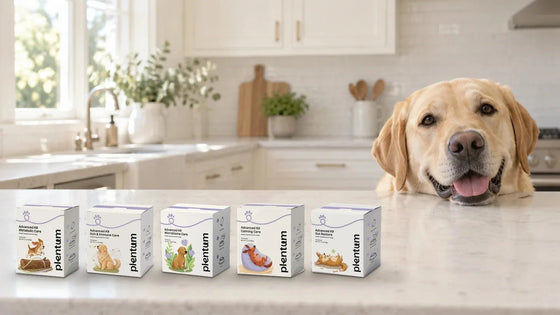
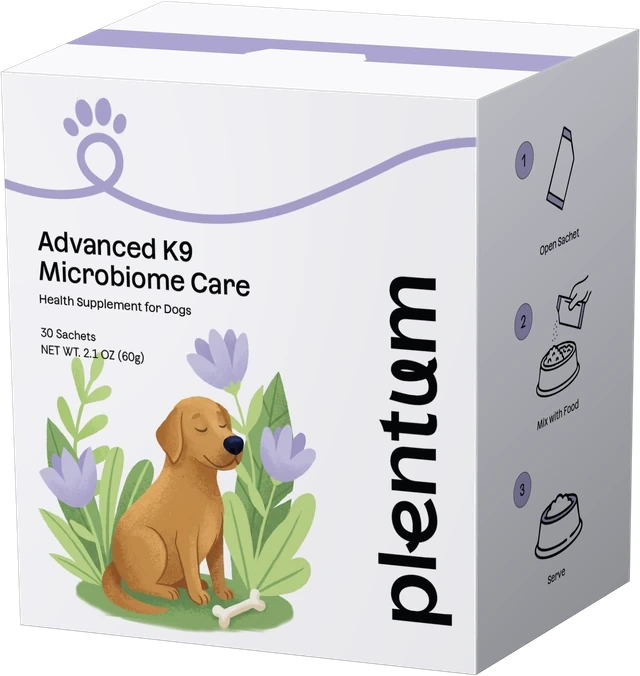
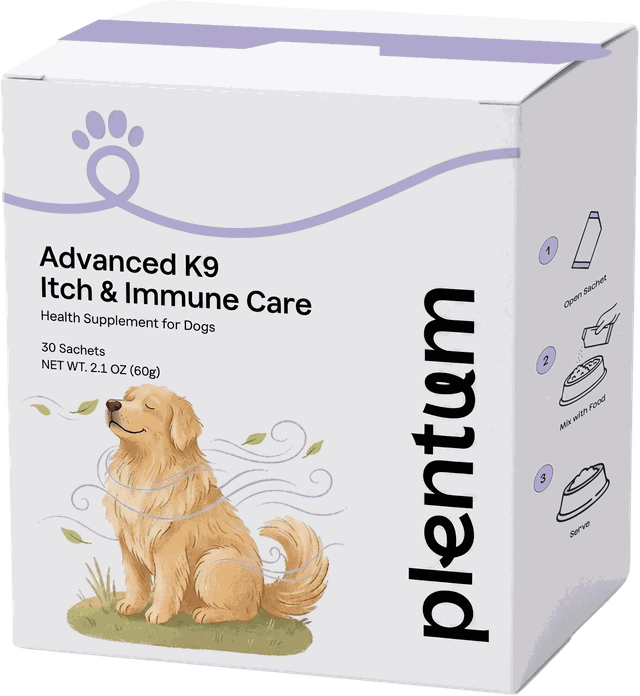
Two Plentum supplements are built around a postbiotic. Microbiome Care is a daily postbiotic and prebiotic powder with an oral-health postbiotic, and Itch & Immune Care adds a postbiotic to skin-support ingredients. Our daily foundation collection explains where each one fits.
For label details and daily-use directions, see our gut and digestion supplements.
Frequently asked questions
Are postbiotics backed by research for dogs?
The research is still young. Scientists are studying gut barrier support, immune signaling and oral microbiome balance in dogs. Ask any brand to name a published canine study, because claims borrowed from human data don't tell you how a product works in dogs.
What is the difference between probiotics and postbiotics for dogs?
Probiotics are live bacteria that have to survive heat, stomach acid and storage. Postbiotics are the stable compounds those bacteria make, and they're already active. They do different jobs, so many dogs do well with both.
Are postbiotics safe for puppies?
Most published work looks at adult dogs, though postbiotics generally have a strong safety profile.
Can postbiotics replace probiotics?
They can't fully replace them. Postbiotics deliver the compounds directly, while probiotics bring the bacteria that keep making them. A synbiotic blend with a prebiotic, a probiotic and a stabilized postbiotic covers all three.
Do postbiotics need refrigeration?
They don't need refrigeration. That's their main practical edge over live probiotics: they hold up in conditions that would wipe out most probiotic cultures.
Is the evidence for postbiotics in dogs good?
It's promising but still developing. Several trials and a 2025 systematic review report good tolerability, but most studies are small and short. Read the study design, the population and the outcome before you rely on a headline result.
Are postbiotics safe for dogs?
They appear well tolerated in healthy adult dogs in the studies so far. That isn't a guarantee for every dog.
What should I watch for in the first week?
Mild, short-lived changes like slightly softer stool or some extra gas can happen while the gut adjusts. Loose stools beyond seven days, vomiting, lethargy or a drop in appetite are reasons to contact your vet.
Do postbiotics contain live bacteria?
No, postbiotics are preparations of inactivated microbes and/or their components. No live cells are needed for their effect.
Sources
- Cornell College of Veterinary Medicine: canine gut microbiome health (PubMed search)
- Aguilar-Toala JE, et al. Postbiotics: An evolving term within the functional foods field. Trends Food Sci Technol. 2018.
- Evaluating the safety and functionality of a novel compound containing prebiotics, probiotics, and postbiotics in healthy cats and dogs
- The International Scientific Association for Probiotics and Prebiotics (ISAPP) consensus statement on the definition and scope of postbiotics