
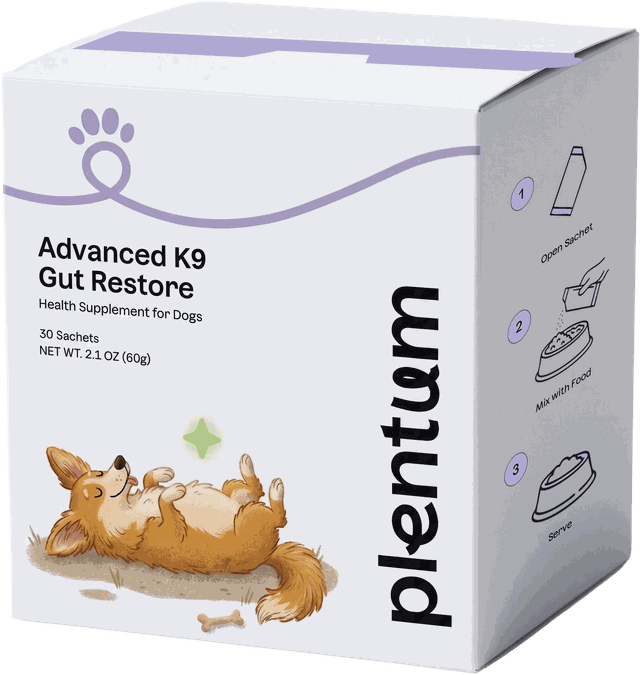





Your vet mentioned Purina Pro Plan FortiFlora, you've also come across Plentum Gut Restore, and now you're wondering what really separates them. FortiFlora is a single-strain packet: one strain, SF68 (Enterococcus lactis SF68 on Purina's US shop), at 100 million CFU, one packet a day. Gut Restore is Plentum's closest match, also a single-dose sachet, with 10 billion CFU, five named strains, a postbiotic and a dose that follows your dog's weight. It costs more per day, too.
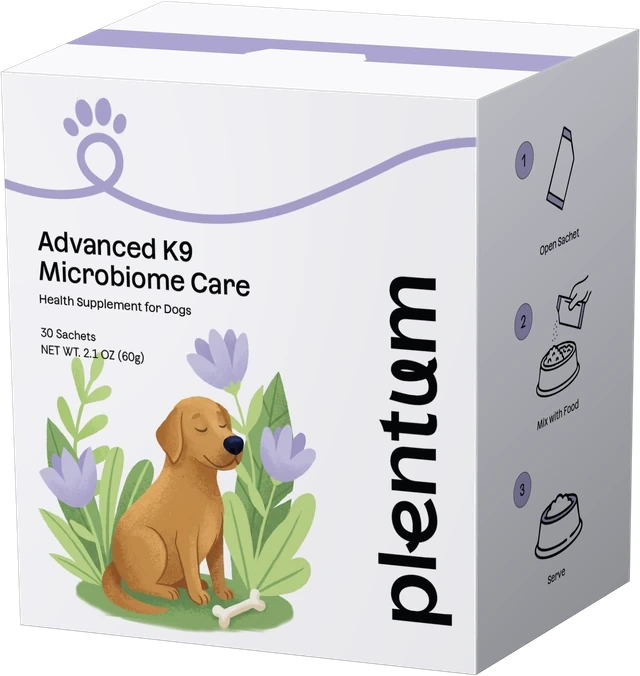
Plentum Microbiome Care has no live cultures, so it's in a different lane.
The label facts side by side
See how FortiFlora lines up against both Plentum supplements on the points owners ask about most.
| Criterion | Plentum Gut Restore | Plentum Microbiome Care | Purina Pro Plan FortiFlora |
|---|---|---|---|
| Format | Single-dose 2 g sachet, stirred into food | Single-dose 2 g sachet, stirred into food | Single-serve powder packet |
| Dose by dog size | Four weight tiers: 1 sachet up to 25 lb, 2 at 26 to 50 lb, 3 at 51 to 75 lb, 4 over 75 lb | Three weight tiers: 1 sachet under 20 lb, 2 at 20 to 50 lb, 3 over 50 lb | 1 packet daily, no weight tiers in the directions |
| CFU per serving | 10 billion CFU per sachet | Not a probiotic, so no CFU | 1x10^8 CFU (100 million) per packet |
| Strain disclosure | 5 strains named, four with strain designations: L. casei K9-1, L. fermentum K9-2, L. brevis WF-1B, L. reuteri WF-1 and S. boulardii | No probiotic strains, only a 125 mg oral-health postbiotic complex | 1 strain named: SF68 (Enterococcus lactis SF68 on Purina's US shop; Enterococcus faecium SF68 on the Amazon listing) |
| Postbiotic included | Yes: yeast cell wall postbiotic (Saccharomyces cerevisiae), 75 mg per sachet | Yes: oral-health postbiotic complex, 125 mg per sachet | Not listed in the ingredients |
| Binders and other ingredients | Two inactive ingredients: brewer's yeast and silicon dioxide, plus fiber and botanical actives (amounts below the table) | Two inactive ingredients: brewer's yeast and silicon dioxide. Nine actives, each listed with its amount | Inactive: liver flavor and yeast. The Amazon listing's full ingredient list begins with animal digest |
| Vet formulated | Yes | Yes | "Developed in collaboration with Purina nutritionists, researchers and veterinarians" |
| Price per day | One-time: $1.50 (up to 25 lb), $2.87 (26 to 50 lb), $4.00 (51 to 75 lb), $5.00 (over 75 lb). Monthly subscription from $1.33 | One-time: $1.17 (under 20 lb), $2.22 (20 to 50 lb), $3.25 (over 50 lb) | About $1.03 for a dog of any size: $30.99 for a 30-packet box, 1 packet a day |
| Guarantee | 30-day satisfaction guarantee | 30-day satisfaction guarantee | 100% Satisfaction Guarantee on Purina's own shop: refund or replacement if you ask within 90 days of receipt |
| Lot testing documentation | Certificate of Analysis for every lot | Certificate of Analysis per lot confirming composition | States "a guaranteed level of live microorganisms" per packet |
| Source (checked October 19, 2026) | Plentum Gut Restore | Plentum Microbiome Care | Purina Pro Plan FortiFlora (Purina shop) and brand listing on Amazon |
Competitor details checked against their public product pages on October 19, 2026. Labels change, so check the current one.
The finer print for Gut Restore: the probiotic blend is 300 mg per sachet; the other actives are psyllium 200 mg, slippery elm 150 mg, pumpkin 150 mg and inulin 50 mg; and the lab behind its lot testing is accredited to ISO/IEC 17025:2017.
What FortiFlora does well
FortiFlora keeps it simple. The active ingredient is SF68 (Enterococcus lactis SF68 on Purina's US shop; Enterococcus faecium SF68 on the Amazon listing) at 1x10^8 CFU per packet, once a day or as your vet directs. The listing describes a microencapsulation process meant to help the probiotic reach the gut, and says Purina nutritionists, researchers and veterinarians developed it together.
Purina's Amazon listing also cites an online survey of US vets (Q4 2025) ranking it the number 1 vet-recommended probiotic brand for digestive health. That's Purina's own claim. If your vet already recommends it, that counts for something when your clinic is managing your dog's care.
Where Gut Restore differs
Gut Restore includes more. It names five strains, four with strain designations, where FortiFlora names one, and it has 10 billion CFU per serving against 100 million. Strains aren't interchangeable, though, so read that gap as context, not a verdict.
The dose runs from 1 to 4 sachets across four weight tiers, while FortiFlora is one packet a day for every dog. Gut Restore also includes a 75 mg yeast cell wall postbiotic, which FortiFlora doesn't list. Its inactive list is two items.
On the Amazon listing, FortiFlora's ingredient list begins with animal digest, with liver flavor and yeast as inactives. Some owners prefer to skip flavorings, and some are glad of them, since a flavored powder can win over a picky eater.
The rest of the 2 g sachet is fiber and soothing botanicals (organic pumpkin and slippery elm bark among them; amounts are listed under the table), aimed at normal bowel function and healthy stool consistency through diet changes and travel.
There are trade-offs. Gut Restore costs more per day, it's open for pre-order and ships by October 26, 2026, and it has less of a track record with owners than a product that's sat on shelves for years.
Where Microbiome Care fits
Microbiome Care has no probiotic strains and no CFU. It combines an oral-health postbiotic with colostrum, inulin, fish oil and L-glutamine. If your question is "which probiotic," you're comparing Gut Restore and FortiFlora. If you'd like a daily routine without live cultures, Microbiome Care is the one to look at.
It's also the only one of the three with an oral-health angle. Its postbiotic ingredient has been studied in dogs for breath odor: in a 14-day, double-blind, placebo-controlled study of 24 dogs, volatile sulfur compounds were about 27% lower than with placebo (DOI 10.3390/ani15111596). That was ingredient-level research, and the ingredient supplier's own scientists ran it, so take it as supporting context. Regular dental checks with your vet are still the main step for oral health.
For background, see Canine oral health: breaking down periodontal disease (2026).

What each one costs per day
Plentum is the higher-priced option here, and we'd rather say so up front. At one-time prices, Gut Restore works out to $1.50 a day for a dog up to 25 lb, $2.87 at 26 to 50 lb, $4.00 at 51 to 75 lb and $5.00 over 75 lb. A monthly subscription starts at $1.33 a day. Because the dose rises with weight, a 60 lb dog gets three sachets (30 billion CFU) a day.
FortiFlora is $30.99 for a 30-packet box on Purina's shop and on Amazon, which works out to about $1.03 a day. It's one packet a day for every dog, so the daily cost stays flat no matter how big your dog is.
If you're weighing this against a stack of separate products, add up everything your dog would take in a month and compare the totals. All-in-one vs single dog supplements: which is better? goes deeper on that math.
Five supplements, each aimed at a different need
- Gut RestoreFits this guide It supports normal bowel function and healthy stool consistency, and helps maintain a balanced gut. From $1.50/day
- Itch & Immune Care It supports a normal immune response to environmental and seasonal triggers, and helps maintain a healthy coat. From $1.50/day
- Calming Care It supports a calm, relaxed demeanor during occasional situational stress such as storms, travel, or vet visits. From $1.50/day
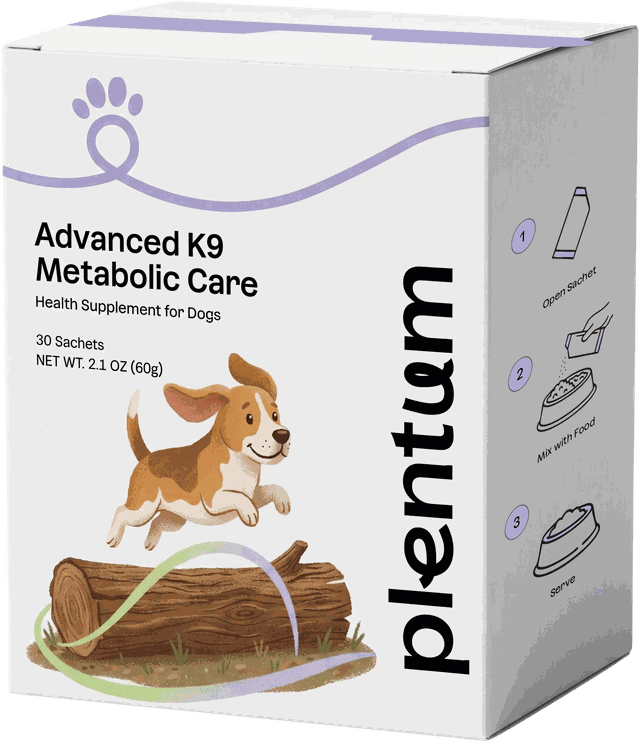
- Metabolic Care It supports healthy weight management alongside measured portions and daily exercise. From $1.50/day
- Microbiome Care It’s a daily powder with a postbiotic and prebiotic foundation, plus colostrum and omega-3, to support gut, oral, skin, and coat health. From $1.17/day
Which one should you pick?
It comes down to your goal and your dog's weight. Your vet can look over the choice, especially if your dog takes medication or has a health condition.
FortiFlora is the easy call if your vet already recommends it or your dog is doing well on it. It also makes sense if you want a single named strain from a large, familiar brand, or you have a big dog and like a flat daily cost.
Gut Restore suits owners who want more CFU per serving, five named strains including S. boulardii and a postbiotic in one sachet, with dosing in four weight tiers. A short inactive list and a Certificate of Analysis for every lot may matter to you too.
Microbiome Care is for you if you'd like a postbiotic and prebiotic powder with no live cultures. If allergies are part of the picture, Do dog supplements help with allergies? A science-first look is a good place to start. Either way, your vet's assessment comes first.
Dosing and what to watch for
For Gut Restore, mix 1 sachet into food once a day up to 25 lb, 2 at 26 to 50 lb, 3 at 51 to 75 lb and 4 over 75 lb. For FortiFlora, give one packet daily, or as your vet directs.
Start one new product at a time, or you'll never know which one changed your dog's stool. Give it a steady trial and jot down stool, appetite, vomiting and comfort each day. Check the storage directions on any live-culture product, too, and keep it cool and dry if the label asks.
Frequently asked questions
Can FortiFlora cause diarrhea in dogs?
Any new product can change stool, especially alongside a food or supplement change. Call sooner if it lasts, has blood in it, or comes with vomiting or lethargy.
Which dog probiotic brands use strains that have been studied?
Find the strain name on the label, then look up the studies the company cites: what each one measured, in which dogs and for how long. FortiFlora names one strain, SF68 (Enterococcus lactis SF68 on Purina's US shop, Enterococcus faecium SF68 on its Amazon listing). Gut Restore names five: L. casei K9-1, L. fermentum K9-2, L. brevis WF-1B, L. reuteri WF-1 and S. boulardii. Your vet can help you decide which suits your dog.
How long for FortiFlora to work in dogs?
There's no single answer, since it depends on the dog and why you're using it. Keep a dated log and give it a steady trial.
Is Plentum safe for puppies?
Check the age guidance on the current label before giving any product to a puppy. Puppies have different needs, so ask your vet first, especially if yours is very young or has a health condition.
Sources
- Purina Pro Plan FortiFlora (Purina shop: packet count, price, strain, guarantee), checked October 19, 2026
- Purina shop FAQ (90-day satisfaction guarantee), checked October 19, 2026
- Purina Pro Plan FortiFlora (brand listing on Amazon), checked October 19, 2026
- Plentum Gut Restore, checked October 2026
- Plentum Microbiome Care, checked October 2026
- WSAVA Global Nutrition Guidelines
- Sordillo et al., Animals 2025;15(11):1596 (postbiotic ingredient study)
Competitor information comes from each brand's own product page or brand-run listing. Plentum facts come from its printed labels and product pages.