
Quick answer: The best sensitive-stomach food is a complete-and-balanced recipe for your dog’s life stage that matches the reason for changing diets. Compare the nutritional adequacy statement, calories, protein source, fat and fiber guarantees, manufacturer quality controls, and your dog’s response during a slow transition. Repeated vomiting, blood in stool, weight loss, marked lethargy, abdominal swelling, or persistent diarrhea needs veterinary care rather than another over-the-counter food switch.
Key takeaways
- “Sensitive stomach” describes a pattern; it is not a diagnosis. Parasites, pancreatitis, adverse food reactions, chronic enteropathy, medication effects, and other conditions can look similar.
- Start with the nutritional adequacy statement. It should say the food is complete and balanced for your dog’s life stage.
- No ingredient list proves that one food is best. Calories, nutrient guarantees, formulation expertise, quality controls, and the individual dog matter too.
- The four foods below are label-researched examples, not a universal ranking and not substitutes for a veterinary diet trial.
- Change one variable at a time and keep a dated stool, appetite, vomiting, comfort, and weight log.
Four label-checked adult dry foods
These are four different starting points for dog food for dogs with sensitive stomachs, not positions one through four. All figures are the manufacturers’ current as-fed guarantees unless a row says otherwise. The comparison method is explained in the next section.
| Formula | Nutritional adequacy | First named animal protein | Protein min. | Fat min. | Fiber max. | Moisture max. | Calories | A practical fit to discuss |
|---|---|---|---|---|---|---|---|---|
| Purina Pro Plan Sensitive Skin & Stomach Salmon & Rice Adult Dry | Adult maintenance; AAFCO feeding tests | Salmon | 26% | 16% | 4% | 12% | 449 kcal/cup | An adult salmon-first formula with feeding-test substantiation; not a fit for a dog that must avoid fish |
| Royal Canin Medium Digestive Care Dry | Adult maintenance; formulated to meet AAFCO profile | Chicken by-product meal | 23% | 16% | 3.7% | 10% | 321 kcal/cup | Specifically labeled for medium adult dogs, 23–55 lb; it is not a small-breed, large-breed, puppy, or prescription diet |
| Natural Balance Limited Ingredient Salmon & Brown Rice Adult Dry | Adult maintenance; formulated to meet AAFCO profile | Salmon | 24% | 12% | 4.5% | 10% | 360 kcal/cup | A poultry-free, salmon-first option with one named animal-protein source; an OTC label does not replace a controlled elimination trial |
| Hill’s Science Diet Adult Sensitive Stomach & Skin Chicken & Barley Dry | Adult maintenance; AAFCO feeding tests | Chicken | — | — | — | — | 391 kcal/cup | An adult chicken-first option with feeding-test substantiation; the live page reports typical dry-matter values, so those values are not mixed with the other rows’ as-fed guarantees |
The dashes in the Hill’s row are deliberate. Its current public page reports typical dry-matter protein, fat, and fiber values, while the other rows expose as-fed minimum or maximum guarantees. Putting both bases into the same columns would create a false comparison.
How to use the table
- If life stage is the first constraint: choose only a formula whose adequacy statement fits the dog. Adult-maintenance foods are not automatically appropriate for puppies or reproduction.
- If a veterinarian suspects a food reaction: ask whether the next step should be a veterinary hydrolyzed or novel-protein elimination trial. An over-the-counter “limited ingredient” label cannot establish a diagnosis and may not provide the controls needed for a formal trial.
- If calories or fat matter: use the exact product label and your veterinarian’s target. “Sensitive stomach” does not mean low fat, and the foods above differ substantially in calories per cup.
- If body size matters: respect size-specific labeling. Royal Canin’s formula in this table is explicitly for medium adult dogs.
- If one protein has caused problems before: do not select a formula just because another ingredient looks appealing. Review the full ingredient panel for all animal proteins and discuss prior exposures with your veterinarian.
How we compared the foods
We reviewed current U.S. manufacturer pages and package information on August 21, 2026. We recorded:
- the nutritional adequacy statement and life stage;
- whether adequacy was established by formulation or an AAFCO feeding test;
- the first named animal-protein source;
- the guaranteed minimum protein and fat, maximum fiber and moisture, and calories per cup;
- the dog or use case the manufacturer specifies; and
- limitations that matter before a food change.
The FDA explains that a “complete and balanced” claim must be supported by an AAFCO nutrient profile or feeding trial. It also cautions that wet and dry foods cannot be compared directly from as-fed percentages without converting them to a dry-matter basis. Read the FDA’s complete-and-balanced guide.
We also used the WSAVA pet-food selection questions: who formulates the diet, who manufactures it, what quality controls and research are available, whether the company will provide a typical nutrient analysis, and whether owners can reach the company with questions. WSAVA does not approve or rank brands; its questions are a due-diligence framework.
This is a label comparison, not a feeding trial. Plentum did not purchase, feed, laboratory-test, or receive these foods. Prices were excluded because they change frequently and vary by package and retailer.
How to read a sensitive-stomach food label
Find the nutritional adequacy statement
AAFCO calls this one of the most important parts of the label. It identifies the species, life stage, and whether the food is intended as a complete diet. A food, topper, or supplement labeled for intermittent or supplemental feeding should not replace a complete diet. See AAFCO’s label guide.
“Formulated to meet” and “animal feeding tests substantiate” are different substantiation paths. Neither phrase proves that a food will suit every dog, but both are more useful than an unregulated front-of-bag phrase.
Compare calories before comparing serving cups
Cup recommendations are not interchangeable. In this comparison, the stated energy ranges from 321 to 449 kcal per cup. The appropriate amount depends on body condition, activity, age, health history, and the manufacturer’s gram-per-cup measure. A kitchen scoop that is larger than a standard measuring cup can quietly add calories.
Treat the guaranteed analysis as a starting point
The guaranteed analysis usually gives minimum protein and fat and maximum fiber and moisture. It does not show the exact amount in every batch, digestibility, amino-acid quality, or the full nutrient profile. Ask the manufacturer for a typical nutrient analysis when a specific nutrient matters.
Do not directly compare dry and wet foods from as-fed percentages. The FDA recommends converting nutrients to a dry-matter basis when moisture differs substantially.
Read the complete ingredient panel
The first ingredient alone does not determine food quality or tolerance. Look for every animal-protein source, fat source, fiber source, and any ingredient your dog has previously reacted to. A short ingredient list can be easier to interpret, but “natural,” “premium,” and similar marketing terms do not establish nutritional adequacy or digestibility.
Evaluate the manufacturer
Ask who formulated the food and their qualifications, where the food is made, what finished-product and ingredient testing is performed, whether the company conducts or supports relevant research, and whether a knowledgeable representative will answer nutrient questions. If the company will not provide basic information, discuss that gap with your veterinarian.
How to switch foods without confusing the result
Unless your veterinarian gives a different plan, a gradual transition is easier to interpret than an abrupt switch.
| Transition window | Current food | New food | What to record |
|---|---|---|---|
| Days 1–3 | 75% | 25% | Appetite, stool frequency and consistency, vomiting, gas, comfort |
| Days 4–6 | 50% | 50% | Whether signs are improving, unchanged, or worsening |
| Days 7–9 | 25% | 75% | Weight trend, energy, itching, and any new sign |
| Day 10 onward | 0% | 100% | Keep the rest of the routine stable long enough to interpret the change |
Some dogs need a slower plan, and some medical diets require a veterinarian-directed switch. Stop the experiment and call your veterinarian if signs become severe or rapidly worsen.
Avoid adding a new topper, treat, chew, probiotic, and food on the same day. If several variables change together, neither you nor your veterinarian can tell what helped or caused a problem.
Where supplements fit
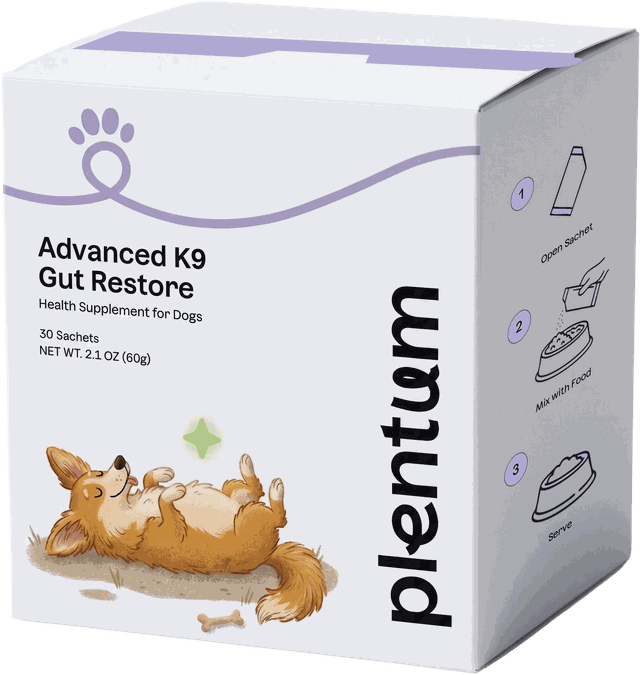
Change one thing at a time: if you add a supplement such as Gut Restore, start it a few days before or after the food switch so you can tell which change helped.
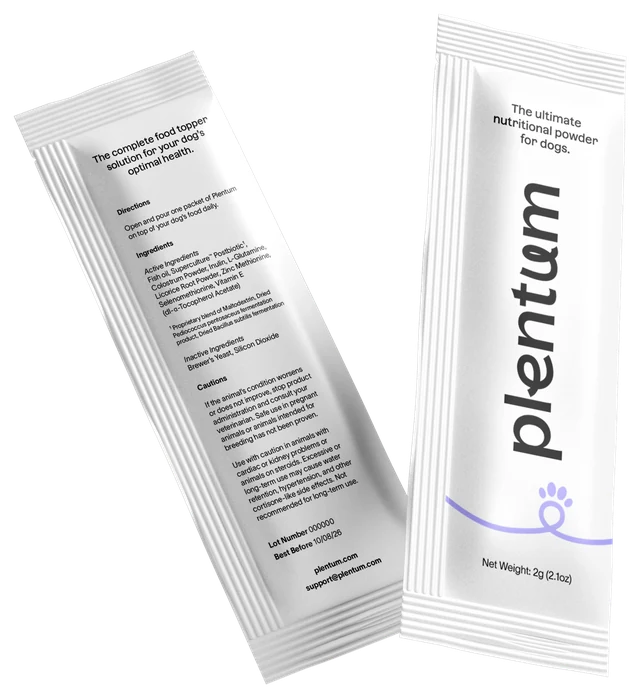
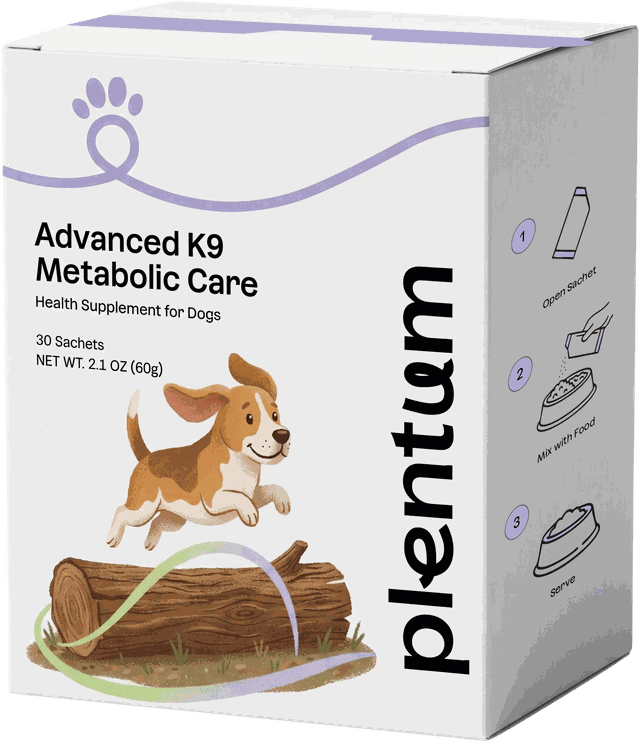
Once a complete food routine is stable, some owners ask about a separate digestive-support product. Plentum is a postbiotic and prebiotic dog supplement, not dog food, and it does not replace complete nutrition or veterinary care. Review Plentum's ingredient list and serving directions with your veterinarian before adding any supplement.
Raise it especially when your dog has chronic signs, allergies, pancreatitis, another medical condition, or takes medication.
Supplement, not a medicine. Ask your vet if your dog has a health condition or takes medication.
When a “sensitive stomach” needs veterinary care
For mild, short-lived softness, these food-first steps to firm up loose stool are a reasonable start.
A food switch should not delay diagnosis of parasites, obstruction, pancreatitis, chronic enteropathy, an adverse food reaction, medication effects, or another condition. If the signs below appear, call your veterinarian before changing the food again.
Frequently asked questions
Is grain-free food better for a dog with a sensitive stomach?
Not automatically. A dog can react to many dietary components, and grain-free does not mean more digestible or appropriate. Choose a complete-and-balanced food for the correct life stage and use a veterinarian-guided trial when an adverse food reaction is suspected.
What dog food brands are known for limited-ingredient formulas?
Several manufacturers make limited-ingredient dry foods, and Natural Balance is one example in the table above. A limited-ingredient diet is not the same as a prescription elimination diet. An over-the-counter limited-ingredient food may simplify the label, but it does not necessarily provide the ingredient controls or hydrolyzed proteins used in a veterinarian-supervised elimination trial.
What are the top-rated dry dog foods for sensitive stomachs?
There is no single ranking that fits every dog. The table above compares four adult dry foods by their labels, and no one of them is the winner. Match the life stage, calories, protein source and your dog’s history, then check the choice with your veterinarian.
Which dog foods are known for high digestibility?
Digestibility is not shown on the guaranteed analysis, so a label alone cannot answer this. Ask the manufacturer for a typical nutrient analysis and for any digestibility research it can share. Judge the food by how your own dog does during a slow transition.
How long should a food transition take?
Many manufacturers suggest about 7–10 days, but tolerance varies. Dogs with a history of digestive upset may need a slower transition, and medical diets may have a veterinarian-specific schedule.
Should I add a probiotic or postbiotic during the switch?
Do not add several variables automatically. First establish why the food is changing, then ask your veterinarian whether a specific product, strain, ingredient, and amount makes sense for your dog. A supplement should not replace a complete diet or evaluation of persistent symptoms. Before introducing a probiotic, review the possible probiotic side effects and red flags.
Sources
Primary references were checked on August 21, 2026. Formula details can change, so recheck the package before purchase.
- FDA: Complete and balanced pet food
- AAFCO: Reading pet food labels
- WSAVA: Selecting a pet food for your pet
- Purina: Pro Plan Sensitive Skin & Stomach Salmon & Rice Adult label
- Royal Canin: Medium Digestive Care Dry
- Natural Balance: Limited Ingredient Salmon & Brown Rice Adult
- Hill’s: Science Diet Adult Sensitive Stomach & Skin Chicken Dry
Plentum sells a dog supplement, not dog food. The foods above were selected for an educational label comparison. Plentum did not purchase, feed, laboratory-test, or receive these products, and the manufacturers did not sponsor this guide. This article provides general educational information and is not a substitute for veterinary diagnosis or care.
Supplement, not a medicine. Ask your vet if your dog has a health condition or takes medication. These statements have not been evaluated by the Food and Drug Administration. This product is not intended to diagnose, treat, cure, or prevent any disease.