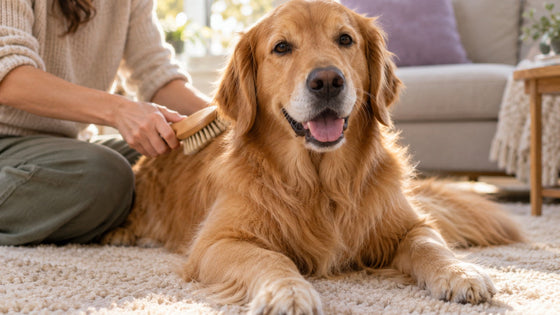









You’re checking your dog’s ribs. Body condition score uses sight and touch to assess fat alongside scale weight.
What does body condition score tell you?
| Compare | What to check |
|---|---|
| 1–3 | Underweight |
| 4–5 | Ideal body condition |
| 6–7 | Overweight |
| 8–9 | Obese |
Two dogs of the same breed and weight can look very different under the fur.
One may be lean with good muscle. Another may carry a lot of fat and less muscle.
BCS is a hands-on way to tell them apart. Most vets use a 9-point scale:
- 1–3: Underweight (1 is severely emaciated, 3 is thin but not severely so)
- 4–5: Ideal body condition
- 6–7: Overweight
- 8–9: Obese
Your vet will usually score your dog at wellness visits.
A quick check at home between visits helps you catch weight changes early, before they turn into a medical problem.

Check your dog in three steps
1. Feel the ribs
Place both thumbs on your dog's spine and spread your fingers across the rib cage.
Press lightly and slide your fingers along the ribs.
- Ideal (BCS 4–5): You can feel each rib easily with light pressure. A thin, smooth layer of fat covers them, but the ribs don't poke through the skin.
- Overweight (BCS 6–7): Ribs are hard to feel and need moderate to firm pressure. There's a noticeable fat layer.
- Obese (BCS 8–9): Ribs are very hard to feel even with firm pressure. Heavy fat deposits are visible.
- Underweight (BCS 2–3): Ribs are easy to feel with no pressure at all and may be visible. There's little to no fat covering.
2. Look for the waist from above
Stand directly over your dog and look down at their back.
- Ideal: You can see a waist, an indentation behind the rib cage and before the hips. The body isn't a straight-sided rectangle from this view.
- Overweight or obese: The waist is missing or barely visible, and the outline from above is oval or barrel-shaped.
- Underweight: The waist may look exaggerated, and the hip bones may stand out.
3. Check the belly tuck from the side
Step back and look at your dog from the side, at their eye level.
- Ideal: The belly rises from the bottom of the rib cage toward the hind legs in a visible upward tuck.
- Overweight or obese: The belly is flat or hangs below the rib cage. A sagging belly is a clear sign of extra weight.
- Underweight: The tuck is dramatic, with the belly drawn sharply upward.

Why the scale can mislead you
Scale weight is easy to measure, but it doesn't show what that weight is made of. A few examples:
- A 32 kg (about 70 lb) Labrador with good muscle and BCS 5 is at an ideal weight. A 32 kg Lab with poor muscle tone and heavy fat deposits might be BCS 7 and overweight.
- A dog who's lost muscle instead of fat (common in illness) may weigh less but be in worse nutritional shape.
- Breeds vary a lot. A "normal" male Golden Retriever weighs 29–34 kg (about 64–75 lb), and that range doesn't tell you where your dog should sit in it.
Vets who specialize in nutrition use BCS alongside scale weight as standard, because together they give a fuller picture.
How often to check
For healthy adult dogs at a stable weight, once a month at home is enough.
For senior dogs or dogs with chronic conditions, ask your vet how often to check.
If your dog scores too high or too low
Overweight (BCS 6–7) or obese (BCS 8–9)
Work out a calorie and exercise plan with your vet.
For a score of 6 or above, follow our 12-week weight plan.
Measure food, follow an appropriate diet and activity plan, and recheck body condition monthly.
Veterinary weight-management diets can help meet nutritional needs while reducing calories.
Ask which approach suits your dog.
If your vet sets a feeding plan, Metabolic Care supports healthy body condition alongside it.
Underweight (BCS 1–3)
An underweight dog needs a vet to find the cause.
Low body condition can involve food intake, parasites, poor absorption, or another illness.
Don't just increase food before you know why.
Sources and further reading
These resources provide background. Diagnosis and treatment need a vet who has examined your dog.
Questions owners ask
What's a healthy body condition score for a dog?
On the 9-point scale, 4–5 is ideal. A score of 1–3 is underweight, 6–7 is overweight and 8–9 is obese.
Can I check my dog's body condition at home?
You can feel ribs and check the waist and belly tuck at home. Score a stable adult dog monthly.
My dog's weight looks right on the scale. Could they still be overweight?
A normal-looking weight can hide excess fat. Body condition scoring adds information the scale cannot.
What should I track while my dog is on a weight plan?
Log weight, body condition, meals, treats, and activity. Note appetite changes for your vet.
Why does a weight check matter?
Extra weight can make walks and play harder for many dogs.
A check at home shows whether the food plan and activity are working, and it gives you a clear record to bring to a vet visit.
Use the same scale at a similar time of day. Meals and water affect weight readings.
For more depth, see the AAHA 2021 nutrition and weight management guidelines.