








To track your dog's weight, weigh on the same scale under the same conditions.
Write down the number and date.
Also add a body condition score from looking at and feeling your dog's ribs and waist.
Call the vet if your dog's weight changes for no clear reason.
What should a weight log include?
VCA describes a body condition score as a rating of fat cover.
It is based on looking at your dog and feeling specific body sites.
So the log pairs it with the weight.
Copy the table into a notebook or phone note, and fill in one row each month.
| Entry | What to write | Why it helps |
|---|---|---|
| Date and time | Same day each month, same time of day | Keeps entries comparable |
| Weight and scale | The number, the units, and which scale | Scales vary, so switching skews the trend |
| Body condition score | The score as a fraction, such as 5/9 | The same number means different things on each scale |
| Ribs and waist | Whether you can feel the ribs easily | Shows fat cover that a number cannot |
| Measured food | Daily amount, using the same measuring cup | Heaping portions add extra calories |
| Treats and extras | Chews, scraps, and training rewards | Extras are a common hidden source of calories |
| Notes | Appetite, exercise, thirst, medication changes, vet visits | Medical conditions and medicines can affect weight |
How do you weigh your dog the same way each time?
Use one scale for every entry, because PetMD quotes a vet who says scales vary a great deal.
If your dog is too big to lift, PetMD says almost any vet clinic will let you stop by and use its scale for free.
So make that clinic scale your only scale.
For the bathroom-scale method, read our guide to weighing your dog at home.
How often should you weigh your dog?
PetMD quotes vets who suggest weighing healthy adult dogs at least once a year or about every six months.
Puppies and dogs with chronic conditions need more frequent checks.
If your vet has asked you to watch weight, a monthly weigh-in is an easy habit to log.
How do you read the numbers?
Look at the last few entries instead of a single weigh-in.
PetMD's vet says home scales are fine for basic trends, and big surprises should be confirmed on the clinic's scale.
Then read the score next to the weight.
Cornell says your vet can rank your dog on a 1 to 9 body condition scale and help set an ideal weight.
A log with both numbers helps your vet assess your dog's weight.
VCA's quick touch test: at an ideal weight, the ribs feel like your knuckles when your hand rests flat.
For each score, read dog body condition score guide.
How does Plentum fit?
A supplement is daily support only after your vet has ruled out a medical cause for a weight change.
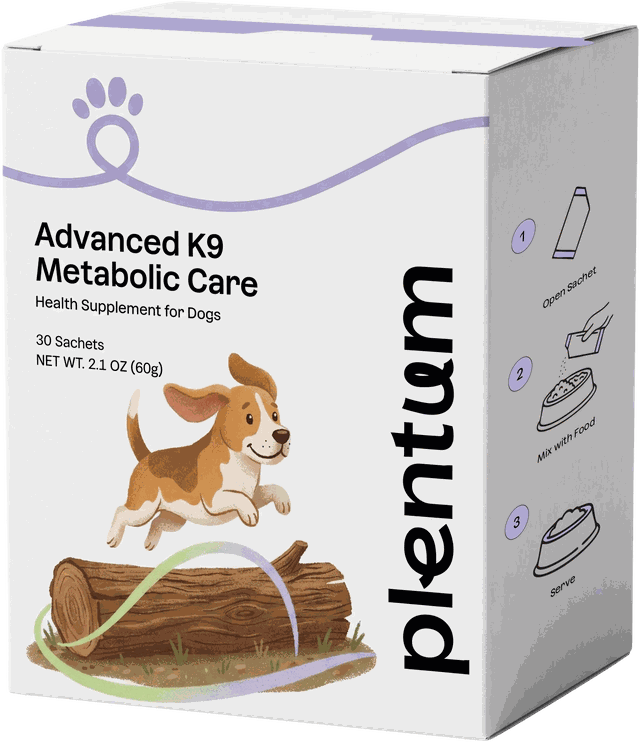
Plentum Advanced K9 Metabolic Care supports healthy weight management.
It does so alongside measured portions and daily exercise, the same habits your log tracks.
It contains chitosan, which comes from shellfish, so skip it for dogs with a shellfish allergy.
What is different for Cocker Spaniels?
Most breed data here comes from English Cocker Spaniels in UK vet practices.
These facts change what you check and when.
| Fact | How it changes what you do | Source |
|---|---|---|
| English Cockers have been identified as high risk for obesity | Measure meals and score body condition monthly | Engdahl 2023 |
| Obesity in 9.88% of English Cockers, 7.1% of UK dogs | Ask for a body condition check at every visit | Engdahl 2023 |
| Obesity peaked in middle-aged dogs | Start tracking weight before middle age | Engdahl 2023 |
| Undiagnosed hypothyroidism might add to that middle-age peak | Report weight gain on steady food to your vet | Engdahl 2023 |
| Hypothyroidism in 0.37% of English Cockers, 0.23% of all dogs | Check feeding and exercise too, since thyroid disease is uncommon | O'Neill 2022 |
| Weight gain without more appetite is a thyroid sign | Note appetite changes, or the lack of them | Merck thyroid |
When should you call the vet?
- A gain or loss you cannot explain by food or activity
- Ribs you cannot feel under a thick layer of fat
- Ribs and hip bones that stick out
- Loss of appetite or sudden pickiness
- More drinking or more urination than usual
- Vomiting, diarrhea, or lethargy with a weight change
Bring the log to the visit so your vet can see the pattern.
For the full picture, read the healthy weight routine for dogs.
To set the food rows in your log, read dog portion control.
If a puppy is on your list, read puppy healthy weight and growth.
Sources
- VCA Animal Hospitals: Body condition scores
- PetMD: How to weigh your dog at home
- Cornell Riney Canine Health Center: Obesity and weight loss in dogs
- Engdahl et al. 2023: Demography and disorders of English Cocker Spaniels under primary veterinary care in the UK (Canine Med Genet)
- O'Neill et al. 2022: Hypothyroidism in dogs under primary veterinary care in the UK (Canine Med Genet)
- Merck Veterinary Manual: Disorders of the thyroid gland in dogs
Frequently asked questions
Is body condition score or weight more useful?
Both help.
The weight shows the trend over time, and the score shows how much fat covers the ribs and waist.
How often should I weigh a puppy?
PetMD quotes a vet who suggests far more often than for adults.
That means at least every three to four weeks for the first four to six months of life.
Can Plentum Advanced K9 Metabolic Care fix a weight problem?
No. It is a daily supplement, not a fix.
Find the cause of a weight change with your vet first, and keep portions and exercise at the center of the plan.