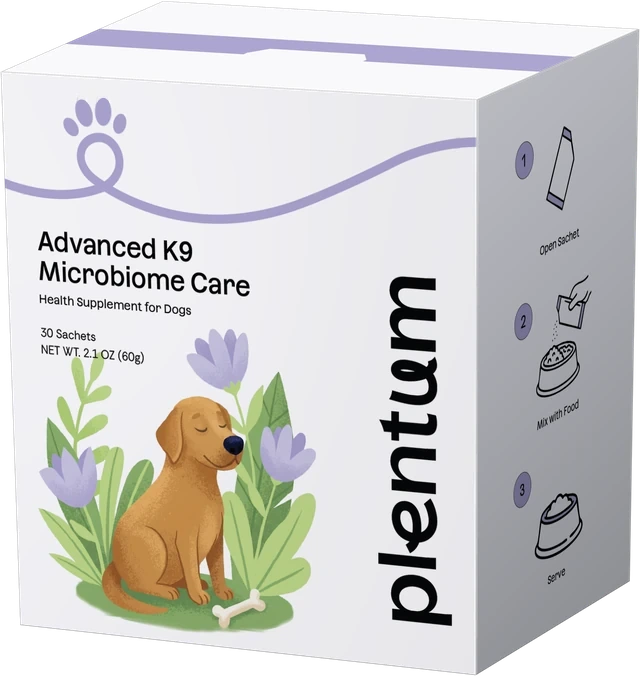

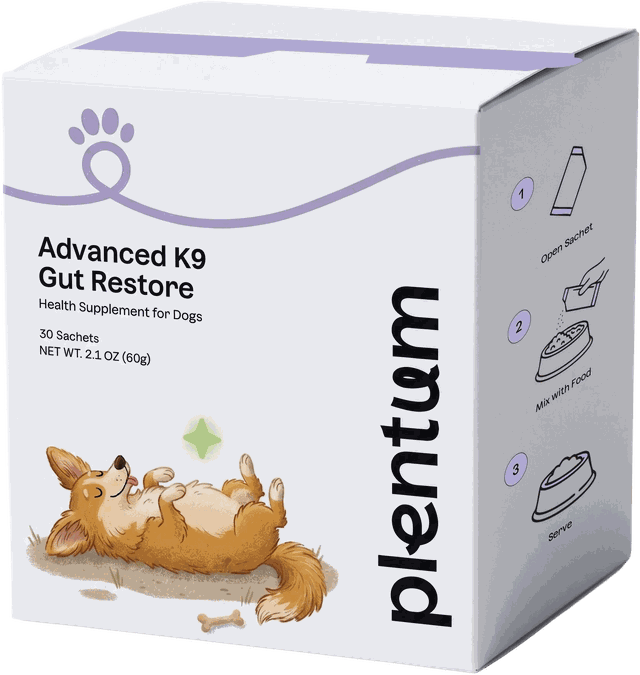





You’re choosing between Microbiome Care and Gut Restore.
Microbiome Care is the daily foundation; Gut Restore adds live cultures.
Which supplement fits your dog’s gut routine?
Microbiome Care combines a postbiotic, prebiotic, colostrum, and omega-3 without live cultures.
Gut Restore adds live cultures and three fibers.
Give Microbiome Care every day as the foundation.
Give Gut Restore daily too, starting on day 1 of a food switch, travel or boarding, or after a vet-prescribed antibiotic course.
You can give them together.
- Microbiome Care is the daily foundation. Gut Restore is the daily probiotic.
- Gut Restore contains live probiotics. Microbiome Care does not.
- You can give both. Start one at half the daily dose for 3 days, then give the full dose for your dog's weight. Wait a week at the full dose before introducing the second supplement the same way.
- Loose stool that lasts, or comes with other signs, is a vet visit first.
| Microbiome Care | Gut Restore | |
|---|---|---|
| Job | Daily foundation | Daily probiotic support |
| Type | Postbiotic + prebiotic | Probiotic + 3 fibers |
| Live cultures | No | Yes, 10 billion CFU at manufacture |
| Best moment | Every day | Daily, from day 1 of a food switch, trip or antibiotics |
| From, per day | $1.00 (subscription) | $1.33 (subscription) |
What each sachet contains
Microbiome Care: postbiotic and prebiotic, no live cultures
A postbiotic is a preparation of inactivated microbes or their components.
It is not alive, so it does not need to survive the gut.
A prebiotic, such as inulin, is fiber that feeds the bacteria already there.

| Active | Per 2 g sachet |
|---|---|
| Fish oil | 150 mg |
| Canine oral health postbiotic | 125 mg |
| Colostrum | 100 mg |
| Inulin | 100 mg |
| L-glutamine | 100 mg |
| Licorice root | 50 mg |
| Zinc methionine | 5 mg |
| Selenomethionine | 20 mcg |
| Vitamin E | 25 IU |
Gut Restore: canine probiotic blend plus three fibers
A probiotic is a live microorganism given in an amount that can benefit the host.
Gut Restore pairs a five-strain blend with stool-friendly fibers.
| Active | Per 2 g sachet |
|---|---|
| Probiotic blend with S. boulardii; 10 billion CFU at manufacture | 300 mg |
| Psyllium husk | 200 mg |
| Slippery elm bark | 150 mg |
| Organic pumpkin | 150 mg |
| Yeast cell wall (MOS) postbiotic | 75 mg |
| Jerusalem artichoke inulin | 50 mg |
Canine probiotic blend (four Lactobacillus strains + S. boulardii), 10 billion CFU at manufacture
Which one fits your dog right now?
Answer four questions, and the pattern points to the supplement.
- Stool right now: mostly firm → maintain. Soft or changeable lately → Gut Restore.
- A recent food switch, trip or boarding stay? Yes → start with Gut Restore.
- Your goal: everyday gut, mouth, and coat care → maintain.
Microbiome Care is the daily foundation. Gut Restore can be used daily from day one, including alongside Microbiome Care.
How to choose and start
Pick the supplement that matches your dog right now, or start with both if the answers above point to each.
Give it daily at the label amount for your dog's weight.
- Start with Microbiome Care for everyday gut, mouth and coat care.
- Start with Gut Restore on day 1 of a food switch, trip, boarding stay or vet-prescribed antibiotic course.
- Track stool a few times a week. Our dog poop color chart helps.
Changing one thing at a time makes it easier to see what helps.
Read more on stool in our guide to firming up dog stool, or compare both supplements in gut and digestion.
Read the healthy stool consistency guide for the probiotic blend and three fibers.
Can you give both together?
Yes, you can give both together as daily supplements. Both are 2 g sachets mixed into food.
The overlap is inulin: 100 mg in Microbiome Care and 50 mg in Gut Restore, a small amount of shared fiber.
Start one supplement at half the daily dose for 3 days, then give the full dose for your dog's weight.
After a week at the full dose, add the second supplement the same way: half the daily dose for 3 days, then the full dose for their weight.
| Dog weight | Microbiome Care | Gut Restore | Total sachets a day |
|---|---|---|---|
| 15 lb | 1 | 1 | 2 |
| 40 lb | 2 | 2 | 4 |
| 60 lb | 3 | 3 | 6 |
| 80 lb | 3 | 4 | 7 |
Starting one at a time lets you see how your dog does on each before the full daily amount of both.
Cost per day
Our five supplements line up side by side on our supplement comparison page, with the rules for using more than one.
| Dog weight | Microbiome Care | Gut Restore |
|---|---|---|
| Small | $1.00 sub · $1.17 one-time (under 20 lb) | $1.33 sub · $1.50 one-time (up to 25 lb) |
| Medium | $1.53 sub · $2.22 one-time (20–50 lb) | $2.50 sub · $2.87 one-time (26–50 lb) |
| Large | $2.17 sub · $3.25 one-time (above 50 lb) | $3.33 sub · $4.00 one-time (51–75 lb) |
| Giant | Same as large | $4.17 sub · $5.00 one-time (above 75 lb) |
When to see a vet first
- Blood in the stool, or black, tarry stool.
- Vomiting with the loose stool.
- Low energy, not eating, or signs of pain.
- A puppy, a senior dog or a dog with a health condition.
- Loose stool that lasts more than a couple of days, or keeps coming back.
A supplement is not the right first step for any of these. Some questions belong to your vet.
Microbiome Care, Gut Restore or both
The table below sums up the choice in one place so you can match the supplement to your dog today.
| Option | How it works | Best fit |
|---|---|---|
| Microbiome Care daily | Postbiotic and prebiotic foundation for gut and oral support | Best as the everyday base for most dogs |
| Gut Restore daily | Live probiotic blend with three fibers for stool support | Best when stool consistency needs daily support |
| Both together | Foundation plus live cultures and fiber in separate sachets | Add the daily sachets for both supplements together |
FAQ
Are all-in-one dog supplements with probiotics better than standalone probiotics?
Neither type is best for every dog. Microbiome Care uses a postbiotic, while Gut Restore has live probiotics.
Should I give my dog probiotics every day?
Not every dog needs a daily probiotic. Ask your vet whether Gut Restore fits your dog's routine.
How long does it take for probiotics to work in dogs?
Timing varies by dog and reason for use. Give the labeled amount and track stool changes.
Can probiotics cause diarrhea in dogs?
Some dogs develop loose stool or gas after starting. Stop and call your vet if signs persist or worsen.
What questions should I ask my veterinarian about probiotics for a sensitive dog?
Ask about tests, medication interactions, trial length, and success measures. Bring the product label.
Sources
- Salminen S, et al. The ISAPP consensus statement on the definition and scope of postbiotics. Nat Rev Gastroenterol Hepatol. 2021;18:649–667. PubMed 33948025
- Hill C, et al. The ISAPP consensus statement on the scope and appropriate use of the term probiotic. Nat Rev Gastroenterol Hepatol. 2014;11:506–514. PubMed 24912386
- Whittemore JC, et al. Randomized, controlled, crossover trial of prevention of antibiotic-induced gastrointestinal signs using a synbiotic mixture in healthy research dogs. J Vet Intern Med. 2019;33:1619–1626. PubMed 31268578