





Can a Probiotic Help an Anxious Dog? The Gut-Brain Connection Explained
Quick answer: Research suggests certain probiotic strains may support calmer behavior in dogs by acting on the gut-brain axis — the bidirectional communication network that links your dog's digestive system to its brain.
Because roughly 90% of serotonin is produced in the gut, and because the vagus nerve continuously relays gut signals to the brain, the state of your dog's microbiome can influence its emotional responses.
Probiotics are not a cure for anxiety, but they may be a meaningful part of a whole-dog wellness approach.
The Vagus Nerve: Your Dog's Gut-to-Brain Superhighway
The vagus nerve is often called the "wandering nerve" — from the Latin vagus, meaning to wander — because it stretches from the brainstem all the way down through the chest and into the abdomen.
What makes the vagus nerve so relevant to anxiety is its composition: approximately 80% of its fibers are afferent, meaning they carry information from the gut to the brain, not the other way around.
The gut is not passively receiving instructions from the brain — it is actively sending a constant stream of status reports about what is happening below.
Vagal sensory neurons lining the intestinal wall detect:
- Mechanical stretch and pressure (how full the gut is)
- Chemical signals from bacteria and their metabolic byproducts
- Neurotransmitters produced by enterochromaffin cells in the gut lining
- Inflammatory signals when the gut barrier is compromised
All of this information reaches the brain, where it contributes to emotional tone, threat perception, and stress reactivity.
When the gut microbiome is healthy and balanced, the signals traveling up the vagus nerve tend to support calm baseline states.
When the microbiome is disrupted — by diet, stress, illness, or antibiotics — those signals may shift in a direction that heightens arousal and anxiety.

Where Your Dog's Serotonin Actually Comes From
Most owners think of serotonin as a brain chemical. In fact, approximately 90% of the body's total serotonin is produced in the gut — specifically by enterochromaffin cells that line the intestinal wall.
This is true in humans, and it is true in dogs.
Here is where the picture gets more nuanced: gut-produced serotonin does not cross the blood-brain barrier directly. It cannot simply travel through the bloodstream and elevate a dog's mood.
Instead, it functions as a local messenger — stimulating the vagus nerve endings in the gut wall, which then transmit those signals upward to the brain.
The gut microbiome plays a direct role in regulating how much serotonin the enterochromaffin cells produce.
Certain bacterial strains — including members of the Bifidobacterium and Lactobacillus families — produce short-chain fatty acids (SCFAs) such as butyrate, acetate, and propionate.
These SCFAs stimulate serotonin synthesis in the gut lining, which in turn influences the quality and character of vagus nerve signals reaching the brain.
When the balance of gut bacteria shifts — reducing populations of SCFA-producing species — serotonin synthesis may fall, and the calming signals relayed by the vagus nerve may weaken.
This is one plausible mechanism by which gut dysbiosis could contribute to a dog appearing more anxious, reactive, or easily startled.
GABA: The Other Calming Signal From the Gut
Serotonin is not the only neuroactive compound linked to gut health.
GABA (gamma-aminobutyric acid) is the brain's primary inhibitory neurotransmitter — it is what puts the brakes on excessive neural firing. Certain Lactobacillus and Bifidobacterium species can produce GABA directly in the gut.
In preclinical studies, administration of GABA-producing Lactobacillus rhamnosus reduced anxiety-like behaviors and altered GABA receptor expression in ways that paralleled the effects of established calming medications.
While direct canine studies on GABA-producing probiotics remain limited, the mechanistic pathway is biologically plausible and actively researched.

What Research Shows About Probiotics and Anxious Dogs
The science is early but compelling.
Several controlled studies have now specifically examined probiotic supplementation in dogs with anxiety-related behaviors, and the results point in a consistent direction.
Bifidobacterium longum (BL999) in Anxious Labradors
In a blinded, placebo-controlled crossover study, researchers at Purina PetCare evaluated the impact of Bifidobacterium longum NCC3001 (also known as BL999) in anxious Labrador Retrievers.
Dogs alternated between the probiotic and a placebo over a multi-week period with a washout phase between conditions.
Research suggests that, when supplemented with BL999, dogs may show reductions in anxiety-related behaviors including barking, jumping, spinning, and pacing.
Physiological markers — such as salivary cortisol and heart rate — also appeared to decrease. The proposed mechanism of action involves vagal pathways, consistent with the gut-brain axis biology described above.
This study is frequently cited as category-defining, though it is worth noting that the full data were not published in a peer-reviewed journal at the time of this writing.
It should be interpreted as a signal, not a settled conclusion.
Lactiplantibacillus plantarum LP815 in a Randomized Trial
A 2025 randomized, placebo-controlled trial published in PMC (PMC12345577) evaluated a novel Lactiplantibacillus plantarum strain (LP815) in dogs.
Research indicates that, after several weeks of daily supplementation, the treatment group may show improvements in aggression and separation-anxiety behaviors.
The researchers also observed a reduction in plasma serotonin turnover ratio in the dogs with separation anxiety — suggesting changes in gut-to-brain serotonin signaling.
Gut Microbiome and Anxiety: The 2024 Predictive Study
A 2024 study published in Scientific Reports took a different approach: rather than supplementing dogs with probiotics, researchers compared the gut bacterial populations of anxious and calm dogs.
They found that anxious dogs had measurably different microbiome compositions — and machine-learning models were able to predict whether a dog was anxious or calm based on gut bacteria profiles alone.
While correlation is not causation, this finding adds biological weight to the hypothesis that gut state and emotional state are genuinely linked in dogs.
Key Studies at a Glance
| Study / Reference | Strain Studied | Design | Key Finding | Mechanism Proposed |
|---|---|---|---|---|
| Purina PetCare / BL999 crossover study | Bifidobacterium longum NCC3001 (BL999) | Blinded crossover, anxious Labradors, multi-week | Research suggests reduced anxiety behaviors, with lower salivary cortisol and heart rate | Vagal gut-brain pathway |
| PMC12345577 (2025) | Lactiplantibacillus plantarum LP815 | Randomized, placebo-controlled, multi-week | Research indicates improvement in aggression and separation-anxiety scores | Serotonin turnover ratio reduction |
| Scientific Reports 2024 | N/A — microbiome analysis | Observational, anxious vs. calm dog comparison | Anxious dogs have distinct gut bacterial profiles; anxiety predictable by microbiome alone | Gut dysbiosis linked to behavioral phenotype |
| Sacoor et al. 2024 (PMC10827376) | Multiple — review paper | Systematic review in Veterinary Medicine International | Gut-brain axis implicated in canine anxiety disorders; probiotics flagged as emerging intervention | Multiple: vagal, immune, neuroendocrine |

What to Look For in a Probiotic — and What to Expect
If you are considering adding a probiotic to your dog's routine as part of a gut-health and behavioral wellness approach, a few practical points are worth keeping in mind.
Strain Specificity Matters
Not all probiotics are alike. The behavioral research reviewed above involved specific, named strains — not just "a Bifidobacterium" or "a Lactobacillus." When evaluating a probiotic product, look for:
- Identified strain names (genus, species, and ideally a strain designation)
- Published CFU (colony-forming unit) counts at time of expiry, not just at manufacture
- Products formulated specifically for dogs, since human gut pH and transit time differ from canine
For a side-by-side evaluation of leading dog probiotics on the market in 2026, see: Best Dog Probiotics 2026: 5 Tested Picks That Actually Work.
Pair Probiotics with Prebiotics for Better Results
Probiotic bacteria need a food source to establish and proliferate in the gut.
Prebiotics — dietary fibers that selectively feed beneficial bacteria — are increasingly understood as essential companions to probiotic supplementation. A product that combines both is known as a synbiotic.
Probiotic for Dogs: What's the Difference?
Timeline: How Long Before You See Results?
The gut microbiome does not shift overnight. Most studies showing behavioral outcomes measured changes over four to twelve weeks of consistent daily supplementation.
Some research protocols detected measurable physiological changes (cortisol, heart rate) within two weeks, but observable behavioral changes may take longer.
Expect to give any new gut supplement at least four to six weeks before evaluating its effect on behavior.
Gut Support Is Not a Standalone Solution
Dogs with significant anxiety — separation distress, noise phobia, fear-based aggression, or compulsive behaviors — need individualized veterinary assessment.
Gut support can be a meaningful part of a comprehensive approach, but it does not replace behavioral modification training, environmental management, or prescription medication where indicated.
Always discuss new supplements with your veterinarian, particularly if your dog is on other medications.
You can also explore the broader role of digestive supplements in canine wellness at: Postbiotics for Dogs: What They Are and Why Your Dog's Gut Needs Them
A Plain-Language Guide.
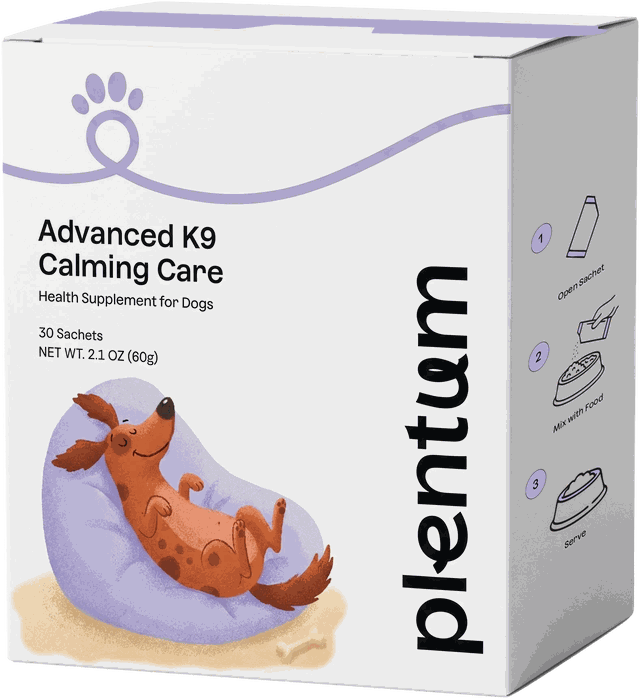
Calming Care combines L-theanine and GABA with a canine probiotic blend for dogs that get stressed by storms, travel or vet visits.
Could Gut Health Be Contributing to Your Dog's Anxiety?
Signs to Watch
Gut dysbiosis and anxiety can reinforce each other in a feedback loop.
Stress activates the hypothalamic-pituitary-adrenal (HPA) axis, which triggers cortisol release, which in turn can alter gut motility and bacterial balance — which then changes the quality of signals traveling up the vagus nerve to the brain, potentially sustaining the stress state.
It can be difficult to know where the cycle started.
Some signs that may suggest gut health deserves attention alongside behavioral support include:
- Anxiety symptoms that worsen around eating or after dietary changes
- Chronic loose stools or digestive irregularity in a dog that is also reactive or fearful
- A history of antibiotic use that preceded the onset of anxious behaviors
- Dogs that seem calmer on high-fiber, minimally-processed diets and more reactive on highly processed ones
None of these observations are diagnostic on their own, but they can be useful data to share with your veterinarian when discussing a holistic approach to your dog's behavioral health.
KEY TAKEAWAYS
Can a Probiotic Help an Anxious Dog? The Gut-Brain Connection Explained
- The Vagus Nerve: Your Dog's Gut-to-Brain Superhighway: The vagus nerve is often called the "wandering nerve" — from the Latin vagus , meaning to wander — because it stretches from the brainstem all the way
- Where Your Dog's Serotonin Actually Comes From: Most owners think of serotonin as a brain chemical. In fact, approximately 90% of the body's total serotonin is produced in the gut — specifically by
The Bottom Line
The gut-brain axis is real in dogs.
The vagus nerve is a genuine, high-traffic communication highway running from your dog's intestinal wall to its brain, and approximately 90% of its serotonin originates in the gut — where the microbiome directly influences how much is produced and how effectively it signals.
A growing body of peer-reviewed research confirms that anxious dogs have distinct gut microbiome profiles, and that certain probiotic strains can produce measurable shifts in both physiological markers (cortisol, heart rate) and observable anxiety-related behaviors.
What the science does not yet support is thinking of a probiotic as a calming treatment.
The evidence points toward gut health as one meaningful piece of a larger picture — one that includes diet quality, consistent routine, behavioral support, and veterinary guidance for dogs whose anxiety significantly affects their quality of life.
If you are exploring gut health support for your dog, start with the foundation: a high-quality, strain-identified probiotic, ideally combined with prebiotic fiber to nourish the bacteria you are introducing.
Give it four to six consistent weeks. And keep your veterinarian in the loop.
These statements have not been evaluated by the Food and Drug Administration.
This product is not intended to diagnose, treat, cure, or prevent any disease.
Compare ingredients and doses in our guide to the best calming supplements for dogs.
Sources and further reading
Use these resources for general standards and background. Individual symptoms, diagnoses, medications, and treatment decisions require a veterinarian who has examined your dog.
Frequently Asked Questions
Can a Probiotic Help an Anxious Dog?
Research suggests certain probiotic strains may support calmer behavior in dogs by acting on the gut-brain axis — the bidirectional communication network that links your dog's digestive system to its brain. Because roughly 90% of serotonin is produced in the gut, and because the vagus nerve continuously relays gut signals to the brain, the state of your dog's microbiome can influence its emotional responses. Probiotics are not a cure for anxiety, but they may be a meaningful part of a whole-dog wellness approach.
What should dog owners know about the vagus nerve their dog's gut-to-brain superhighway?
The vagus nerve is often called the "wandering nerve" — from the Latin vagus , meaning to wander — because it stretches from the brainstem all the way down through the chest and into the abdomen.
What should owners compare before making a change related to can a probiotic help an anxious dog the gut-brain connection explained?
For Can a Probiotic Help an Anxious Dog The Gut-Brain Connection Explained, compare the dog's baseline, the exact goal, product or diet details, relevant health conditions, medications, and the evidence supporting the proposed change. Change one variable at a time so benefits or adverse effects can be interpreted.
Which changes should owners track while following guidance on can a probiotic help an anxious dog the gut-brain connection explained?
For Can a Probiotic Help an Anxious Dog The Gut-Brain Connection Explained, track the dog's baseline, the one variable changed, appetite, stool, vomiting, comfort, energy, skin or coat signs when relevant, and any adverse effect. A dated record helps owners and veterinarians judge trends instead of isolated days.