

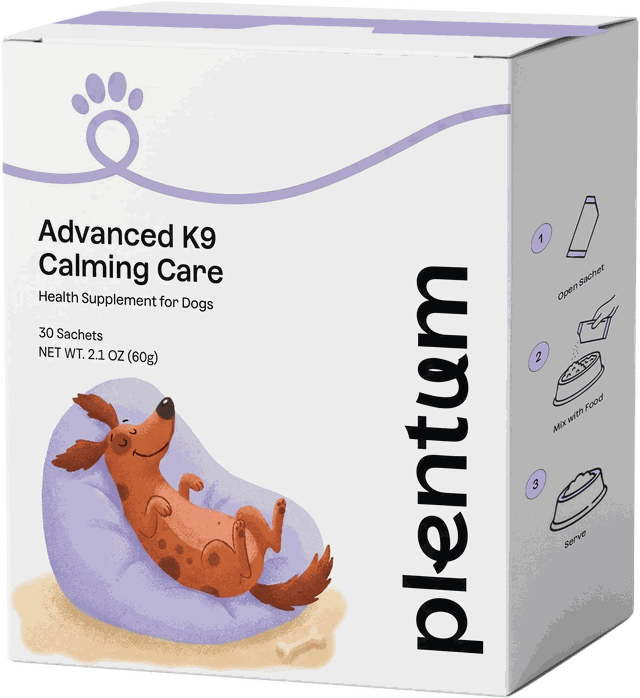




If storms or car rides leave your dog pacing and panting, you want to know exactly what goes into the bowl. Here are Calming Care's eleven actives, with no melatonin, and what the research shows for each one.
Quick answer
Calming Care is a melatonin-free powder made to support calm behavior in stressful moments, such as storms, car rides and vet visits. It holds eleven actives, and every amount is on the label. Research in dogs is limited for most of them, and much of the data comes from people. We show which is which below.
- Eleven actives: Suntheanine L-theanine, GABA, magnesium, L-tryptophan, chamomile, passionflower, valerian, KSM-66 ashwagandha, vitamin B6, a postbiotic and a proprietary probiotic blend.
- It is melatonin-free and supports a calm, relaxed demeanor during occasional stress.
- It supports calm behavior.
Why we built a melatonin-free supplement
Melatonin is a sleep hormone. It has a place, and your vet can tell you whether it suits your dog. But the moments that worry dog parents happen when the dog is awake: the first rumble of a storm, the car park at the vet, a house full of guests.
So we built a supplement for the daytime. It uses amino acids, minerals, botanicals and one adaptogen that dog parents and vets already know, at amounts printed on the label. The Calming Care label reads Veterinarian Formulated. If you are weighing it against a prescription, our guide to calming supplements and sedatives explains the difference.
The eleven actives at a glance
| Ingredient | Per 2 g sachet | What it is | What research exists |
|---|---|---|---|
| Suntheanine L-theanine | 200 mg | An amino acid from tea leaves | Dog research is limited. A placebo-controlled study of this brand in healthy adults, not dogs. |
| GABA | 150 mg | A calming signal molecule made in the body | Human data only, and limited. No published dog studies. |
| Magnesium | 100 mg | A mineral | Little research in dogs. |
| L-tryptophan | 100 mg | An amino acid the body uses to make serotonin | Mixed results in dogs. |
| Chamomile | 75 mg | A daisy-family herb | Mostly human data. |
| Passionflower | 75 mg | A climbing-vine herb | Mostly human data. Tested in a dog study as part of a combination. |
| Valerian | 50 mg | A root used in traditional herbal products | Mostly human data. Tested in a dog study as part of a combination. |
| KSM-66 ashwagandha | 50 mg | A root extract | Human studies of this brand. No dog data. |
| Vitamin B6 | 2 mg | A vitamin the body uses with amino acids | Little research in dogs. |
| A postbiotic | 100 mg | A postbiotic, a by-product of fermentation | We found no published study of calm behavior with this ingredient. |
| Proprietary probiotic blend | 75 mg, 10 billion CFU at manufacture | A proprietary probiotic blend (L. casei K9-1, L. fermentum K9-2, L. brevis WF-1B, L. reuteri WF-1, S. boulardii) | We found no published study of calm behavior with this ingredient. |
The amino-acid trio: theanine, GABA and tryptophan
L-theanine is the lead ingredient at 200 mg per sachet, as Suntheanine. In a 4-week placebo-controlled crossover study in 30 healthy adults, 200 mg/day of L-theanine from the Suntheanine maker was associated with better self-rated stress and sleep scores. The supplier funded the human study.

GABA is a messenger that settles nerve activity. Whether a swallowed dose reaches the brain is still debated. A 2020 systematic review of 14 human studies found limited evidence that oral GABA supports a sense of calm. There are no published dog studies.
L-tryptophan is an amino acid the body turns into serotonin. Dog research is mixed, so we keep it to 100 mg per sachet as one supporting piece rather than the main one.
Magnesium and vitamin B6
Magnesium gives 100 mg of a mineral involved in normal nerve and muscle function. Vitamin B6, at 2 mg, helps the body use amino acids. Neither has much dog research behind it for calm. They are there as quiet support, not as the headline.
Botanicals and the adaptogen
Chamomile (75 mg), passionflower (75 mg), and valerian (50 mg) are plant ingredients with long histories in herbal products. Most of the research is in people. For dogs, there is one placebo-controlled study of a combination product.
In a randomized, placebo-controlled study in 44 dogs, a supplement combining tryptophan, valerian, and passionflower was associated with calmer owner-rated behavior and lower cortisol around fireworks. The product's maker funded the study.
KSM-66 ashwagandha (50 mg) is a branded root extract. In a 60-day placebo-controlled study in 64 stressed adults, KSM-66 ashwagandha (the brand in Calming Care) was associated with lower stress scores and lower cortisol. The brand owner supplied the extract for this human study.
The gut side of the supplement
Calming Care also holds a postbiotic and a proprietary probiotic blend (L. casei K9-1, L. fermentum K9-2, L. brevis WF-1B, L. reuteri WF-1, S. boulardii), with 10 billion CFU at manufacture. A settled tummy matters to a dog who is nervous about a trip. But we found no published study of calm behavior with this ingredient, so we do not say it calms. It is there for gut support.
How to use it
The label gives one daily serving by weight. Tear the sachet, pour it over your dog's food, and stir. A little warm water or wet food makes a gravy.
- Every day: 1 sachet up to 25 lb, 2 at 26–50 lb, 3 at 51–75 lb, 4 above 75 lb.
- Start with half your dog's daily dose for 3 days, then the full dose for their weight.
- Pair it with a plan: a quiet room, steady sound and practice. Veterinary reviews stress that calming supplements are best used alongside training, routine and, where needed, veterinary advice, not as a stand-alone answer.
| Ingredient | Up to 25 lb | 26–50 lb | 51–75 lb | Above 75 lb |
|---|---|---|---|---|
| L-theanine | 200 mg (1) | 400 mg (2) | 600 mg (3) | 800 mg (4) |
| GABA | 150 mg (1) | 300 mg (2) | 450 mg (3) | 600 mg (4) |
| Magnesium | 100 mg (1) | 200 mg (2) | 300 mg (3) | 400 mg (4) |
| L-tryptophan | 100 mg (1) | 200 mg (2) | 300 mg (3) | 400 mg (4) |
| Ashwagandha (KSM-66) | 50 mg (1) | 100 mg (2) | 150 mg (3) | 200 mg (4) |
You can also pair it with the daily foundation. The Microbiome Care + Calming Care bundle is 10% off.
To see how these ingredients fit into a calm week at home, with timing around loud events, read our guide to supporting a calm demeanor during storms and travel.
Safety first
Safe use in pregnant animals or animals intended for breeding has not been established. If your dog takes prescription medicine, particularly an MAOI, consult your veterinarian before use.
Calm support during occasional stress
Calming Care supports a calm, relaxed demeanor during occasional stress and is melatonin-free.
Our guide to calming supplements and our piece on the gut and calm go deeper. If you are not sure it is the right supplement, try the two-minute quiz, and see how every lot is tested on our quality page.
The settle-at-home plan explains a step-by-step plan to help a dog settle at home.
How to compare calming supplements fairly
A fair comparison starts with serving amounts, because ingredient lists alone hide the real differences.
| Option | How it works | Best fit |
|---|---|---|
| Amounts listed for every active | You see milligrams for each ingredient in one serving | You can compare strength across products |
| Melatonin included | The supplement adds melatonin to the calming blend | Ask your vet whether melatonin fits your dog |
| Melatonin-free daily powder | The supplement supports calm without added melatonin | Fits owners who prefer a daily routine |
FAQ
What ingredients should I look for in a calming supplement for a stressed dog?
Look for a label that shows every ingredient and its amount, and for probiotics, named strains and a CFU count. Common calming ingredients include L-theanine, GABA, L-tryptophan, magnesium, chamomile, passionflower, valerian, and ashwagandha. Research in dogs is limited for most of them.
Does Calming Care contain melatonin?
Calming Care is melatonin-free and supports a calm, relaxed demeanor during occasional stress.
Is Calming Care safe with my dog's medicines?
Your vet knows your dog's full history and can tell you whether it suits your dog.
Can I give Calming Care every day?
Yes, you can. The label directions are a daily serving by weight: 1 sachet up to 25 lb, 2 at 26–50 lb, 3 at 51–75 lb and 4 above 75 lb. Start with half your dog's daily dose for 3 days, then the full dose for their weight.
Will Calming Care make my dog sleepy?
Calming Care is melatonin-free and supports a calm, relaxed demeanor during occasional stress.
Sources
- Riemer S, et al. Therapy and Prevention of Noise Fears in Dogs-A Review of the Current Evidence for Practitioners. Animals. 2023. PubMed 38067015
- Hidese S, et al. Effects of L-Theanine Administration on Stress-Related Symptoms and Cognitive Functions in Healthy Adults: A Randomized Controlled Trial. Nutrients. 2019. PubMed 31623400
- Hepsomali P, et al. Effects of Oral Gamma-Aminobutyric Acid (GABA) Administration on Stress and Sleep in Humans: A Systematic Review. Frontiers in neuroscience. 2020. PubMed 33041752
- Ramos D, et al. Is It Possible to Mitigate Fear of Fireworks in Dogs? A Study on the Behavioural and Physiological Effects of a Psychoactive Supplement. Animals. 2024. PubMed 38612264
- Chandrasekhar K, et al. A prospective, randomized double-blind, placebo-controlled study of safety and efficacy of a high-concentration full-spectrum extract of ashwagandha root in reducing stress and anxiety in adults. Indian journal of psychological medicine. 2012. PubMed 23439798
- Plentum Product Facts panel for Calming Care (amounts per 2 g sachet, directions, cautions). Compare the supplements