








A dog anxious in the car usually shows fear, nausea, or both.
Fear shows as whining, pacing, or trying to climb out, while nausea shows as drooling, lip licking, or vomiting.
Short, pleasant trips built up gradually can help dogs, and a vet can check for motion sickness if the signs continue.
Is it fear, motion sickness, or both?
The signs overlap, so watch the timing.
Fear often starts at the door before the car moves, while motion sickness tends to start once the ride begins.
| Sign | Points to fear | Points to nausea |
|---|---|---|
| Whining or pacing | Yes | Sometimes |
| Trembling at the door | Yes | Sometimes |
| Drooling or lip licking | Sometimes | Yes |
| Vomiting during the ride | Sometimes | Yes |
The AKC guide to fears and phobias explains how fear shows up in dogs across many settings.
How do you retrain car rides step by step?
Go slowly, and move to the next step only when your dog takes a food reward and stays relaxed at the current one.
| Step | Practice | Move on when |
|---|---|---|
| 1 | Sit in the parked car with food rewards | Relaxed for a few minutes |
| 2 | Start the engine without driving | Calm with the engine on |
| 3 | Drive around the driveway | Stays relaxed |
| 4 | Take a short trip to a fun place | Happy to hop in |
| 5 | Repeat longer trips on the same routine | Calm for the whole ride |
How do you keep your dog safe in the car?
Secure your dog in the back seat with a harness or a crate that is fastened in place.
A loose dog can be thrown forward in a sudden stop, and a loose crate can slide.
Crack a window only enough for fresh air, and never leave your dog alone in a parked car.
What can help during the ride?
Keep the first trips short, and bring water and a familiar blanket for comfort.
Stop for a break if your dog seems unwell.
How does Plentum fit?
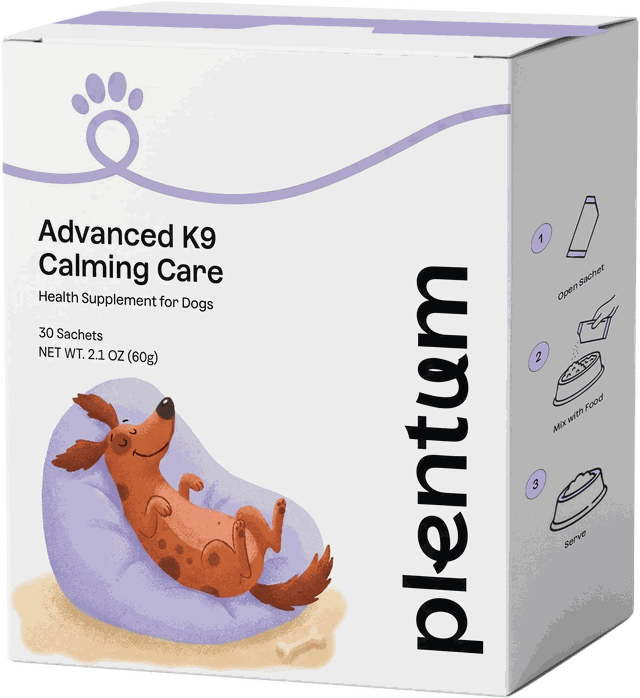
Plentum Advanced K9 Calming Care supports a calm, relaxed demeanor during occasional stress, and it is melatonin-free.
It works alongside gradual training, not in place of it, and it is not meant for motion sickness.
Dosing is by weight, from 1 to 4 sachets a day.
Safe use in pregnant animals or animals intended for breeding has not been established.
Consult your veterinarian before use if your dog takes prescription medication.
This is especially important for monoamine oxidase inhibitors (MAOIs).
Our guide to calming an anxious dog covers the wider routine, and the calm dog guide, training first sets out the full plan.
If alone time is also a problem, see our guide to separation anxiety in dogs.
Our dosing by dog weight guide explains sachet counts.
When should you see a vet or behaviorist?
Some car reactions point to a problem beyond fear or a bumpy ride.
- Vomiting on most trips
- Diarrhea after car rides
- Signs of pain when getting in or out
- Panic that does not improve
- Drooling so heavy that your dog seems unwell
Your vet can check for motion sickness and talk through options, including medication, that only a vet should choose.
Sources
- VCA Animal Hospitals: Motion sickness in dogs
- VCA Animal Hospitals: Air and car travel
- AKC: Fears and phobias
- Merck Veterinary Manual: Behavior problems in dogs
- AKC: Should I call my dog's vet
Frequently asked questions
Does motion sickness go away on its own?
Some dogs settle with practice, while others need help.
Persistent vomiting on every trip is a reason to see a vet.
Can I give my dog a human motion sickness pill?
No.
Human medicines can be unsafe for dogs, and only a vet can recommend a motion sickness medication and its dose.
Does the engine need to be running for training?
Start with the engine off, then move to the engine running once your dog stays calm.
Those small steps are the point of the training.