








Separation anxiety in dogs is a stress response that starts when a dog is left alone.
It shows up as destruction near doors, howling, house-soiling, or panic when you leave.
Dogs may improve with a graded plan that teaches them to be alone in short, calm steps.
If the signs are new, a vet check helps rule out pain or a medical cause first.
What are the signs of separation anxiety?
The signs usually start within minutes of your departure, and they stop when you return.
Watch for these patterns, which often appear together.
- Chewing or scratching at doors, windows, or crates
- Howling or barking soon after you leave
- Accidents in the house from a dog that is trained
- Drooling, pacing, or heavy panting
- Following you from room to room
How is it different from boredom?
Boredom tends to produce chewing at any time, and the damage is often spread around the home.
Separation anxiety clusters around your departures, and the dog may look frantic at the door.
Filming your dog for a short session shows you which pattern you are seeing.
The AKC guide to separation anxiety describes this training approach in detail.
How do you build a graded training plan?
Build alone time in small steps, and move on only when your dog stays relaxed at the current step.

| Step | Practice |
|---|---|
| 1 | Get dressed and grab your keys |
| 2 | Step outside, then return |
| 3 | Leave for a short walk to the mailbox |
| 4 | Leave the home for a short errand |
| 5 | Build to longer absences |
Keep your arrivals and departures low key.
Give a food puzzle or a chew that your dog only gets when you are gone.
Skip punishment: it raises stress and does not teach your dog to feel safe.
Keep daily exercise and a predictable schedule in place, because a tired dog settles more easily.
The calm dog guide, training first lays out the wider approach.
Our guides on dogs afraid of thunderstorms and fireworks and dogs anxious in the car cover related triggers.
How does Plentum fit?
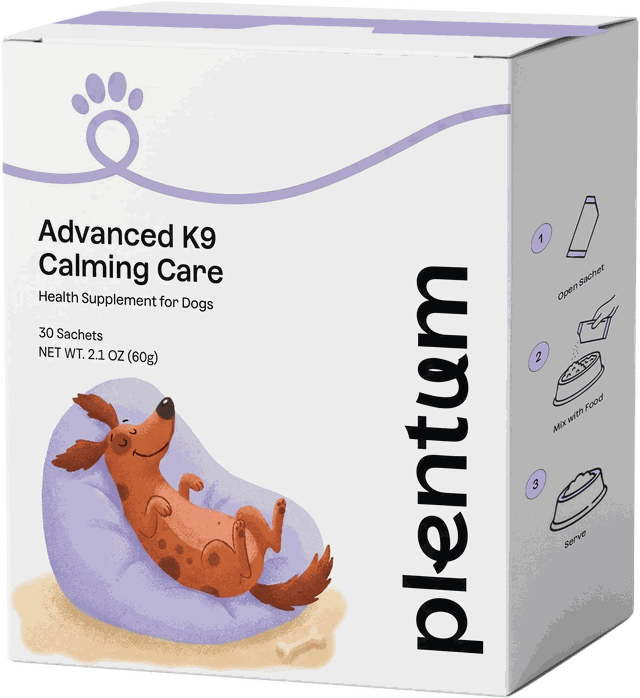
Plentum Advanced K9 Calming Care supports a calm, relaxed demeanor during occasional stress, and it is melatonin-free.
It does not replace a training plan, and no single product fixes separation anxiety.
Dosing is by weight, from 1 to 4 sachets a day.
Safe use in pregnant animals or animals intended for breeding has not been established.
Consult your veterinarian before use if your dog takes prescription medication.
This is especially important for monoamine oxidase inhibitors (MAOIs).
If you are comparing options, our melatonin and melatonin-free calming guide explains the difference.
When should you see a vet or behaviorist?
Some signs point beyond training and need a professional.
- Injuries from chewing, such as bleeding paws or broken teeth
- Escape attempts through doors or windows
- Refusing food or water while alone
- Panic that does not ease
- New signs in a senior dog
Your vet can rule out pain or medical causes, and a behaviorist can build a plan around your schedule and your dog's triggers.
Why does your dog stick so close?
AKC advises keeping departures and returns calm, because excitement makes them seem like major events.
Stay consistent, so your dog learns the same routine each day.
The ASPCA adds that anxious behaviors are stress responses, not disobedience.
Scolding or punishment tends to add to the problem.
What is independence training?
Practice comfortable settling a short distance away while you remain nearby.
Reward relaxation rather than forcing separation.
If your dog is comfortable, briefly step out of sight and return before distress starts.
Increase distance or duration only as comfort allows.
For a dog already panicking when alone, ask for a tailored plan rather than relying on a fixed five- or ten-minute target.
Sources
- AKC: Separation anxiety
- ASPCA: Separation anxiety
- Merck Veterinary Manual: Behavior problems in dogs
Frequently asked questions
How long does separation anxiety take to improve?
Progress varies by dog, and it usually takes weeks of steady practice.
Small gains, such as a calmer departure, count as real progress.
Can I punish my dog for chewing when I leave?
No.
Punishment after the fact does not teach the dog anything useful, and it can raise stress around your departures.
Will a supplement fix separation anxiety?
No single product fixes it.
Calming support works best alongside a training plan, and a vet can check for medical causes.
Should I crate my dog when I leave?
Some dogs settle in a crate, but a dog that panics inside one can hurt itself.
Watch closely, and see a behaviorist if the crate makes things worse.