








Your dog starts panting the second the first boom rolls in from a neighbor's yard. Maybe she's wedged behind the couch, or pacing the hallway, or ignoring the dinner she normally inhales. If that sounds familiar, the Fourth of July is probably the night you dread most.
The good news is that most of what helps happens well before the first sparkler. Plan on four to six weeks of small, repeated steps, because none of them work if you start the week of.
- Start preparing four to six weeks before fireworks, not the week before.
- Set up a safe space your dog can choose on its own, and keep it low in light and quiet.
Why fireworks hit dogs so hard

Fireworks throw several triggers at a dog at once. The bangs are loud and arrive with no warning, the lights flash, and smoke drifts through the air. Even a dog who shrugs off the vacuum can come apart.
VCA Animal Hospitals describes noise aversion in dogs, including fear of fireworks and thunderstorms, as one of the more common behavioral concerns veterinarians see. It isn't bad training or a flaw in your dog. It's a survival reflex firing at sounds her brain reads as a threat.
Dogs show it by panting, drooling, trembling, hiding, pacing, trying to escape or refusing food. Some bark or cry through the whole show. The time to act is before the next event.
Start four to six weeks out
Most people start the week before, which has a perfect record of not working.
Desensitization means playing recorded fireworks at low volume, then turning it up slowly over many short, calm sessions. One or two sessions won't do it, and it can't be crammed into the last few days. Yes, you'll be playing fireworks in your living room on a Tuesday afternoon. The neighbors will never know.
VCA Animal Hospitals' guidance on noise phobia describes a structured desensitization program paired with counter-conditioning, which means pairing the scary sound with something good, like a treat or a game. The combination can reduce fear in dogs with noise aversion, though results vary from dog to dog.
Sound practice, a safe space and a tired dog

Play the sounds at low volume
Find a good-quality recording of fireworks. Plenty are online, including playlists made for this. Play it so quietly you can barely hear it while your dog does something relaxed, like eating, playing or resting beside you.
Over several days, raise the volume a notch at a time. You want your dog to learn that these sounds go with good, calm moments, and that takes weeks. If she shows distress at any volume, turn it back down and end on a good note.
Set up a safe space now
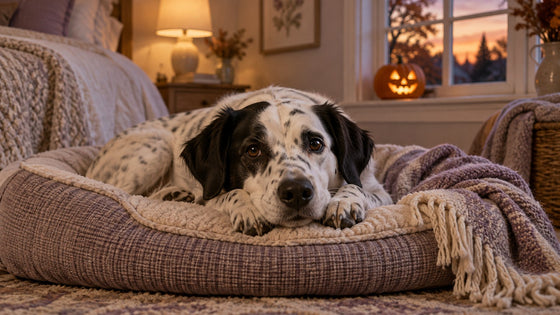
A crate covered with a heavy blanket works, and so does a bathroom, a walk-in closet or any interior room with few windows. You're looking for low light, muffled sound and something familiar.
Introduce it weeks ahead, not the day before. Leave treats there, put her favorite bed inside and let her explore on her own. You want her to walk in on her own when she feels overwhelmed.
Wear her out, body and brain
A dog who is tired in body and mind handles stress better than one who has been lying around all day. In the weeks before the Fourth, add longer walks, more fetch, puzzle feeders at mealtime and nose-work games.
| When | What to do | Why it helps |
|---|---|---|
| 6 to 4 weeks out | Start low-volume sound sessions and set up the safe space | Slow practice builds calm links to the sounds |
| 3 to 2 weeks out | Raise the volume a notch and add longer walks and puzzle feeders | A tired, busy dog copes better with stress |
| The last week | Check ID tags and microchip details and test any supplement on a quiet day | No surprises on the night itself |
| Fireworks night | Early walk, early dinner, safe room, white noise, and calm company | Fewer triggers reach your dog |
| The day after | Keep the routine quiet and write down how it went | Next year's plan starts from real notes |
The night itself
The prep is done. See how the evening goes.
Before dark
- Take a long, tiring walk in the early afternoon, before the crowds and noise build.
- Feed dinner a little earlier than usual. Some dogs lose their appetite once they get worried.
- Keep the usual daily routine, including any gut support you already use, so the day feels familiar.
As dusk approaches
- Move your dog into her safe space.
- Turn on white noise, a fan or calming music to soften the bangs.
- Close blinds and curtains to cut down on flashing lights.
- Stay calm yourself. Dogs pick up on your mood, and your worry can feed theirs.
During the fireworks
- Stay home if you can. Most dogs find your presence reassuring.
- Let her hide if she chooses, even if it's the bathtub you didn't plan for. Don't drag her toward the noise.
- Offer calm company: gentle petting if she asks for it, a puzzle feeder or a long-lasting chew.
- Don't punish fear. Trembling, whimpering and hiding are distress signals.
Dragging a scared dog toward the thing she's afraid of tends to make the fear worse.
After the fireworks
- Keep the next day or two calm and consistent, since stress can linger.
- Jot down how she handled this year's event, while you still remember. It makes next year's plan easier.
Where gut support fits

It may sound odd that digestion and stress are connected, but research in this area is growing. The gut and the brain talk through what researchers call the gut-brain axis, a network of nerves, hormones and immune signals that runs both ways between the digestive tract and the central nervous system.
Purina Institute researchers studied the strain Bifidobacterium longum NCC3001 (BL999) and found it was associated with calmer behavior in dogs when given consistently. That's a useful clue from one line of general research, and no more than that. The researchers studied the strain itself, and Calming Care does not contain BL999.
Don't expect overnight change. What steady daily gut support may do is help create a calmer internal baseline, so your dog's stress response isn't already near its limit when the fireworks start. That's why it works as a background habit built over weeks, well before the night.
If you want a daily gut routine, Advanced K9 Microbiome Care is a postbiotic and prebiotic powder with colostrum and omega-3 that you stir into food, at 1 to 3 sachets a day depending on your dog's weight.
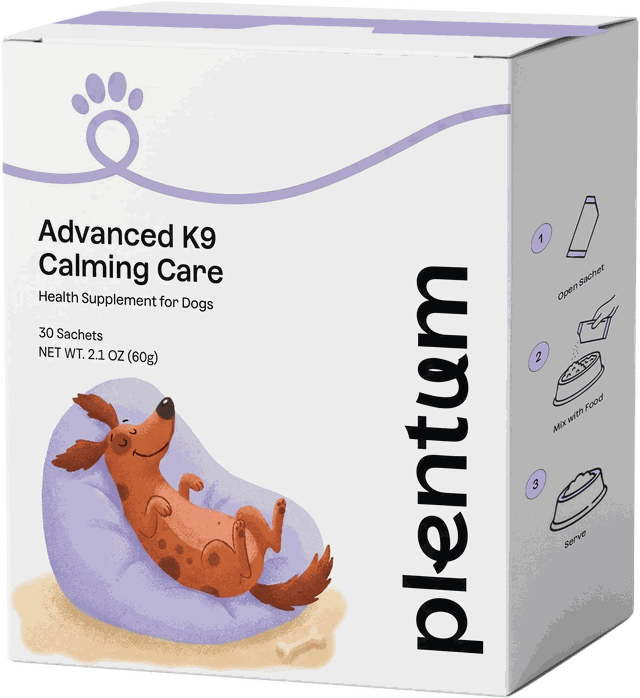
A supplement is an extra layer on top of the quiet room and the tired dog. If yours struggles with noise, Calming Care is one option. Give it before the fireworks start. Our comparison of the best calming supplements lists onset times.
Check with your vet first if your dog has a health condition or takes an MAOI, SSRI, trazodone or other medication.
For the calming side, our page on supporting a relaxed dog through storms and fireworks lists each ingredient in Calming Care and the amount in every sachet.
If you want more reading
The WSAVA Global Nutrition Guidelines are a solid general reference on feeding and gut health.
Sound training, a supplement or medication
The strongest plans combine practice at home with the right extra support.
| Option | How it works | Best fit |
|---|---|---|
| Desensitization training | Recorded sounds at low volume paired with treats over weeks | Every noise-sensitive dog, starting early |
| Calming supplement | Daily or event-day support for a calm demeanor | Dogs with mild to moderate fear of loud nights |
| Vet-prescribed medication | Chosen after an exam and given as your vet directs | Panic, escape attempts or injuries from fear |
What is different for puppies?
These facts change how you introduce sounds to a young puppy.
| Fact | How it changes what you do | Source |
|---|---|---|
| Puppies have a fear period at about 8 to 10 weeks | Make early sound exposure gentle and short | Purdue early exposure |
| Exposure must be short, gradual, positive, frequent, and varied | Pair soft sounds with play or a favorite toy | Purdue early exposure |
| Experiences that are too intense can increase fear | Keep the sound low enough that the puppy stays relaxed | Purdue early exposure |
| Noise phobia is a common listed problem in dogs | Plan ahead for fireworks and storm season | Merck behavior |
How do you start gentle exposure?
Start with a sound the puppy can hear without reacting. Go slowly, and end each session on a good moment. Use these steps.
- Play a recording of a soft sound at a low volume
- Pair the sound with play, a chew, or a bit of food
- Raise the volume only when the puppy stays relaxed
- Stop before the puppy shows fear, and end on a success
Sources:
Frequently asked questions
What should I check on my dog before the Fourth?
Make sure her ID is current. Dogs in a panic sometimes try to escape, and a collar tag or chip with the right number is what gets her home.
Will fireworks fear fade on its own?
Usually it doesn't. It can grow with age and repeated exposure if nobody works on it, which is why the weeks of practice matter.
Can I give Calming Care for the first time that evening?
It's a bad night for a first try. Give it on an ordinary day first so you know how she responds.
Sources
- WSAVA Global Nutrition Guidelines
- Riemer S, et al. Therapy and prevention of noise fears in dogs: a review of the current evidence for practitioners. Animals. 2023. PubMed 38067015
- Ramos D, et al. Is it possible to mitigate fear of fireworks in dogs? A study on the behavioural and physiological effects of a psychoactive supplement. Animals. 2024. PubMed 38612264
How do you recognize noise fear?
Noise fear often begins before the storm arrives, as the dog reacts to changes in the air or to distant sounds. Common signs include the following.
- Pacing, trembling, or panting
- Hiding under beds or in closets
- Clinging to you or following you closely
- Drooling, whining, or barking
- Digging or jumping to escape
The AKC guide to coping with loud noises describes these signs in more detail.
How do you build a safe den?
A den gives the dog a place to feel protected. Set it up before the next storm, not during one.
- Pick an interior room with no windows.
- Add a bed, a crate with the door open, and familiar toys.
- Play a radio or white noise to mask outside sounds.
- Close the blinds and curtains before the storm starts.