







You’re measuring your dog’s meals and wondering whether a supplement will help.
A healthy-weight plan starts with portions and suitable activity.
Daily supplements can fit alongside measured meals and suitable exercise.
Here is what each ingredient can and cannot do.
Quick answer: food and exercise first
A healthy weight in dogs comes from measured calories and more movement, and a vet sets the pace.
Vets rely on a therapeutic weight-management diet as the main evidence-based tool.
A supplement is a small add-on that may support fullness and normal metabolism.
The evidence for most weight-support ingredients is limited, and much of it comes from people, not dogs.
Start with your vet, a body condition score and a measured bowl.
- 59% of dogs in a 2022 US survey were overweight or obese.
- Diet and exercise do the heavy lifting.
- Fiber, with protein, has the best dog evidence for fullness.
- Chitosan comes from shellfish. Check for sensitivities.
Evidence-graded ingredient table
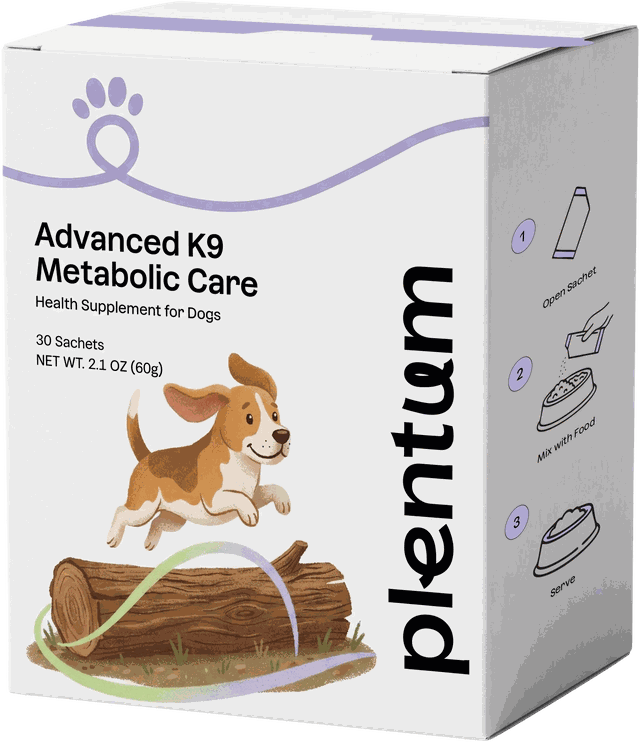
| Ingredient | What it is for | Evidence | In Metabolic Care |
|---|---|---|---|
| Soluble fiber (acacia, chia) | Fullness between meals | Some canine diet research | Included |
| L-carnitine | Normal energy metabolism | Limited in dogs | Included |
| White kidney bean extract | Starch digestion | Human trials only | Included |
| Chitosan | Studied in people for weight | Human trials; effect small in better studies | Included |
| Probiotics and postbiotics | Gut flora and normal bowel function | Early | 2 billion CFU; postbiotic included |
The probiotic count is stated at manufacture.
Fiber evidence: Some, in dogs (as part of high-fiber, high-protein diets).
White kidney bean extract: Slows starch digestion (alpha-amylase).
The human data comes with two notes.
A 2026 review of 8 trials in adults found a small effect for white kidney bean extract.
A Cochrane review found chitosan's effect in the best-quality trials was small.
Neither was done in dogs.
What supplements cannot do
- Replace measured meals and daily exercise.
- Cancel out treats and table scraps.
- Guarantee a number on the scale.
- Fix a medical cause of weight gain, such as a hormone problem.
How to use one inside a vet-agreed plan
- Get a baseline: weight and body condition score at the vet. Our body condition score guide explains the 1 to 9 scale.
- Set the target: ideal weight and a daily calorie amount from your vet.
- Measure every meal with a kitchen scale, not a cup.
- Count treats inside the daily total.
- Add movement your dog can manage: longer sniff walks, play, swimming.
- Add the supplement last, mixed into water or wet food, and weigh in every 2 to 4 weeks.

| Score | What you see and feel |
|---|---|
| 1–3 Too thin | Ribs, spine and hip bones easy to see |
| 4–5 Ideal | Ribs easy to feel, visible waist from above, tummy tuck |
| 6–7 Overweight | Ribs hard to feel, waist barely visible |
| 8–9 Well above ideal | Ribs not felt under fat, no waist, belly sags |
Pick up more steps in our healthy weight routine, or browse healthy weight.
A vet-agreed weight plan
- BaselineWeight and body condition score
- TargetIdeal weight and daily calories
- MeasureWeigh every meal and treat
- RecheckWeigh in every 2 to 4 weeks
Safety
- Dogs with diabetes, or on any medicine, need a vet check first.
- Safe use in pregnant or breeding dogs has not been proven. Puppies need growth plans, not weight products.
- Your vet sets the pace of any weight plan.
What about prescription diets?
Therapeutic weight-management foods are the main evidence-based option vets use.
They are designed to keep protein and nutrients adequate while calories come down.
Our healthy weight support guide explains measured meals, exercise, and daily support.
Diet change, activity and supplements compared
The rows below are listed in order of the evidence behind them for weight in dogs.
| Option | How it works | Best fit |
|---|---|---|
| Vet-planned diet | Cuts calories while protein and nutrients stay adequate | Dogs your vet scores at 7 or more |
| Measured portions and more activity | Lowers calories in and raises calories out | Every overweight dog |
| Fiber-based supplement | Supports fullness alongside measured meals | Dogs who seem hungry on a plan |
Diet option: Therapeutic weight-management diet.
FAQ
Should I see my vet if my overweight dog seems stiff or slow on stairs?
If your dog is stiff after rest, slow on stairs or reluctant to walk, see your vet before starting a weight plan.
Extra weight and joint discomfort often go together, and your vet can set a safe exercise level.
Can you explain daily calorie needs for a dog in simple terms?
Your dog's calories depend on its ideal weight, age and activity.
Your vet can work out a daily target from your dog's ideal weight, then you measure every meal and count treats inside that total.
What questions should I ask my veterinarian about tracking a dog's weight plan?
Ask for a target body condition score, how often to weigh in, what pace is safe for your dog, and what to change if progress stalls.
What should I know about using treats during a dog's weight plan?
Count treats as part of the daily calories.
Use small pieces, swap some for praise or play, and take treats from the daily food allowance rather than adding them on top.
Which supplements support a healthy weight in dogs?
No supplement replaces measured meals and daily exercise.
A supplement can support fullness and normal metabolism inside a vet-agreed plan.
Sources
- Association for Pet Obesity Prevention. 2022 Pet Obesity Prevalence Survey. petobesityprevention.org
- Weber M, et al. A high-protein, high-fiber diet designed for weight loss improves satiety in dogs. J Vet Intern Med. 2007;21:1203–1208. PubMed 18196727
- Shi N, et al. White kidney bean extract reduces body weight and adiposity with acceptable safety in adults with overweight and obese: a systematic review and meta-analysis. Nutr Res. 2026;150:49–61. (Human data.) PubMed 42066439
- Jull AB, et al. Chitosan for overweight or obesity. Cochrane Database Syst Rev. 2008;(3):CD003892. (Human data.) PubMed 18646097
- WSAVA Global Nutrition Guidelines, body condition score tools. wsava.org