Last Updated: February 2026
Quick Answer
The best FortiFlora alternative for dogs is a multi-strain synbiotic that combines several Lactobacillus and Bifidobacterium species with prebiotics and postbiotics. Multi-strain formulas address multiple gut pathways simultaneously, while prebiotics nourish beneficial bacteria and postbiotics deliver bioactive compounds that help maintain gut barrier integrity and support immune balance — offering broader daily gut and microbiome support than a single-strain probiotic alone.
Direct Answer
The strongest FortiFlora alternative for dogs is a multi-strain synbiotic that pairs several Lactobacillus and Bifidobacterium species with prebiotics and a postbiotic. Unlike FortiFlora's single strain (Enterococcus faecium SF68) plus animal digest, a multi-target sachet may support gut, oral, and immune balance together. For dogs whose main concern is breath and oral care, see our dog oral health guide.
Evidence At A Glance
The clearest way to compare alternatives is to ask which formulas are supported by published canine research. In the postbiotic category, published canine randomized controlled trials (RCTs) remain uncommon — several popular postbiotic brands have no published canine RCT at all.
| Publication |
Year |
Study Design / n |
Endpoint |
Result |
Source |
| Stübing et al., Vet Sci |
2024 |
27 dogs |
Clinical course in acute diarrhea + core microbiota |
Comparable resolution to metronidazole; better preservation of beneficial gut microbiota |
PMID 38787169 (third-party synbiotic study; not Plentum's formula) |
| FortiFlora (E. faecium SF68) |
— |
Single-strain probiotic; animal digest first ingredient |
Digestive support |
Established single-strain support; no prebiotic or postbiotic |
Purina PDP |
Author: Plentum Editorial Team. Educational comparison only — this content may support informed decisions but does not replace veterinary advice. Talk to your veterinarian before changing a prescribed supplement.
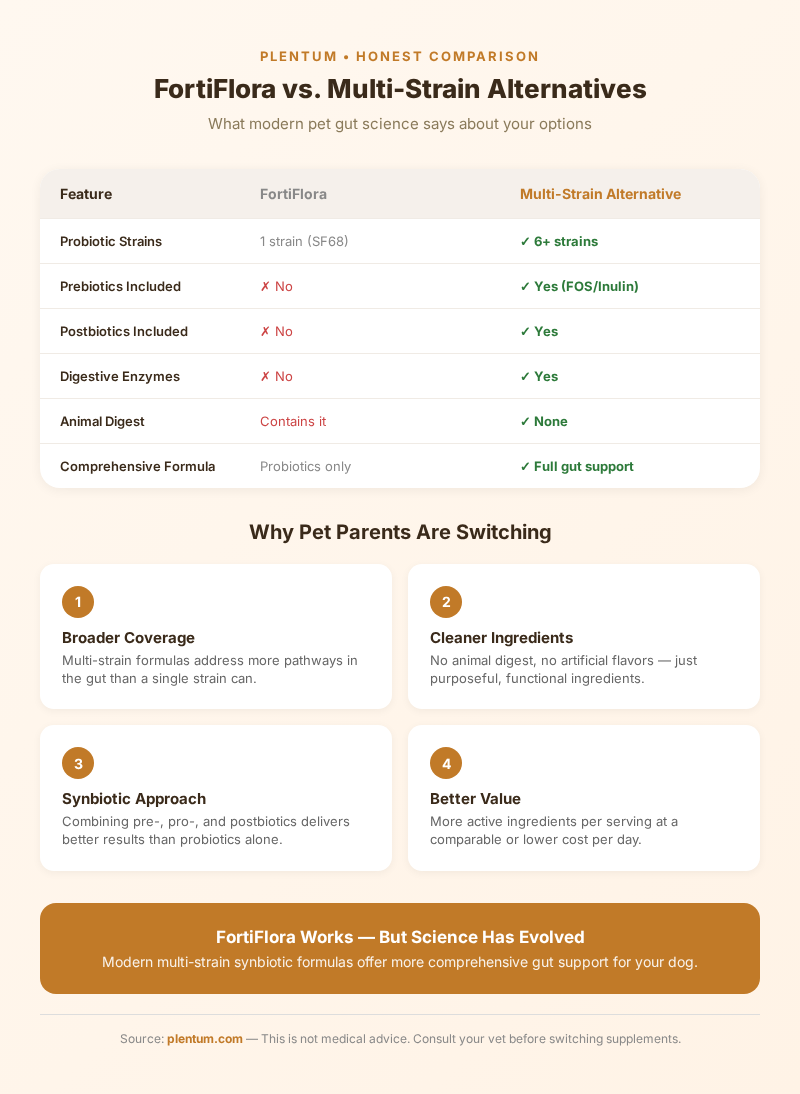
The best FortiFlora alternative for dogs in 2026 is a multi-strain probiotic that also includes prebiotics and postbiotics — delivering what single-strain formulas cannot. Current research favours comprehensive gut support over one-strain approaches: multi-strain probiotics address multiple gut pathways simultaneously and show stronger clinical outcomes for digestion and immunity. Plentum's daily powder combines a postbiotic complex and prebiotic fiber (inulin) with colostrum, omega-3, and micronutrients for complete gut and whole-body support.
TL;DR: FortiFlora's single-strain (Enterococcus faecium) approach works, but multi-strain probiotic formulas with added prebiotics and postbiotics provide broader, more comprehensive
complete dog gut health guide benefits for most dogs.
The science of the canine microbiome has advanced significantly since FortiFlora first gained popularity. Research now points toward multi-strain, multi-target formulas that combine probiotics with prebiotics and postbiotics for more comprehensive gut support. If you're considering an alternative, here's what to look for — and what the research says.
Understanding What FortiFlora Does (and Doesn't Do)
FortiFlora contains one probiotic strain: Enterococcus faecium SF68. This strain has documented benefits for digestive health and has been studied in veterinary contexts. It works.
However, there are a few limitations worth understanding:
-
Single-strain approach: Your dog's gut microbiome contains hundreds of bacterial species working together. A single strain supports one narrow pathway. Multi-strain formulas can address multiple pathways simultaneously.
-
No prebiotic or postbiotic components: FortiFlora delivers live bacteria but doesn't include the fiber (prebiotics) that feeds beneficial gut bacteria or the metabolic compounds (postbiotics) that directly modulate immune and oral health.
-
Contains animal digest: Listed as the first ingredient, animal digest is a palatability agent. While safe, it contributes no therapeutic value and takes up formula space.
-
Packet format with limited scope: FortiFlora is specifically a probiotic — it doesn't address skin health, oral health, or immune support, which are increasingly understood as connected to gut microbiome balance.
None of this makes FortiFlora a bad product. It makes it a focused product — and for some dogs, focused is exactly what's needed. But if your dog could benefit from broader support, alternatives exist.
What to Look for in a FortiFlora Alternative
If you're evaluating options beyond FortiFlora, here are the criteria that matter most:
Multiple Probiotic Strains
Look for formulas with 3+ species-specific probiotic strains. Different strains colonize different parts of the digestive tract and serve different functions. A multi-strain approach creates a more resilient gut ecosystem.
Prebiotics + Probiotics + Postbiotics
The most effective modern formulas use what microbiome researchers call the "synbiotic" approach — combining all three biotic types. Prebiotics feed beneficial bacteria. Probiotics introduce beneficial bacteria. Postbiotics deliver the metabolic byproducts that provide direct health benefits. Together, they create a more complete support system than any single component alone.
Clean Label (No Fillers as Primary Ingredients)
Read the ingredient list. If palatability agents, animal digest, or binding compounds appear before active ingredients, a significant portion of each serving is filler rather than functional nutrition.
Third-Party Testing and NASC Compliance
The National Animal Supplement Council (NASC) seal means a product has met quality manufacturing standards and undergoes regular audits. Third-party testing verifies that what's on the label matches what's in the product.
Additional Health Targets
The gut microbiome doesn't work in isolation. It connects to skin health, oral health, immune function, and even behavior through pathways like the gut-brain axis and the gut-skin axis. Formulas that address these connections deliver broader value per serving.
Feature Comparison: FortiFlora vs. All-in-One Alternatives
Supporting your dog's senior wellness and vitality? Plentum Advanced K9 Microbiome Care is a veterinarian-informed daily powder combining a postbiotic complex, prebiotic fiber, colostrum, and omega-3 — simply mix one sachet into your dog's food.
| Feature |
FortiFlora |
Multi-Target Alternative |
| Probiotic Strains |
1 (E. faecium SF68) |
3+ species-specific strains |
| Prebiotics |
No |
Yes |
| Postbiotics |
No |
Yes (oral + gut) |
| Omega-3 (DHA/EPA) |
No |
Yes |
| Colostrum |
No |
Yes |
| Animal Digest |
Yes (primary ingredient) |
No |
| Health Targets |
Gut only |
Gut + skin + oral + immune |
| Format |
Powder packet |
Powder sachet |
| Vet-Recommended |
Widely |
Growing |
| Price per Day |
~$0.75-1.00 |
~$1.00-1.50 |
When to Stay with FortiFlora
FortiFlora may be the right choice if:
- Your vet has prescribed it for a specific acute condition (like antibiotic-associated diarrhea)
- Your dog responds well to it and you've seen documented improvement
- You're looking for a single-target probiotic with extensive veterinary research behind it
- Your dog has no additional health concerns beyond basic digestive support
Never discontinue a vet-prescribed supplement without consulting your veterinarian first.
When to Consider an Alternative
An alternative may be worth exploring if:
- Your dog has multiple health concerns (digestive issues plus skin problems, dog oral health guide, or low energy)
- You've been using FortiFlora for months without meaningful improvement
- You prefer a cleaner ingredient profile without animal digest or added sugars
- You want comprehensive daily support rather than single-target supplementation
- You're supplementing a homemade diet and need broader nutritional coverage
Making the Switch: What to Expect
If you decide to transition from FortiFlora to a different probiotic supplement, here's how to do it smoothly:
Days 1-3: Give half the dose of the new supplement alongside your regular FortiFlora serving. This introduces the new probiotic strains gradually.
Days 4-7: Move to a full dose of the new supplement. You can reduce FortiFlora to half a packet during this period.
Days 8-10: Discontinue FortiFlora and continue with the full dose of your new supplement.
Weeks 2-4: Monitor your dog's stool quality, energy, coat condition, and appetite. Most dogs show initial improvements within 2-3 weeks.
Weeks 4-8: Full microbiome adaptation. This is when you'll see the broader effects — improved coat condition, fresher breath, better immune resilience — if you've chosen a multi-target formula.
Some dogs may experience mild digestive adjustment (slightly softer stools) during the first 3-5 days of any probiotic transition. This is normal and typically resolves on its own.
Our Approach: Why We Built Plentum Differently
Transparency note: Plentum is our product. We'll explain our approach honestly and let you decide if it fits your dog's needs.
We designed Plentum's All-in-One formula to address the exact gaps that single-target supplements leave open. Rather than focusing only on gut probiotics, our formula combines a postbiotic complex, prebiotics, bovine colostrum, and DHA omega-3 in a single daily sachet.
We chose the powder format specifically because heat-sensitive ingredients like probiotics and colostrum retain significantly higher potency when they're not subjected to the high-temperature extrusion process used to manufacture chews.
Is it right for every dog? No. If your vet has prescribed FortiFlora for a specific clinical reason, follow their guidance. But if you're looking for comprehensive daily support that goes beyond a single probiotic strain, it's worth comparing what different formulas actually deliver per serving.
Frequently Asked Questions
Is FortiFlora the best probiotic for dogs?
FortiFlora is the most widely vet-recommended probiotic for dogs, and its single strain (E. faecium SF68) has solid research support for digestive health. Whether it's the "best" depends on your dog's specific needs. For targeted probiotic support, it's a proven choice. For comprehensive gut, skin, oral, and immune support, multi-target alternatives may deliver broader benefits.
Can I switch from FortiFlora to another probiotic?
Yes. Transition gradually over 7-10 days by overlapping the old and new supplements. Start with a half dose of the new supplement alongside FortiFlora, then phase FortiFlora out. Most dogs adjust within 1-2 weeks. If your vet prescribed FortiFlora for a specific condition, consult them before switching.
Why do vets recommend FortiFlora so often?
FortiFlora has been on the market for over a decade, is backed by Purina's veterinary research network, and has strong clinical data for its single probiotic strain. Vets tend to recommend products they've seen work consistently and that have institutional support. The pet supplement market has evolved rapidly, and many newer multi-strain formulas haven't yet built the same level of veterinary awareness.
What probiotic has more strains than FortiFlora?
Several modern supplements offer multi-strain probiotic formulas with 3-10+ strains. Look for species-specific strains (formulated specifically for dogs rather than adapted from human products), transparent CFU counts, and manufacturing processes that preserve probiotic viability — particularly important since not all strains survive heat processing equally well.
An homemade dog food supplements guide worth knowing about: Plentum Advanced K9 Microbiome Care delivers prebiotic fiber, postbiotics, colostrum, omega-3, vitamins, and minerals in a single daily sachet — designed for dogs of all ages, just mix into food.
Ready to support your dog's senior wellness and vitality?
Plentum Advanced K9 Microbiome Care delivers postbiotics, prebiotics, colostrum, and omega-3 in one veterinarian-informed daily sachet — no measuring, no mixing.
Try Plentum Advanced K9 Microbiome Care →
Related Guides
If your dog is on a probiotic because of allergy-related gut disruption, this guide covers the connection between gut health and skin and immune reactions:
References
- AKC. Dog Vitamins and Supplements: What You Need to Know. https://www.akc.org/expert-advice/nutrition/vitamins-supplements/
- NASC. Quality Standards for Pet Supplements. https://www.nasc.cc/members/
- PubMed. Efficacy of supplements in dogs: a systematic review (Hall et al., 2021). https://pubmed.ncbi.nlm.nih.gov/34178990/
Related Articles
These statements have not been evaluated by the Food and Drug Administration. This product is not intended to diagnose, treat, cure, or prevent any disease.
Related reading: What Can Dogs Eat? Complete Guide