


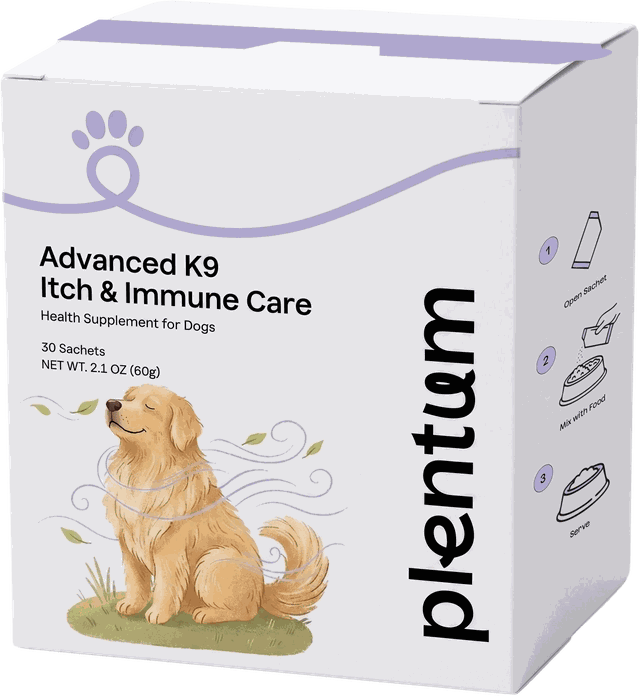



Your dog scratches more when the season changes, and you’re checking the label.
Itch & Immune Care supports healthy skin, coat, and normal immune responses to seasonal triggers.
Quick answer
It contains six components: Canine Immune Health Postbiotic (250 mg), algal DHA (250 mg), and colostrum (150 mg).
It also contains quercetin (100 mg), spirulina (75 mg), and a four-strain probiotic blend (150 mg, 2 billion CFU).
- It has six pieces in one sachet: a postbiotic, algal DHA, colostrum, quercetin, spirulina and a probiotic blend.
- Research on each piece varies. We show which findings come from dogs and which do not.
- Give it daily and keep it steady through the season. Broken skin or constant scratching needs your vet.
Why we built a supplement for the whole season
Skin and coat are the part of your dog you see every day.
Fall brings pollen, leaf mold and damp walks. Spring brings it again.
A dog whose coat looks dull or who scratches more in one season is telling you something.
The first step is always your vet, who can find the cause.
Our guide to fall allergies in dogs covers the home steps.
Itch & Immune Care is the nutrition side: ingredients that support skin, coat and a steady immune response, every day.
The label reads Veterinarian Formulated.
What is in a sachet
| Ingredient | Per 2 g sachet | What it is |
|---|---|---|
| Canine Immune Health Postbiotic | 250 mg | A heat-treated fermentation product, not alive |
| Algal DHA | 250 mg | An omega-3 from microalgae, fish-free |
| Colostrum (30% IgG) | 150 mg | The first milk, from cows (bovine) |
| Quercetin | 100 mg | A plant flavonoid found in apples and capers |
| Spirulina | 75 mg | A blue-green microalgae |
| Four-strain Lactobacillus probiotic blend | 150 mg (2 billion CFU) | Four live Lactobacillus strains |
Probiotic blend: L. casei K9-1, L. fermentum K9-2, L. brevis WF-1B, L. reuteri WF-1
Algal DHA: an omega-3 without fish
DHA is an omega-3 fatty acid. Most dog supplements get it from fish.
The algal DHA in this supplement comes from the microalga Schizochytrium, so it is fish-free.

Dogs preferred a diet containing Schizochytrium algae, the DHA source in Itch & Immune Care, in palatability tests.
The algae diet resisted oxidation better than an anchovy-oil diet.
The test used algae in food, not Plentum.
On skin and coat, the research we can cite uses fish-oil omega-3, not algal DHA.
A 90-day placebo-controlled study involved 24 dogs with dull coats.
An EPA+DHA supplement was associated with better coat scores from day 60. The effect faded after supplementation stopped.
The study tested an omega-3 product, not Plentum. Our guide to omega-3 for dogs goes into more detail.
Colostrum, quercetin, and spirulina
Colostrum: A 40-week randomized study involved 24 healthy dogs.
Dogs eating the colostrum diet had stronger vaccine antibody responses than controls.
They also had higher gut IgA.
Industry ran the study, and it tested colostrum, not Plentum. The study measured immune markers in healthy dogs.
It did not measure skin. Read more in our colostrum guide.
Quercetin is a plant flavonoid linked in lab research to normal histamine metabolism.
Dog evidence for quercetin alone is thin.
A 28-day randomized study involved 30 kennel dogs.
The supplement combined quercetin with two other ingredients.
It was associated with lower fecal markers of gut irritation and histamine metabolism.
Effects cannot be credited to quercetin alone, and the supplement was not Plentum.
Spirulina for dogs: A 42-week randomized study involved 30 healthy dogs.
Dogs eating the spirulina diet had stronger vaccine antibody responses than controls.
They also had higher gut IgA.
Industry funded the study, and it tested spirulina in food, not Plentum.
A study involved 60 dogs and 30 cats receiving spirulina tablets alone or mixed into food.
Most animals accepted them, and they were well tolerated over six weeks.
The postbiotic: what the dog trial measured, and what it did not
The Canine Immune Health Postbiotic in this supplement is the same type of ingredient as one studied in dogs.
A 28-day placebo-controlled study involved 30 dogs with mildly elevated itching and no diagnosed skin condition.
The ingredient dose was 150 mg daily.
It was associated with better skin-and-coat scores and lower itch-rating scores than placebo.
The supplier funded the study, and it tested the ingredient alone, not Plentum.
The ingredient's supplier ran this short, small study in healthy dogs.
It did not involve dogs with a diagnosed skin condition.
It does not show what Itch & Immune Care does.
The four-strain probiotic blend
The blend contains L. casei K9-1, L. fermentum K9-2, L. brevis WF-1B, and L. reuteri WF-1.
The label lists 2 billion CFU.
We describe this blend as gut support. Its exact blend has no published dog trials supporting a skin claim.
The thinking behind pairing gut and skin is in our piece on the gut and itching.
How to use it
Tear the sachet, pour it over your dog's food, and stir.
Give it once a day at the label amount for your dog's weight.
| Ingredient | Up to 25 lb | 26–50 lb | 51–75 lb | Above 75 lb |
|---|---|---|---|---|
| Quercetin | 100 mg (1) | 200 mg (2) | 300 mg (3) | 400 mg (4) |
| Spirulina | 75 mg (1) | 150 mg (2) | 225 mg (3) | 300 mg (4) |
| Probiotic blend | 150 mg (1) | 300 mg (2) | 450 mg (3) | 600 mg (4) |
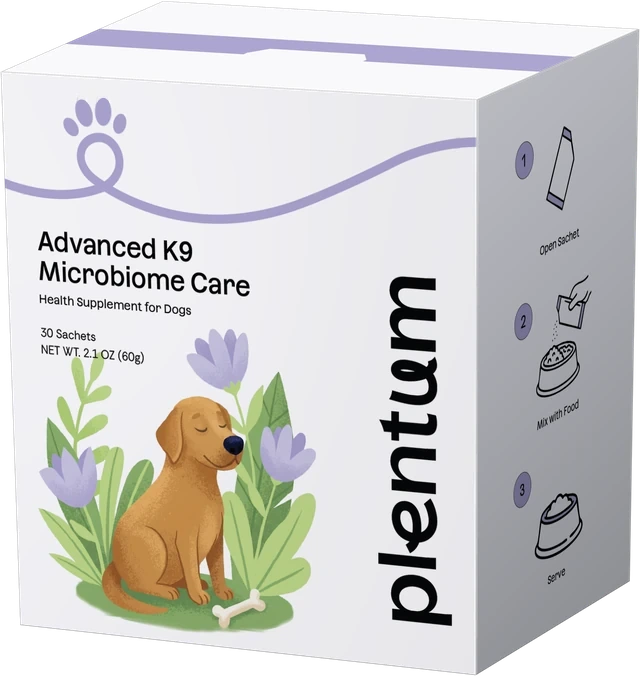
For daily gut care too, the Microbiome Care + Itch & Immune Care bundle is 10% off.
For a routine with brushing and coat checks, read our guide to supporting skin and coat through allergy season.
Who should ask the vet first
- Dogs that react to dairy or beef, because colostrum is bovine.
- Dogs taking prescription medicine, including medicine for itch.
- Puppies, and pregnant or nursing dogs.
- Any dog with a known health condition.
When itching needs the vet, not a supplement
Call your vet for broken or bleeding skin, unpleasant ear or skin odor, patchy hair loss, or itching that disrupts sleep.
Facial swelling also warrants a call.
Our dog allergy supplement guide explains where nutrition fits.
Take the two-minute quiz to explore which supplement fits.
Our quality page explains how every lot is tested.
Fish oil, algal DHA and daily skin powders
Each option below provides omega-3 support in a different daily format for home use.
| Option | How it works | Best fit |
|---|---|---|
| Fish oil capsule or liquid | Provides EPA and DHA from fish sources | Check dose by weight and freshness dates |
| Algal DHA in a daily powder | Provides DHA from microalgae without fish | Fits homes that avoid fish ingredients |
| Daily skin and immune powder | Combines DHA with postbiotic and probiotic support | Fits one-bowl routines across the season |
FAQ
Does algal DHA do the same job as fish oil?
Both are sources of the omega-3 DHA.
Algal DHA comes from microalgae and is fish-free.
It's the DHA source in Itch & Immune Care.
Fish oil also brings EPA, another omega-3. They are not identical, and the amounts matter.
Is colostrum safe for dogs with dairy sensitivity?
Colostrum is bovine, which means it comes from cows. The label says it contains bovine colostrum.
Can I give it with my dog's allergy medicine?
Your vet can check the full list of what your dog takes.
How long should I give it?
Skin and coat nutrition builds up over weeks, so steady daily use makes more sense than starting on a bad day.
Every dog is different, and we do not promise a timeline.
How much quercetin and spirulina are in each sachet?
Each 2 g sachet has 100 mg of quercetin and 75 mg of spirulina.
The label serving is 1 sachet up to 25 lb and 2 at 26–50 lb.
Give 3 at 51–75 lb and 4 above 75 lb.
Start with half your dog's daily dose for 3 days, then the full dose for their weight.
Sources
- Souza CMM, et al. Microalgae Schizochytrium sp. as a source of docosahexaenoic acid (DHA): Effects on diet digestibility, oxidation and palatability and on immunity and inflammatory indices in dogs. Animal science journal = Nihon chikusan Gakkaiho. 2019. PubMed 31680401
- Combarros D, et al. A prospective, randomized, double blind, placebo-controlled evaluation of the effects of an n-3 essential fatty acids supplement (Agepi® ω3) on clinical signs, and fatty acid concentrations in the erythrocyte membrane, hair shafts and skin surface of dogs with poor quality coats. Prostaglandins, leukotrienes, and essential fatty acids. 2020. PubMed 32505998
- Satyaraj E, et al. Supplementation of diets with bovine colostrum influences immune function in dogs. The British journal of nutrition. 2013. PubMed 23773360
- Atuahene D, et al. A Supplement with Bromelain, Lentinula edodes, and Quercetin: Antioxidant Capacity and Effects on Morphofunctional and Fecal Parameters (Calprotectin, Cortisol, and Intestinal Fermentation Products) in Kennel Dogs. Veterinary sciences. 2023. PubMed 37624273
- Satyaraj E, et al. Supplementation of Diets With Spirulina Influences Immune and Gut Function in Dogs. Frontiers in nutrition. 2021. PubMed 34124121
- Stefanutti D, et al. Oral Palatability and Owners' Perception of the Effect of Increasing Amounts of Spirulina (Arthrospira platensis) in the Diet of a Cohort of Healthy Dogs and Cats. Animals. 2023. PubMed 37106838
- Sordillo A, et al. An Indole-Rich Postbiotic Reduces Itching in Dogs: A Randomized, Double-Blinded Placebo-Controlled Study. Animals. 2025. PubMed 40723482
- Plentum Product Facts panel for Itch & Immune Care (amounts per 2 g sachet, directions, cautions). Compare the supplements