






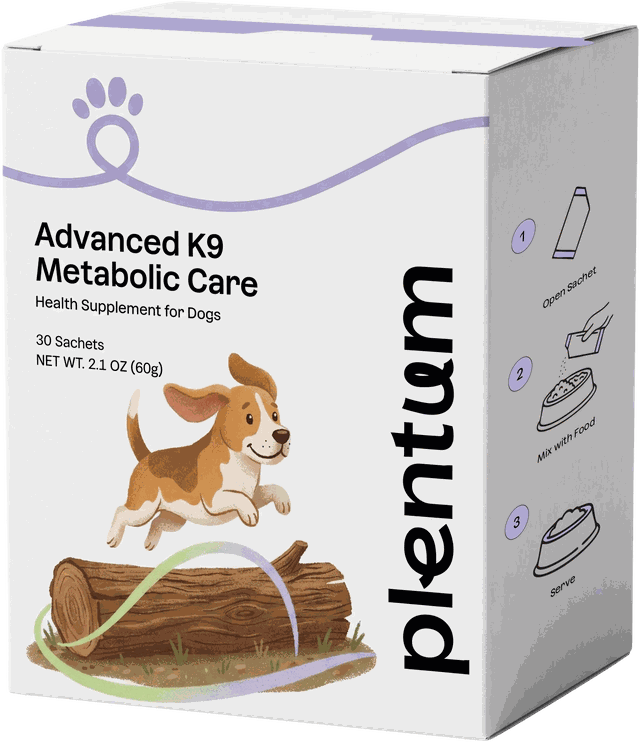


You’re measuring meals and comparing support for your dog’s weight plan.
Metabolic Care supports healthy weight alongside measured portions and daily exercise.
Quick answer
It holds acacia fiber, L-carnitine, white kidney bean extract, chia, chitosan, a postbiotic and a probiotic blend (2 billion CFU).
Research on these ingredients in dogs is limited, and much of it comes from people.
No supplement replaces measured meals and exercise.
- It is made for use alongside measured meals and daily exercise, never instead of them.
- It contains seven pieces: acacia fiber, L-carnitine, white kidney bean extract, chia, chitosan, a postbiotic and a probiotic blend.
- Research on these ingredients in dogs is limited. We show where each finding comes from.
- It contains chitosan, a shellfish derivative.
Why we built it to work with measured meals
Weight is the one place where a supplement can promise too much.
Weight comes from calories in and calories out.
Your vet can set a target weight and a daily food amount.
Our guide to a healthy-weight routine covers the plan.

Metabolic Care is the small add-on.
It is a sachet that sits beside the plan, with fiber for fullness and a few other supporting ingredients.
If you want the evidence ranked, our guide to healthy weight supplements for dogs compares them side by side.
What is in a sachet
| Ingredient | What it is | Research in dogs |
|---|---|---|
| Acacia fiber | A soluble fiber from acacia trees | Dog study tested a mixed supplement |
| Chia | A seed rich in fiber | No dog studies for weight that we found. |
| L-carnitine | An amino-acid-like compound that takes part in normal energy metabolism | Studied in exercising dogs and dieting cats |
| White kidney bean extract | A bean extract | No dog studies that we found. Human research only. |
| Chitosan | A fiber from shellfish exoskeletons | No dog studies that we found. |
| Postbiotic (Pediococcus acidilactici) | A heat-treated bacterial preparation | No published dog study of this postbiotic for weight that we found. |
| Probiotic blend (L. gasseri, B. animalis) | Two live strains, 2 billion CFU | Research used different probiotic strains |
Tested in dogs inside a mixed supplement, so effects cannot be credited to acacia alone.
Studied in exercising dogs and in cats on a diet, not as a stand-alone weight tool.
Probiotics have been studied for weight in dogs, including L. plantarum CBT LP3 and B. breve CBT BR3.
Four ingredient groups in one sachet
- FiberAcacia fiber and chia
- Energy useL-carnitine
- Supporting extrasWhite kidney bean and chitosan
- MicrobesA postbiotic and a probiotic blend
Fiber and fullness: acacia and chia
Fiber takes up room and slows the pace of a meal.
That is the idea behind both acacia fiber and chia.
A 28-day randomized study in 36 healthy dogs tested a supplement combining acacia gum with other prebiotics and postbiotics.
The combination was associated with higher fecal butyrate and lower gut-irritation markers.
The study tested acacia with other prebiotics and postbiotics, so the effects cannot be credited to acacia alone.
Researchers tracked fecal butyrate and gut-irritation markers.
Our science page on fiber and satiety in dogs explains how fiber is used in weight foods.
L-carnitine
The body uses L-carnitine to move fuel into cells for energy.
In exercising Labrador retrievers, 250 mg/day of L-carnitine was associated with better activity and lower muscle-strain markers.
It tested supplemented L-carnitine and tracked activity and muscle-strain markers, not weight loss.
White kidney bean and chitosan
We found no dog studies of white kidney bean extract or chitosan for weight.
Human research exists, and the effects there are small or uncertain.
We include them as supporting ingredients, not as the reason to use Metabolic Care.
We do not describe either as blocking calories, because the evidence does not support that.
The microbes: a postbiotic and a probiotic blend
Metabolic Care holds a Pediococcus acidilactici postbiotic blend (200 mg).
Its probiotic blend contains L. gasseri and B. animalis, at 2 billion CFU.
A 12-week randomized study in 41 overweight dogs tested two strains that are not in Metabolic Care.
They were Lactiplantibacillus plantarum CBT LP3 and Bifidobacterium breve CBT BR3.
We found no published dog study of this postbiotic or this probiotic blend for weight.
How to use it
Tear the sachet, pour it into water or wet food, and stir.
Give it once a day at the label amount for your dog's weight.
Start with half your dog's daily dose for 3 days, then the full dose for their weight.
| Dog's weight | Sachets a day |
|---|---|
| Up to 25 lb | 1 |
| 26–50 lb | 2 |
| 51–75 lb | 3 |
| Above 75 lb | 4 |
If you want a daily foundation too, the Microbiome Care + Metabolic Care bundle is 10% off.
Pair it with a plan. This 12-week check-in keeps it simple:
| When | What to do |
|---|---|
| Week 0 | Record weight and a body condition score. |
| Every day | Measure every meal. Count treats inside the daily total. |
| Every 2 weeks | Use the same scale and timing |
| Week 6 | Review unexpected or rapid changes |
| Week 12 | Review the plan with your vet and decide what comes next. |
Weigh on the same scale at the same time of day. Write it down.
Check in with your vet if the numbers are not moving, or if they move quickly.
Who should ask the vet first
- Dogs with diabetes or other health conditions, and dogs on any medicine.
- Puppies, and pregnant or nursing dogs.
- Any dog that has gained weight quickly or lost interest in food: that is a vet visit first.
When weight change needs a vet
Sudden weight gain or a swollen belly needs veterinary attention.
So does a big appetite or thirst change, or a dog who tires easily.
Our guide to body condition scoring helps you see where your dog is.
If you are unsure about Metabolic Care, take the two-minute quiz.
See how every lot is tested on our quality page.
Weight support formats compared
Format changes how you serve support, while the plan from your vet sets the daily food amount.
| Option | How it works | Best fit |
|---|---|---|
| Daily powder stirred into food | Adds fiber and other actives to the measured meal | Dogs on a measured-meal plan |
| Low-calorie bowl add-ins | Adds plain green beans or cucumber for volume | Dogs who finish meals fast |
| Prescription weight diet | Your vet sets the food and the weigh-in plan | Dogs who need medical weight care |
FAQ
Can I give Metabolic Care without changing my dog's food?
It is made for use alongside measured meals and daily exercise, not instead of them.
Measured meals, counted treats and regular walks do the heavy lifting.
Is Metabolic Care safe for a dog allergic to shellfish?
No, because it contains chitosan, which is made from shellfish.
Skip it if your dog is sensitive to shellfish, and ask your vet about alternatives.
How long until I see a change?
Every dog is different, and we do not promise a result or a timeline.
Weigh your dog every two weeks on the same scale and note the body condition score.
Share those notes with your vet.
Can I use it with a prescription weight diet?
Therapeutic weight diets aim to keep protein and nutrients adequate as calories come down.
Your vet should decide what else goes alongside them.
How many sachets does my dog need?
Start with half your dog's daily dose for 3 days, then the full dose for their weight.
Mix the label amount into water or wet food once a day.
Give 1 sachet up to 25 lb, or 2 at 26–50 lb.
Give 3 at 51–75 lb, or 4 above 75 lb.
Sources
- Yi C, et al. Effects of a Novel Prebiotic and Postbiotic Dietary Supplement on Gut Microbiota, Intestinal Barrier Markers, and Inflammation in Healthy Dogs. Veterinary sciences. 2026. PubMed 42188886
- Varney JL, et al. Utilisation of supplemented l-carnitine for fuel efficiency, as an antioxidant, and for muscle recovery in Labrador retrievers. Journal of nutritional science. 2017. PubMed 28620483
- Choi J, et al. Effects of Lactiplantibacillus plantarum CBT LP3 and Bifidobacterium breve CBT BR3 supplementation on weight loss and gut microbiota of overweight dogs. Scientific reports. 2024. PubMed 39455650
- Plentum Product Facts panel for Metabolic Care (directions, cautions). Compare the supplements