








The doorbell is a sound your dog cannot predict and a person your dog cannot control. That pair is why door barking sticks. Here is a two-week plan that changes both halves.
Quick answer
Door barking has two parts. The chime startles your dog, and charging the door has worked before. So the plan has two parts too.
Make the sound boring by playing it on purpose and paying for calm. Then give your dog a better job, which is a mat a few steps from the door. Two weeks of short daily sets turn visitors into one more rep instead of a relapse.
- Play the doorbell yourself at an easy volume, then reward calm.
- Teach a settle mat away from the door, then move it closer.
- Reward the head lift and the look back at you.
- Practice before guests arrive, not during the visit.
- On Halloween and during holiday travel, manage the door rather than train at it.
Why the doorbell wins every time
A doorbell is a cue, because your dog learned that the chime predicts a stranger, an open door and a burst of movement. Excitement and worry look the same from where you stand, so judge the body rather than the noise.
Then the door itself pays your dog. Visitors crouch, call and pet, which confirms the bell means something good happens loudly. Every greeting after a charge makes the next one likelier, which is why the habit survives scolding.
Check the body before you judge the noise. A loose, wiggly rush is excitement. A stiff body, a closed mouth or a dog hiding behind you is a worried dog, and she needs the sound made smaller rather than a firmer rule. Our guide to reading calming signals shows the difference.
What you need before you start
You need five items, and none of them is a command.
- A mat or bed your dog already likes.
- Soft snacks you can break into small pieces.
- A way to play your chime from a phone, or a second doorbell button.
- A helper who can knock, ring and walk through the door on cue.
- A notebook for one line after each set.
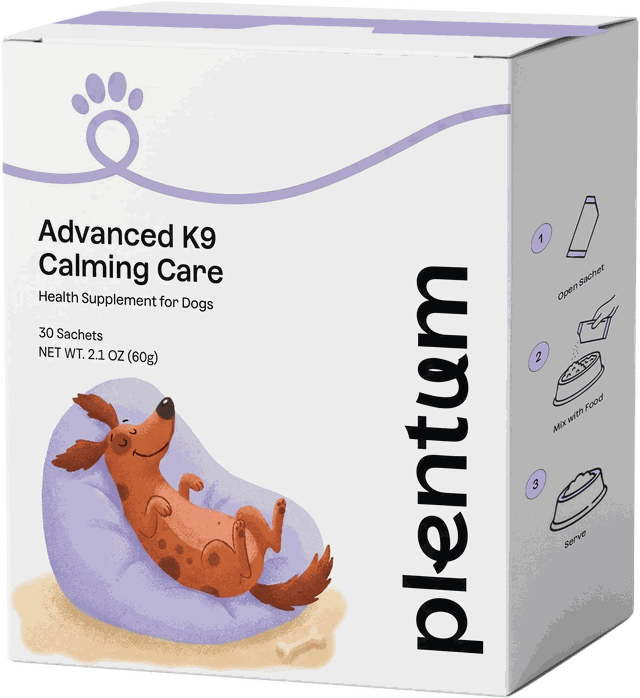
If your dog cannot take food at the door, increase the distance and lower the sound before you continue. A daily supplement can sit underneath the training. Advanced K9 Calming Care is our melatonin-free powder that supports a calm and relaxed demeanor during occasional situational stress, in a serving sized by weight.
If you are comparing daily support options, see our guide to the best calming supplement for dogs.
It contains L-theanine, an amino acid found in tea, GABA, a signaling compound in the brain, and a postbiotic made by fermenting good bacteria. It is not a sedative, and the work still happens on the mat.
Before use, check with your vet if your dog takes prescription medication, particularly a monoamine oxidase inhibitor (MAOI), a type of prescription medication. Safe use in pregnant or breeding dogs has not been established. Start with half your dog’s daily dose for 3 days, then the full dose for their weight. See how the five supplements compare if you are choosing.
How to help a dog barking at the doorbell settle, step by step
- Make the sound mean food. Play the chime quietly once and food lands the instant it sounds, so practice five times twice a day while your dog is in the room.
- Raise the volume across days rather than within one set, so a bark means the sound was too loud and you drop back a level for a day.
- Add the mat. Toss food onto a mat a few steps from the door until your dog walks there expecting dinner.
- Send your dog to the mat on the sound, where chime and cue lead to ten calm seconds that earn more food on the mat.
- Add the real door with a helper. Helper knocks, your dog takes the mat, you open the door, and the greeting is short. If your dog breaks for the door, close it and start over.
- Fade to an unpredictable payoff. Once the mat is reliable, pay every other ring, then sometimes.
Do them in this order
- Sound equals foodQuiet chime, five reps, twice a day
- The mat is the jobFood lands on the mat, away from the door
- Add the real doorKnock, mat, short greeting
- Fade the payoffEvery other ring, then sometimes
Your two-week calendar
| Days | What you practice | Move on when |
|---|---|---|
| 1 and 2 | Quiet chime, food on the floor | She looks at you at the sound |
| 3 to 5 | Normal volume chime, food moves onto the mat | She walks to the mat on the sound |
| 6 to 9 | Chime then mat, ten-second stays | She holds the mat through a knock |
| 10 to 14 | Helper rings, door opens, short greeting | Two visits end with four paws on the mat |
Mistakes that make the door louder
Yelling over the barking adds noise to a moment that already has too much of it, so walk to the mat quietly and start the rep again. Letting the dog greet every visitor undoes the week, because one excited greeting can pay for five boring practice sets.
Practicing only when people arrive is the most common failure, because a dog cannot learn at the moment it is hardest. Everyone in the house also has to use the same rule.
Three ways to handle the door, compared
Most households use the first two together, and the second one on the nights training is not realistic.
| Option | How it works | Best fit |
|---|---|---|
| Train a settle mat | Practice the sound and the place in daily sets | A worried dog who still eats, and a house with two weeks to spare |
| Manage the door | Gate, closed door, white noise, snacks handed out outside | Party nights, Halloween, and days you are not ready to teach |
How to tell it is working
Watch for three changes: a later first bark, a faster recovery, and more check-ins at the sound, then log one line per set.
Expect steady progress rather than a permanent switch, since Cornell's Riney Center frames the goal the same way: an appropriate amount of barking, and a dog who recovers.
Your one-line log
- VolumeQuiet, normal, or shouting
- Seconds to quietFirst bark to silence
- Mat or no matDid she take the place on the sound
What to do on Halloween and during guest season
Some nights are not for training, so on Halloween and when relatives arrive, manage the door by closing the curtains, running a fan or white noise, gating the hallway and settling your dog in a familiar quiet room with a chew and an adult checking in. Our Halloween safety tips cover candy and decorations.
Keep the rest of the day normal, because our stressful-events guide covers the safe-space setup, daily routines explains why a predictable walk carries most of the load, and the fireworks plan covers the loud night.
When to call your vet
If your dog injures itself at the door, will not eat for a day after a visit, or has ever snapped at a guest, get a veterinary opinion before adding another training layer, since pain and medical causes can look exactly like door reactivity.
How do you keep door practice safe and steady?
Start with the lowest version of the trigger.
VCA says you can lower the intensity by lowering the volume or increasing the distance.
Raise the intensity only when your dog shows no signs of fear.
If your dog gets worked up, go back a step.
Pushing too fast makes the reaction worse.
- Use a leash or a gate if your dog tends to dart out the door.
- With more than one dog, separate them during training.
- A new puppy can copy an older dog's reactions.
- Keep a treat jar near the front door for surprise visitors.
Greet guests once your dog is calm. Until then, use a gate or another room.
Sources: VCA Animal Hospitals and AKC.
When does door barking need a vet or a trainer?
Barking at a sound is common on its own.
Snarling, lunging, or biting needs a trainer or behaviorist.
Merck advises seeking help from a veterinarian as soon as any signs of aggression occur.
A trainer or behaviorist can then build a plan that suits your dog.
A vet can check for pain or other medical causes first. See your vet for any of these.
- Barking that starts suddenly with no clear trigger.
- Snarling, lunging, or biting at guests.
- Barking alongside limping, pain, or a change in appetite.
- Barking that escalates or prevents safe handling.
Source: Merck Veterinary Manual, behavior problems in dogs.
FAQ
Why does my dog go crazy when the doorbell rings?
The chime predicts a stranger and an open door, and both have paid off before. For some dogs that is excitement and for others worry, and both produce barking.
How do I get my dog to stop barking at the door?
Teach an incompatible job by playing the doorbell at a volume your dog can handle, rewarding calm, and building a mat routine that adds knocks and real visitors over two weeks. Scolding rarely works, because the greeting arrives faster than the correction.
Should I ignore a dog who barks at the door?
Ignore the barking and not the dog. Turn away, wait for the pause, then send your dog to the mat and pay for calm feet there. If she cannot settle, drop back to the sound alone.
How long does doorbell training take?
Plan on two weeks of short daily sets for a first change, and longer for a dog with years of practice. If nothing moves after a month, bring in a certified trainer or behavior specialist.
Can a calming supplement help a dog who barks at the door?
Advanced K9 Calming Care supports a calm and relaxed demeanor during occasional situational stress. It does not teach anything on its own, so keep the training and the door management in the plan.
Sources
- Cornell University College of Veterinary Medicine, Riney Canine Health Center. Excessive barking. Cornell Vet
- VCA Animal Hospitals. Dog behavior problems: barking and jumping at the door. VCA
- Cornell University College of Veterinary Medicine, Riney Canine Health Center. Anxious behavior: how to help your dog cope with unsettling situations. Cornell Vet