





Gut microbes contribute to digestion, immune function, and communication with the brain.
Coat changes and scratching have several possible causes.
Gut health may be part of the picture.
Your dog’s gut contains a large community of microbes.
They influence digestion, immune function, and signals associated with mood and skin.
A steady diet, enough fiber, and a predictable routine support gut health.
Discuss gut supplements with your vet before adding one.
What to know about your dog's gut microbiome
| Compare | What to check |
|---|---|
| Complete food | Supplies everyday nutrition |
| Prebiotics | Support selected gut microbes |
| Probiotics | Supply live organisms |
| Postbiotics | Inanimate microbial preparations with demonstrated benefits |
- The gut microbiome is a community of microorganisms that helps shape digestion, immunity, mood and skin.
- Diet, fiber, and daily routine matter most for the microbiome. Supplements are one possible extra layer.
- Discuss any microbiome product with your vet, especially if your dog has a health condition or takes medication.
Who lives in your dog's gut

Your dog's gastrointestinal (GI) tract is home to bacteria, archaea, viruses, and fungi.
When that crowd is diverse and in balance, the state is called eubiosis.
Two bacterial groups do most of the heavy lifting.
Firmicutes are often described as the energy harvesters, and Bacteroidetes as the digestion helpers.
Fusobacterium is common in dogs too and is often linked with breaking down protein.
No single group runs the show, though. The community works as a team.
When the balance slips, that's dysbiosis. Bacteria such as E. coli can overgrow helpful bacteria.
Diet, stress, antibiotics, age, and surroundings can shift the balance.

How the gut reaches the rest of the body

You'll never see these bacteria, but the gut is in constant contact with parts of your dog you can see.
Our rotational feeding guide explores how food changes may affect the microbiome.
1. The immune system
A large share of the immune system is associated with the gut.
Gut bacteria contribute to normal immune function.
The microbiome acts a bit like a training camp, teaching immune cells to tell safe nutrients from real threats.
When digestion is out of balance, that training can slip.
The body may be less ready to defend itself, or quicker to overreact to things around it.
Dog Immune Support Supplement has more on this.
2. Mood and behavior
The gut makes much of the body’s serotonin, a chemical involved in mood.
It also sends signals to the brain through the vagus nerve.
Pacing or distress when you leave can have many causes.
Consider gut signs as part of the wider pattern.
A sudden change in behavior still deserves a call to your vet.
Researchers are studying bacteria such as Bifidobacterium longum, sometimes called psychobiotics.
They are exploring possible effects on thinking and behavior.
In dogs, the evidence is still early.
The Gut-Brain Axis in Dogs covers what's known so far.
3. Skin and coat
The link between a patchy coat and the gut is often called the "gut-skin axis."
Gut imbalance may affect the intestinal wall, allowing unwanted substances into the bloodstream.
Researchers are exploring links with body-wide responses, including skin changes.
Supporting the gut lining helps maintain its barrier function.
Researchers are studying how this relates to skin and coat health.
The Link Between Gut Health and Skin Conditions in 2026 goes into the details.
Building a better gut with food first

Plenty of owners figure fresh food is the whole answer.
Freshness is one of several factors that affect digestion.
Fiber content also shapes the gut environment.
Your vet can help you work out which diet suits your dog's age, weight and health.
Fiber feeds the good guys
Helpful bacteria need fuel, and that fuel is called prebiotics.
Chicory root (inulin) gives them something to ferment into short-chain fatty acids (SCFAs).
Our prebiotics guide covers the options. Our cucumber serving guide offers a fiber-containing treat idea.
Researchers study Faecalibacterium because of its link with gut barrier health.
Its levels can differ between dogs eating different diets.
For how everyday food fits in, see Gut Health Dog Food: A Practical Breakdown (2026).
When food isn't the whole story
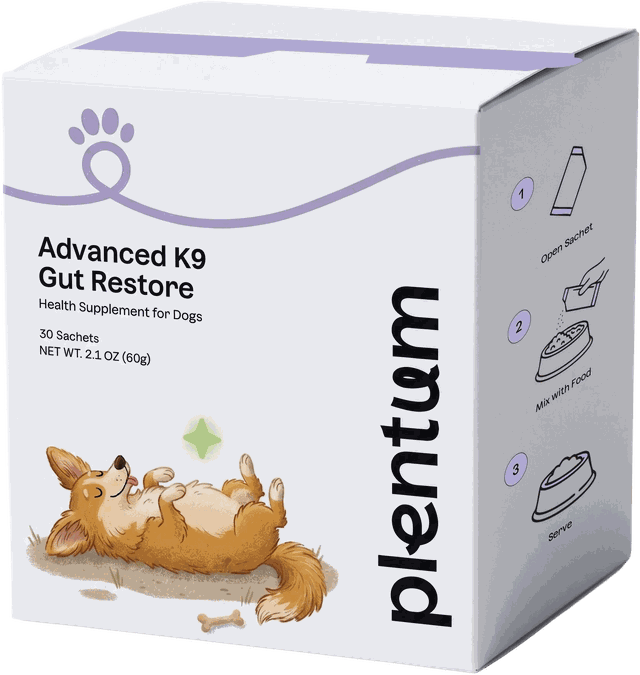
Diet alone often isn't enough to keep the microbiome balanced, and that's where gut supplements come in.
Read the label first.
Some supplements include L-Glutamine and Zinc Methionine, which come up in discussions of the gut lining.
Use gut-support products alongside balanced food, water, and a consistent routine.
Where Plentum fits
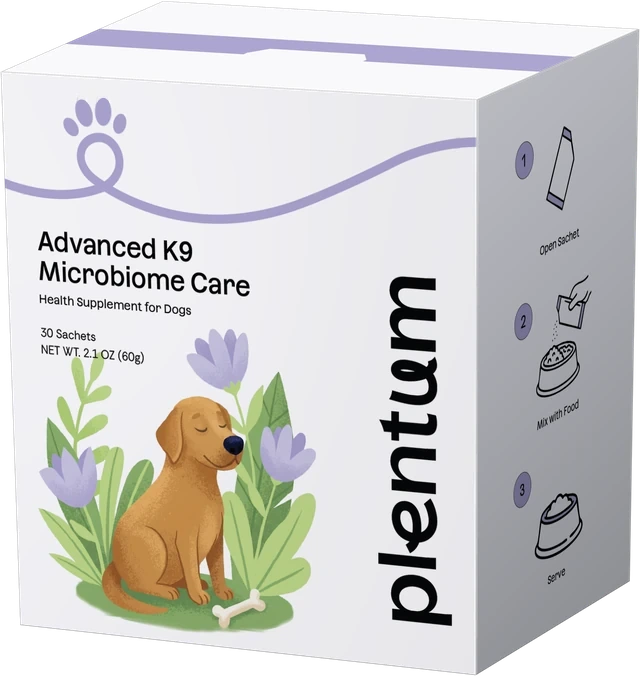
Advanced K9 Microbiome Care is a daily powder with postbiotics and prebiotic inulin.
It also contains colostrum and omega-3.
Mix it into food daily, using the label’s weight-based serving.
Dogs under 20 lb receive 1 sachet; dogs from 20 to 50 lb receive 2.
Dogs above 50 lb receive 3 sachets daily.
Ask your vet first if your dog has a health condition or takes medication.
After that, keep the routine steady and watch the stool, the coat and your dog's mood.
Those are the first places a gut shift shows up.
Frequently asked questions
How does gut microbiome affect dog immunity?
Gut microbes interact with immune cells. Tell your vet about repeated illness or new sensitivities.
What is the gut-immune axis in dogs?
It's the two-way link between the gut community and the immune system.
Why support dog gut microbiome daily?
Consistent food, water, and fiber support the gut daily. Ask your vet whether a supplement fits.
What is gut balance in dogs?
Gut balance means a diverse microbial community working together. New digestive signs need a vet check.