





Quick answer: Dog gut health basics come down to three habits: feed a complete diet that suits your dog, change food and treats slowly, and watch stool, appetite, vomiting and energy so you can spot changes early. Change one thing at a time and keep a dated record. Contact your vet when pain, blood, dehydration, weight loss or persistent signs appear.
Key takeaways
- Start with a complete diet before you add anything else to the routine.
- Write down one clear goal, such as firmer stools or a steadier appetite, so progress is easy to judge.
- Change one variable at a time and keep a dated record of every change.
- Gut signs are a pattern to watch, not a diagnosis to make at home.
- Call your vet when pain, blood, dehydration, weight loss or persistent signs appear.

Plain-language gut-health concepts and their limits
In plain words, a dog's gut is the digestive tract from mouth to bowel, along with the large community of microbes that live in it. Food is broken down, nutrients are absorbed and waste leaves the body as stool. Gut health is a useful shorthand for how well those steps run from day to day.
It is not a single test result, and no one number or product describes it. General education can improve the conversation with your veterinarian, but it cannot replace an examination, a full history or a diagnosis.
First decision: Start with a complete diet and define the sign or routine goal
Before you change anything, look at the whole diet. Write down the main food, any toppers, treats, chews, table scraps and every supplement. A complete and balanced diet that matches your dog's life stage is the foundation for everything else.
Many digestive complaints trace back to a sudden food switch, too many treats or a diet that does not fit the dog's needs. A clear picture of the diet comes first.
Then choose one goal in plain words. Examples include firmer stools, fewer soft days, less gas after meals or a steadier appetite. A specific goal makes it obvious whether anything is working. Our guide to Sensitive Stomach in Dogs: Food, Fiber, Gut Routine, or Vet Visit? walks through that choice step by step.
If fiber is part of the plan, start with the ideas in 7 Best Fiber Sources for Dogs with Food Sensitivities, and check 7 Signs Your Dog Needs More Fiber (Practical) to see whether fiber is really the missing piece.
Match urgency to the pattern
Speed, severity, recurrence, pain and loss of normal function matter more than the name of a symptom by itself. A single soft stool after a new treat is different from several days of vomiting. Look at the pattern over time, not one bad moment.
Keep a simple record of the food, medications, supplements, recent events and normal routine around any change. Separate three things in your notes: the stable baseline, the new change and the action you took in response. That record is the most useful thing you can bring to a veterinary visit.
Avoid this failure mode: Using microbiome language as a diagnosis
A common mistake is to read a microbiome word on a label or in a headline and assume it explains the dog's symptoms. Words such as balance, flora or gut microbiome describe a broad area of research. They do not tell you what is wrong with your dog.
This makes an apparent improvement hard to trust and a worsening pattern hard to explain. Remove the extra variables and return to a dated, observable comparison: what the dog ate, what changed and what happened next. For this subject, the correction is to start with a complete diet and define the sign or routine goal. That keeps the comparison tied to a useful outcome, not to a marketing category or an anecdote.
Where supplements fit
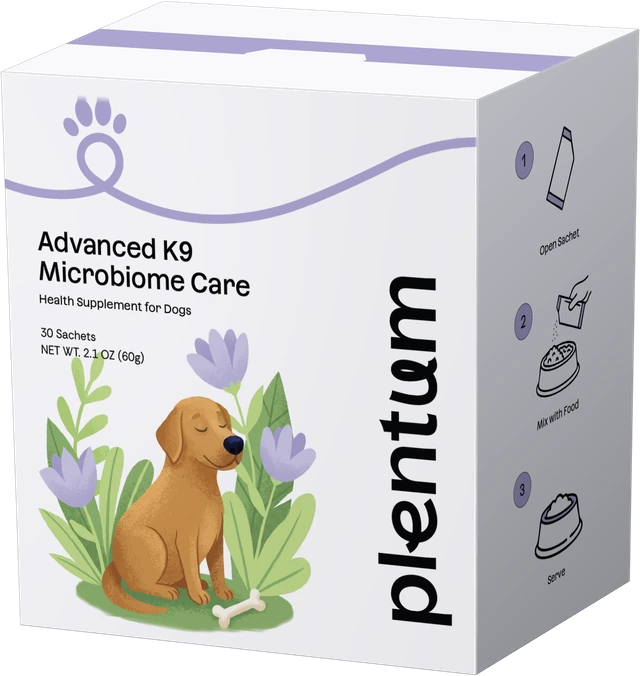
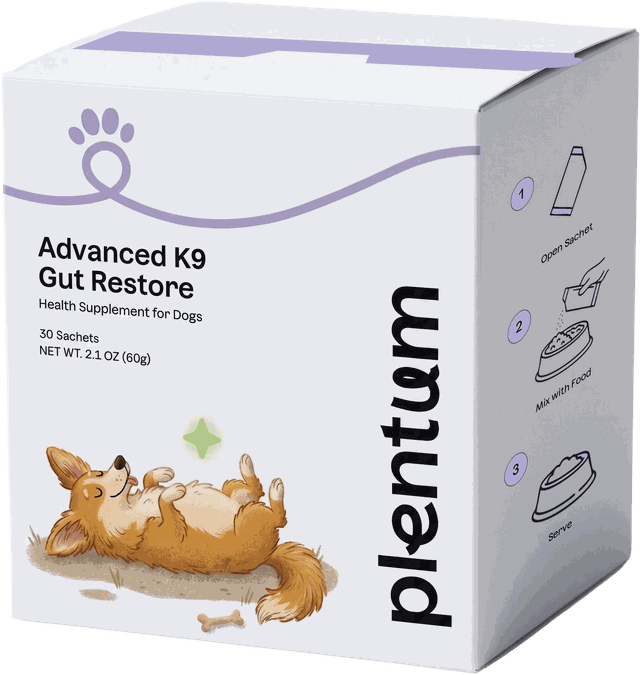
Supplements are an optional layer. They are not a substitute for a complete diet, a clear goal or a veterinary check. If you are considering one, bring the label and your dog's current food to your vet and ask how it fits with the diet and with any medication.
Introduce any new item on its own, on an ordinary day, so you can see how your dog responds before a busy week.
Supplement, not a medicine. Ask your vet if your dog has a health condition or takes medication. Contains chitosan (shellfish).
Know the stop conditions
Decide in advance which signs mean you stop experimenting and contact a veterinarian. For gut-health questions, use this short worksheet:
- Question: Has the complete diet been checked, and is the goal written down in plain words?
- Known risk: Reading microbiome language as a diagnosis.
- Evidence to collect: Stool, appetite, vomiting, gas, weight, and tolerance to changes.
- Handoff threshold: Pain, blood, dehydration, weight loss, or persistent signs.
Measure: Stool, appetite, vomiting, gas, weight, and tolerance to changes
Link each measure to daily function. Eating, resting, moving, toileting, grooming and social participation are often more useful than a vague rating of better or worse. Record the same measures even when the day seems normal, because normal observations make later changes easier to read.
| Measure | What to note |
|---|---|
| Stool | Shape, colour, how often it happens, and any mucus or blood |
| Appetite | Eats the full meal, picks at food, or refuses it |
| Vomiting | How often it happens, what it looked like, and what the dog ate before it |
| Gas | How often it happens, and whether the dog seems uncomfortable |
| Weight | Weighed on the same scale, at the same time of the week |
| Tolerance to changes | How the dog handled each new food, treat or supplement |
Escalation trigger: Pain, blood, dehydration, weight loss, or persistent signs
Pause nonessential experiments at this threshold. Adding more variables makes it harder to know what helped and what caused harm, and it can complicate the veterinary work-up.
Seek emergency care for breathing difficulty, collapse, uncontrolled bleeding, repeated unproductive retching, a rapidly swelling abdomen, severe pain, inability to urinate or another rapidly worsening sign. Do not give human medication unless a veterinarian or animal poison professional directs it.
This guide is general education about plain-language gut-health concepts and their limits. It does not diagnose or treat an individual dog. A veterinarian who knows the dog's history, diet, medications, examination findings and current signs should make individual medical and treatment decisions.
Frequently asked questions
What does dog gut health basics mean in plain words?
It means the digestive tract is working well day to day: food is digested, nutrients are absorbed, and stool stays fairly consistent. It is a useful way to frame questions, but it is not a diagnosis. A vet can tell you whether a pattern needs a closer look.
Should I change my dog's food to improve gut health?
Only after you have checked that the current diet is complete and suits your dog. If you do change food, do it gradually and change only one thing at a time. Keep a dated record so you can see whether the change helped, did nothing or caused a problem.
Is fiber always good for a dog with digestive upset?
Not always. Some dogs do well with a small amount of the right fiber, while others have more trouble with a sudden increase. Ask your vet before adding fiber if your dog has a medical condition, takes medication or has ongoing diarrhea.
Can I work out what is wrong with my dog's gut from stool alone?
No. Stool is useful information, and it is worth describing accurately to your vet. Shape, colour, frequency and any blood or mucus all help. A diagnosis still needs an examination and, when required, further testing by a veterinarian.